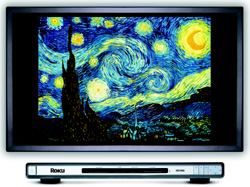
For years architects and designers longed for a TV that could hang on the wall. Now that they’ve got it there’s just one problem: What do you do when the TV is off? A plasma TV, after all, is a focal point. It’s also a status symbol that people want to display prominently. When the screen goes dark it’s like looking at a frame without art.
Two companies are doing their part to fill the void. One uses permanent images on canvas; the other offers a constantly changing electronic slide show. Both give the plasma space purpose during off hours.
VisionArt, a division of Solar Shading Systems, is “a solution for hiding technology,” says Bill Anderson, co-founder of VisionArt and president of custom electronics installation company Genesis Audio in Irvine, Calif. The idea came to Anderson on the job while designing a plasma TV installation for a friend. “She said, ‘I don’t want to see it,’” Anderson recalls, and he was soon at work devising a motorized shade that would double as artwork when the TV was off. He knew his friend wasn’t the only candidate for such a solution and he began a business to fill the need.
Anderson linked up with Solar Shading Systems to create the VisionArt system, which not only hides the TV when it isn’t on but gives it a prominent design role during quiet time. VisionArt completely conceals the plasma display behind a retractable canvas that rolls up into a frame that can be mounted to the wall or installed in the wall. When the TV is turned on, the canvas rolls quietly into the roller hidden inside the frame. When the TV is turned off, the canvas rolls back down to cover the screen.
Three lines make up VisionArt’s portfolio. The high-end Premier line features solid wood frames and limited-edition artwork that’s hand-signed and numbered by the artist. Print runs are limited to 300. Frames are available in eight styles and 28 stock finishes and frame liners are available in linen or oyster white. The limited-edition VisionArt products sell for $7,500 to $8,500.
The company offers a less-exclusive line that doesn’t use hardwood frames for under $4,000. For both lines homeowners can use any art they’d like as long as they provide a written release from the artist. VisionArt also plans to sell frames only, without artwork or rollers, to dress up the look of a plasma frame and conceal wires and brackets.
VisionArt uses a process called giclee, in which images are scanned and then transferred to canvas using a 4 million-drop-per-inch ink jet technology that’s said to provide a reproduction that’s indistinguishable from the original. When dry, the canvas is sprayed with a varnish to preserve the color tones and texture of the image. According to Anderson, the pigmented inks used in giclee, along with a specially designed canvas, ensure a resilient and long-lasting reproduction that can withstand the rigors of frequent rolling that would harm paint or watercolors. A batten at the bottom of the artwork weighs down the giclee as it glides up and down channels on the left and right of the motorized roller. In the down position, the batten keeps the canvas taut to prevent rippling.
Roku sells Picture Packs for $69 each along with the box, which has a retail price of $499. Picture Packs are delivered on a CompactFlash card, a tiny memory card used to store images in digital cameras. The card drops into one of the slots on the front of the box.
Picture Packs are organized by theme: classics, nature, and aquarium, with more to come. Classics include 56 masterpieces by Van Gogh, Monet, Renoir, and more. The Aquarium Pack turns your TV into a virtual aquarium complete with swimming fish and water currents. Nature Pack scrolls through digital images ranging from seasonal landscapes to animal close-ups. The images include works from well-known nature and wildlife photographers.
The Roku HD1000 can work with analog TVs but the high-resolution capability of HDTV brings out the most in high-quality images. The box packs rear-panel jacks for all types of connections to a TV. It’s possible to connect the Roku box in a way that helps guard against “burn-in,” the problem that occurs when a TV displays a stationary image for an extended period of time. If an image is on for too long, the HD1000 automatically puts the TV into a screen saver mode, typical to that used on a PC monitor. Auto-repeat mode ensures that a slide show continues to run, rather than stopping on an image when the show reaches the end.
The HD1000 comes with a remote control, which enables users to manipulate the images to their liking or to select a music play list from the networked home PC. The remote control requires line of sight to the Roku box. If the box is stored out of sight, a custom installation specialist can mount a tiny infrared sensor to receive the commands and shoot them off to the Roku box. In high-end installations, plasma TVs are best suited to placement on or in a wall with an adjacent closet that can house equipment and conceal wiring.
The role of the television is shifting in luxury homes today. It’s no longer just about programming and DVDs. In the age of plasma, there’s always something to watch on TV.
Rebecca Day specializes in writing about home electronics. She can be reached at rebecca362@aol.com.