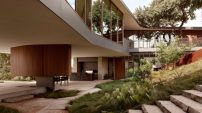
Green building means different things in different places. Site-specific design and construction lie at the very heart of sustainability. Local climate—as local as the microclimate of the site itself—influences virtually every aspect of a sustainable building, from orientation, to materials and detailing, to mechanical systems and finishes. Local materials save energy consumed in transporting the heavy, bulky stuff used to make a building. In an ideal world, climate-responsive buildings would be created from materials found on or near the site itself. Imagine digging a big hole and making a house out of what came out. Better yet, take a look at the house pictured on these pages, because that is exactly how it was built.
The owners, who maintain a small vineyard on the 70-acre property, included a wine-storage “cave” in their plans for a new house. Architect Michael Baushke, builder Roy Beaman, and earth-construction innovator David Easton balanced the equation by turning the insides of the cave into the outside of a house. Using a process called PISÉ, which he invented, Easton mixed
Building with locally sourced materials earns green points, and you can’t get more local than the site itself. The exterior walls of this house are composed primarily of the same earth that the building stands on. Photo: Mark Luthringer soil from the excavation, soil from a nearby quarry, and Portland cement into a slurry and shot it against open wall forms (see “PISÉ,” below). The result, which blends site with structure and structure with finish, is both environmentally sound and earthily elegant. “The owners were very interested in living in a house that was very natural,” says Baushke. “They were very interested in the sustainable aspects of building with soil; they liked that connection to the earth.” The thick, monolithic wall section performs well in Napa’s relatively warm, dry conditions and also addresses concerns about indoor air quality. “A lot of my clients are more interested in the health aspect of living in a house without pressure-treated lumber, Sheetrock, and paint,” Baushke says.
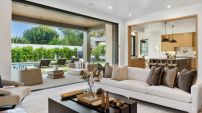
Photo: Mark Luthringer Baushke knows PISÉ, and its inventor, well. “I have a pretty long history with David. I actually worked for him for a couple of years on his wall-building crew.” That experience influenced Baushke’s design for this house, which divides living spaces into two pavilions bridged by a glass-walled living room. “Typically,” he says, “we’ll break down the house into smaller rectangular volumes,” which can then be formed and shot in sequence. In this mild, Mediterranean climate, the scheme works from a livability standpoint as well. The single-story, H-shaped floor plan gives nearly every room direct access to an outdoor living space. Cast soil-cement pavers cover the floors of every room except the master bath, where a redwood deck floats in a bed of smooth river rock. Photo: Mark Luthringer The living room, with its two sets of six-panel sliding doors, straddles the line between indoors and out. “It can be opened up, so the north and south courtyards can be contiguous,” Baushke says. In such an outdoor-oriented house, the architect believes, “There should be more doors than windows.” A dining room doesn’t need six sets of French doors to have a functional connection with the outdoors, but the psychological effect they produce is profound. “Just feeling that you can walk out that door gives you the freedom of space.” As a result of this outward focus, Baushke says, “The immediate exterior of the house is as important as the interior,” and it too reflects a preference for local materials. The courtyards are paved with stone from a nearby quarry. Boulders excavated on the site form borders for planting beds. Landscape plantings lean heavily toward native plants, which can weather the region’s periodic droughts without irrigation. Not everything could be sourced on site, of course, but the “imported” materials reflect the same earthy aesthetic and green sensibility. An unfinished steel trellis and corrugated Cor-Ten steel roof have already acquired
Exposed roof framing is of salvaged old-growth Douglas fir. Photo: Mark Luthringer their protective layer of rust, and will require no further finish or maintenance. The exposed timber framing is salvaged old-growth Douglas fir. Windows and doors are Swedish pine units with integral interior shutters. The foundation is a conventional concrete slab on spread footings. But the material that makes up most of the house and determines its essential character is the same stuff a shovel would turn over out in the yard. Eighteen inches of earth-cement, rebar, and nothing else, the exterior shell acts as a time-buffer for changes in outdoor temperature. During the long cooling season, the heat of the day works its way through the wall to the interior just in time to take off the evening chill. By morning, the walls have cooled enough to keep the house comfortable through the day. A screeded finish gives the exterior an appealing texture that is easily distinguished from that of poured concrete, rammed earth, and stucco. The off-form interior surfaces are more refined, but still varied enough to have character without paint, stain, or any other finish. A wetter soil-cement mix, cast in forms, gives a slightly contrasting color and smoother texture to the door and window lintels, the dining room’s substantial fireplace and chimney, and the pavers that line the floors throughout.
It is common to speak of a building as having “grown out of its site.” But few earn that praise as honestly as this one, in which the metaphor approaches literal fact. Everywhere is evidence of the means—as elegant in concept as in result—by which earth becomes shelter. “To me that’s the marriage between architecture and site,” says Easton. “We turned the cave inside out.”
Project Credits:
Builder: Beaman Construction, Napa, Calif.; Architect: Apparatus Architecture, San Francisco; Living space: 3,136 square feet; Site: 70 acres; Construction cost: Withheld; Photographer: Mark Luthringer (except where noted). Click here for product information.
Web sites: Beaman Construction: www.beamanconstruction.com; Apparatus Architecture: www.apparatus.com; Rammed Earth Works: www.rammedearthworks.com.
PISÉ
Photo: Cynthia Wright Building with earth is nothing new. Much of the Great Wall of China was constructed of mud compacted in lifts between temporary forms. That technique, now called rammed earth, has undergone a minor revival in this country, largely due to the work of David Easton. “He was really the instigator in the rebirth of rammed earth out here in California,” says architect Michael Baushke, who collaborated with Easton’s Rammed Earth Works to produce the shell of this house. PISÉ, the method Easton used to construct the exterior walls, emerged from what Easton calls “a search for a more industrial installation process, still using the same material.” Like rammed earth, PISÉ consists of a suitable soil mixed with 7 percent to 10 percent Portland cement and water. Rather than mechanically compacted in a closed form, however, PISÉ (pneumatically impacted stabilized earth) is sprayed against a one-sided form that allows for faster construction and easy incorporation of reinforcing rod. During construction, a “nozzle man” works his way around the building in an ascending spiral. Two “finishers” create the final exterior surface with long metal screeds, guided by piano wire stretched horizontally between temporary 6×6 corner posts. “PISÉ opened incredible new opportunities for us to build more sophisticated buildings,” says Easton, who has proven the technique in commercial projects for such high-profile clients as Longmeadow Ranch Winery and Fetzer Vineyards. In addition to being faster and more “engineerable” than its traditional antecedent, Easton says, “It demystified rammed earth, because PISÉ is basically just Shotcrete with a different mix.”