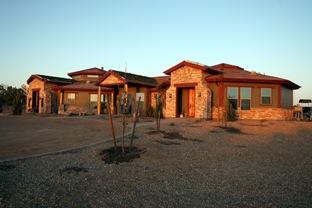
Facing the Challenges
Preparing for an Extreme home makeover project is the first challenge builders encounter. Show producers urge each new builder to visit a home makeover in progress in another city to see how others have organized their projects and gain some insight into what works and what doesn’t.
Then builders have to create a project Web site that goes live immediately following team leader Ty Pennington’s knock on the family’s door. Project Web sites serve to keep the community, local media, and even volunteer workers informed and up to date on the project’s progress and any delays, and also to recognize contributors and partners. Many also offer a way for the community to make monetary donations and allow volunteers to sign up. Daily blog entries from the building team and daily project photos are also a common feature, all maintained by someone on the builder’s team.
Volunteer builders also are largely responsible for the overall design of the homes, with input from the show’s design team about the needs and wishes of the families. It’s not until after the door-knock on day one of the project that they meet the families, who are usually in shock after learning of their impending home makeover.
Until then, all builders have to go on is the design team’s recommendations, the family biography, local building preferences, and their own creativity. From the time the builder commits to the project to the door-knock is usually less than two months—not a lot of time to design a custom house that will make an impact on national television while remaining true to local values.
Creating the schedule is one of the toughest tasks before the project begins, but the Extreme Makeover team has it down pat—mostly. “Now five seasons in we have a pretty rigid schedule,” says show producer and director Denise Cramsey. “It changes when we’re out in the field, but we know what it’s going to take to get these houses done and we can tell the builders what to expect.”
Excluding the products and materials supplied by the show’s sponsors and partners, Extreme builders are responsible for getting product and material donations from their suppliers as well as getting donations of labor from subs and installers. In the end, 100 percent of the materials and labor for the project usually are donated. If they plan well, builders can get catering and other services donated, providing meals at all times, and places for workers to rest and relax after their shifts, even massage therapists to help them relax.
“When you’re first confronted with it, you’re like: I have five weeks to design a house, get everything donated, organize the work crews, and simultaneously get a website designed, find food donors for the VIP tent, get food for all the workers, donated tents … the portolets, heaters because it gets cold at night, lights for night work … four RVs that we used as a field office and for sleeping … It was an enormous undertaking,” Pusateri remembers.
Rallying the Troops
Making the calls for donations, builders discover just how strong (or weak) their trade partnerships are. They cannot divulge the identity of the family who will receive the home makeover, they can only emphasize to their suppliers and subs that the job is for a worthy cause. “We tried to limit the number of people who knew who we were building the house for when we were asking for donations. We could only tell them to trust us—that they’d be so happy they donated once it was revealed,” Pusateri says of his company’s efforts to recruit materials and labor.
“The biggest untold story in this show is the fact that the builders’ trade partners—lumber and concrete suppliers, electricians, plumbers—they donate everything. The TV show doesn’t build the house for those families, everyone in the community builds the house,” says Drevik.
Even local safety and code inspectors get involved, sometimes maintaining a 24-hour presence on jobsites to ensure safety precautions are followed and installations are done according to code. During Atreus’ project on the Navajo Reservation in Pinon, Ariz., (where there are no building codes) code inspectors from Phoenix traveled six hours outside of their home territories and stayed until the job was finished to supervise and conduct inspections.
Elite Homes had plumbers, HVAC technicians, and electricians onsite throughout its Raleigh project in case any plumbing, HVAC, or electrical lines and systems suffered damage during subsequent installations and activity so that repairs could be made immediately. And builders are warned to get two of anything critical—tools, equipment, vital materials—so that there is a back-up if one breaks.
Gathering together hundreds of workers from different trades and asking them all to work on the jobsite practically on top of each other seems like a tall order. People who typically don’t encounter each other during a typical building project come face to face and elbow to elbow during Extreme Makeover builds. As Drevik marvels, “It’s amazing they can get it done, that they don’t break out in fist-fights, and that they don’t get hurt.”
Falling behind schedule by even a few hours can induce panic on the jobsite, as Pusateri found out on the first day of his Raleigh build when his team fell behind by five hours. “We did not expect that. But the show’s people were reassuring that five hours is nothing. If we got 10 hours behind they’d start to worry. But we ended up finishing two hours ahead,” he says.
During the New Orleans build, Deltec’s teams had to deal with a dearth of volunteers. The area is simply tapped out, according to Schlenk. Local builders are busy rebuilding the city and couldn’t spare the time to help, and so much of the local community is still displaced that the team could only draw on 50 to 60 volunteers at any one time, far less than the number usually assisting during Extreme Makeover builds, which can number in the thousands.
Teams of skilled workers and unskilled volunteers alike happily keep up a grueling pace 24 hours a day, meeting deadlines, taking on challenges, solving problems, and shrugging off annoyances or potential conflicts along the way to meet the common goal of giving a family a home that will help make their lives better. “I’ve seen trades and electricians missing a tool or something ask to borrow a tool, and it’s handed over. There’s no problem. Usually that wouldn’t happen,” Drevik says.
The Extreme Home Concept
Families helped by the Extreme Makeover team are those in desperate need who are deserving of the assistance. The families all give of themselves in their own communities, and all are in some type of distressed circumstance that either affects or is affected by their living situation. While many of the homes being replaced are simply insufficient for the needs of their owners, particularly those with limited mobility or special needs, some are in extremely poor or unsafe condition.
When developing the show, its creators and producers had no reason to think a quality house could not be built in four days. Their goal was simply to create a home makeover show that would be worthy of broadcast primetime. “We were totally ignorant of the building process. We had no idea,” admits Cramsey. “We thought: why not?”
Extreme Makeover: Home Edition aired its first season in 2003, and since then more than 120 builders have volunteered their time, energy, and resources to build 125 houses and counting, proving that the seemingly impossible is possible—if it’s for a good cause.