



Judy Davis/Hoachlander Davis Photography
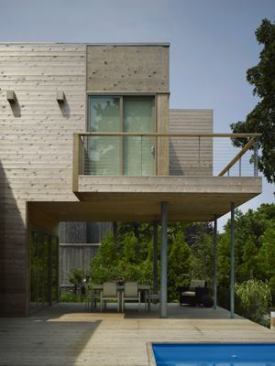
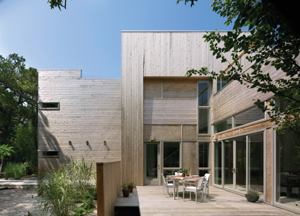
The back of the house opens onto a pool deck and covered dining …
As for its boxy forms and knotty cedar siding, the house takes its cues from the surrounding context. Many Fire Island houses were built in the 1950s and ’60s, with inexpensive, locally sourced materials that area contractors knew how to handle. Their structures were simple to allow for cheap, fast construction. Ray and Llewellyn wanted to stay within the local vernacular, but they tweaked it by adding extra glass and varying the siding treatments. The result is a more polished version of the typical Fire Island beach shack, one that draws admiring glances from the boardwalk while still fitting into its neighborhood.
The owners hoped to entertain frequently, so Ray and Llewellyn designed the layout with an eye in that direction. “They wanted a really open living space,” says Ray. “The pool had to be very connected to the kitchen, because that trip is made very often.” The four guest bedrooms are fairly small; they don’t have the same storage needs as a full-time residence. And the kitchen’s two-level island helps define it and make it the social hub of the 2,266-square-foot residence. Adds Llewellyn: “The kitchen is overscaled for the size of the house.”
A rear dining porch, pool and hot tub decks, and a front terrace add up to 2,154 square feet of outdoor space. The architects studied the sun’s daily path to make sure each outdoor room would receive solar exposure during a different part of the day. And they also carefully placed windows to block views directly into the homes next door. Even though the long, narrow lot closely abuts the two adjoining properties, the house feels private.
Another unusual aspect of the construction process was the client’s central role in procuring most of the finish materials. Rich Walker ordered the lighting, tile, fixtures, cabinetry, and appliances himself, directly from the manufacturers. He had it all shipped to a warehouse in Sayville, across the street from the dock where Santangelo keeps his boats. “I thrive on this sort of thing,” Walker says, jokingly. “I think I like to be in control.”
The strategy also cut costs by about 20 percent, he estimates, because he eliminated a middleman and a standard contractor’s markup. Santangelo didn’t mind at all. “It makes my life easier, because now they know how stuff can get stuck in customs or delayed for some other reason,” he says. “It gave the clients a better understanding of the whole process and got them involved.” And it probably reminded them of a lesson they’ve learned many times over, making the plane-cab-ferry trip from the hectic pace of Washington to the peace of Fire Island: The more challenging the journey, the more worthwhile the final reward.
Details: Siding System The knotty cedar planks gracing the outside of the Fire Island residence seem to represent a straightforward nod to a prevailing local aesthetic. But architects Todd Ray and Bethan Llewellyn manipulated them a little bit to give the project a more sophisticated twist. They developed an architectural language of vertical siding for the central circulation volume and horizontal siding for the bedroom and living areas. Flat planes of cedar plywood, meanwhile, highlight the fine lines of trim around the windows of the private spaces. The architects purposely left all the exterior wood unsealed to let it age in tune with the elements.
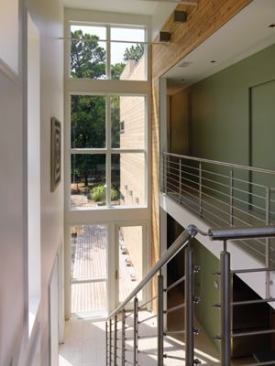
The cedar planks reappear inside the house, cladding one wall of the two-story entry hall. There, though, they’re clear-sealed, with a metal cap finishing the edges. The open kitchen’s glass backsplash and rift-sawn white oak cabinetry continue the more refined tone. “The exterior is quite a raw finish,” Llewellyn explains. “On the interiors, we become a lot more precise. It’s all the same hand, just translated differently.”
The Builder: A Man for All Seasons Building projects like the Walker/DeCrosta residence keep Bill Santangelo busy from September to May. But Fire Island summers are a slow time for residential construction, as homeowners want to be in their houses enjoying the season. Santangelo doesn’t lack for work in the hotter months, though. He merely shifts his focus to other pursuits, such as building and maintaining docks and bulkheads for waterfront properties. “It’s not like trimming out a window,” he says. “It’s more heavy-duty work. We do pilings and vertical sheathing jetted into the sand. A bulkhead is basically a retaining wall on the water.” Homeowners also recruit him to build temporary outdoor structures for parties. And all summer long, he completes maintenance and upkeep jobs for past clients and their friends. He can’t walk a hundred yards on Fire Island in the summertime without someone asking him to come by and complete a small task, and that’s just the way he likes it. “Over there, you’re not just a builder,” he says. “When people need something done, they call you.” The name of his company, Crellory Property Management, reflects that role. (“Crellory” combines the names of his three children, Craig, Kelly, and Cory.) “You’re like a property manager, because the homeowners aren’t there all the time.”