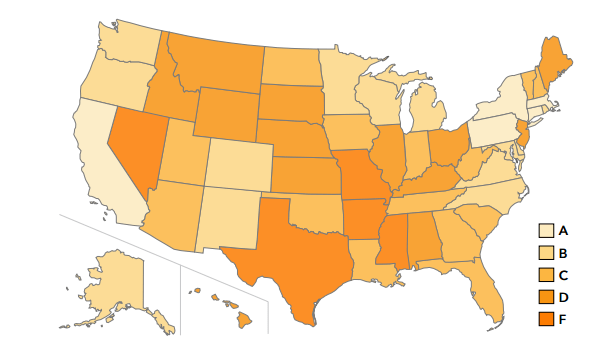
A new report shows that states across the country are largely unprepared to face the significant and increasing risks posed by changing levels of extreme weather, including extreme heat, drought, wildfires, and flooding.
States at Risk: America’s Preparedness Report Card, prepared by the States at Risk Project, a collaboration of ICF International and Climate Central, is the first-ever quantitative assessment of its kind. The report is designed to help provide a benchmark for states to assess risks and build and implement action plans to increase their preparedness levels.
The report provides a grade to each of the 50 states based on the unique profile of threats the state faces. Grades are based on both the magnitude of the current and future threat and the action states have taken to prepare for them relative to other states. “This is the most comprehensive assessment that has ever been done to catalogue how prepared each state is given its unique climate risk profile,” said University of Arizona professor Kathy Jacobs. “It is critically important that states not only recognize the changing nature of the threats they face, but also that they chart a course towards greater preparedness. This report card helps with that.”
Key findings related to the risks states face from the threats of extreme heat, drought,
wildfires, inland and coastal flooding include:
–Florida, Texas, and California are the most at risk states. Florida ranks first for both
inland and coastal flooding threats and second in terms of extreme heat. Texas faces
four threats and is first in extreme heat, drought, and wildfire. California faces all five
threats. It ranks second in wildfire and inland flooding and third in extreme heat.
–The most pervasive threat to the 48 states in the continental U.S. is that of
extreme heat – heat wave days are projected to more than triple by 2050 in every
state except Oregon. This is particularly true in the southeast and Gulf Coast, where
the annual number of days of dangerous heat are projected to skyrocket by 2050:
nearly doubling in Texas, more than tripling in Louisiana and Mississippi and
quintupling in Florida to a grueling 130 days a year, up from the current 26.
–A growing wildfire threat is concentrated in four states: Texas, California,
Arizona, and Nevada, where more than 35 million people live in the high threat
zone where wildlands and development converge. Florida, North Carolina, and
Georgia combine for another 15 million people at risk. And, the threat of wildfire is
growing in the Southeast: Alabama, Arkansas, Louisiana and Mississippi are all
projected to face above average increases in threat level.
–Today, Texas faces the greatest summer drought threat. By 2050, however, nine
states – Colorado, Idaho, Michigan, Minnesota, Montana, New Mexico, Texas, Washington and Wisconsin – are projected to have greater drought threat levels than
Texas has today.
The report further finds that very few states have taken sufficient action to prepare for future
threats. Though most states are reasonably prepared for the threats they face today, levels of
preparedness vary greatly by state and by threat.
Key preparedness findings include:
–States are least prepared for extreme heat risk. All states in the continental U.S.
face this threat, but only 14 percent are taking strong action to prepare.
–States are more prepared for coastal flooding than any other risk, but still only half
of all coastal states are taking strong action to prepare for this risk.
–More than half of all states assessed have taken no action to plan for future
climate-related inland flooding risks or taken action to address them.
–Only a small group of states – Alaska, California, Connecticut, Massachusetts,
Maryland, New York and Pennsylvania – has taken strong action to prepare for
future risks across the threats they face, including assessing future climate
vulnerabilities and designing and implementing plans to address them.
“Data points like those in this report
provide state officials with what they need most: information about current and future risks
that will help them identify specific hazard mitigation actions they can take to prevent future
losses,” says Larry Larson, senior policy advisor for the Association of
State Floodplain Managers. “The Report Card shows the need to improve state level
capacity for disaster preparedness and hazard mitigation and to invest in mitigation in order to reduce the future loss of life, property and public infrastructure and the related costs for
taxpayers.”