Project Credits:
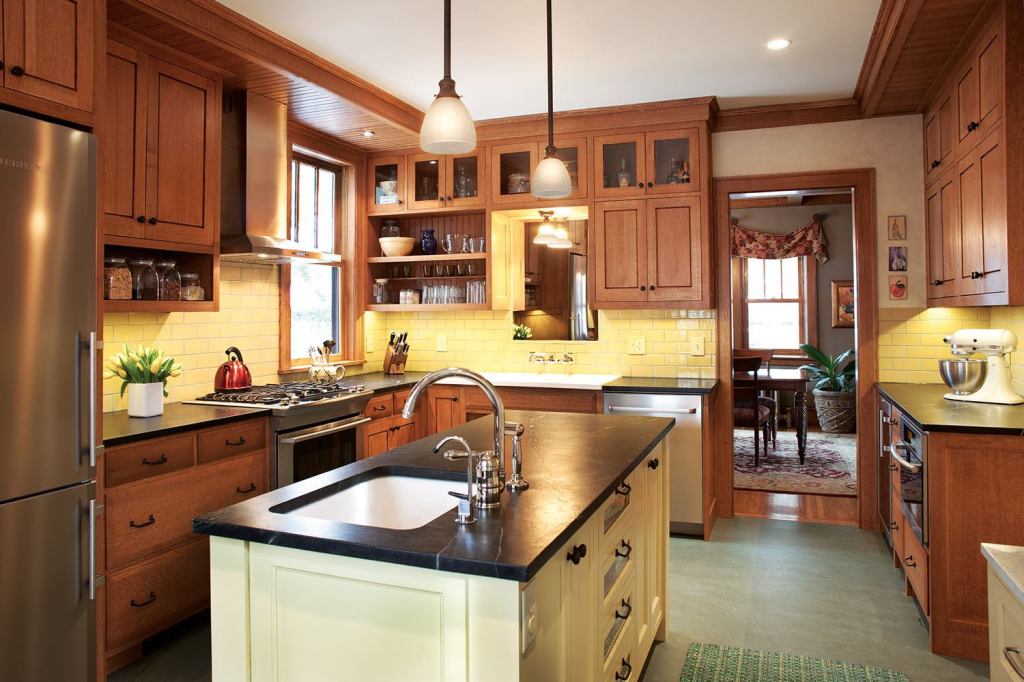
During its early-20th-century heyday, the Craftsman style was popular throughout America, and the houses of that era have proved remarkably adaptable to Americans’ evolving lifestyles. Except, that is, for their kitchens, which often were pretty utilitarian by current standards. This Minneapolis Craftsman house got a kitchen makeover in the 1980s, but not the one it deserved. “The original house had great details, good vintage, a great location … and this awful kitchen,” says architect Jean Rehkamp Larson of Minneapolis-based Rehkamp Larson Architects. “It had nothing to do with the house.” Working with custom builder Curtis Irmiger of Full Circle Construction, Rehkamp Larson corrected that shortcoming, channeling the Craftsman aesthetic—and the best of contemporary craftsmanship—into a compact kitchen that works for today.
Reconfiguring functions creates a near-blank canvas
The new work focused on the kitchen, but Rehkamp Larson first consolidated space there by shifting auxiliary functions to underutilized areas elsewhere. The family’s primary access to the house had been through a cramped back entryway with a tiny powder room. Rehkamp Larson relocated the powder room to an existing closet near the front door, freeing volume at the kitchen entry for a mudroom that accommodates both a coat cabinet and the laundry equipment, which had hogged valuable space in the kitchen.
Those early moves created some much-needed elbow room, but Rehkamp Larson and Irmiger still had to fit a lot of function into the relatively modest volume of the kitchen proper. The primary cabinet layout is an efficient U-shaped arrangement, with a small island at the center and a bay-windowed breakfast alcove at its open end. “The alcove existed, but it was cold,” Rehkamp Larson says. “We added a built-in bench with radiant heat below. It’s now one of the owners’ favorite spaces in the house.” Shifting the mudroom doorway by a few inches opened wall space for narrow hutch that serves as a drop zone. Along with shelves for cookbooks, she says, “it has a place to charge your cell phone and some drawers below for the tape and staples.” To avoid overwhelming the space with a single large refrigerator, she located two separate 24-inch-wide units at opposite sides of the room.
The original house supplies both inspiration and technical challenge
To ground the kitchen in its context, Irmiger copied trim profiles and cabinet details from the existing house, using materials and techniques common in its era. “We hand-made all the trim and built all the cabinetry on site,” says Irmiger, who imported a load of rift-sawn oak from Ohio and set up his portable shop equipment in the backyard gazebo and the kitchen itself. “We planed the oak ourselves,” he adds. “The old stuff was a little more than ¾-inch thick, and we wanted it to be exactly like the old stuff.” The drawer fronts, with their shallow-beveled edges and quarter-inch overlay, mimic a built-in cabinet in the dining room.
The beadboard-paneled soffits—which unify the wall cabinets with the deeper, full-height refrigerator surrounds—also serve as mechanical chases. “The plumbing from upstairs ran through the ceiling,” Irmiger says, “so there’s a lot of stuff packed up in those soffits: pipes and vents and electrical.” The new drainboard sink, which the owners found online and had shipped from England, also took some custom fitting. “It’s not a standard U.S.-depth sink top,” Irmiger says, “so we sized that run of cabinets to fit. But then we had to put a 24-inch dishwasher into that 22-inch-deep cabinet, so we had to cheat into the wall a little bit to fit that.”
Period details turn back the clock
Subtle retro touches reinforce the connection between old and new. “We have some glass at the upper cabinets and some glass-front drawers in the island. That adds some playfulness and energizes the composition,” Rehkamp Larson says. “The owners were also interested in having some open shelves, which always animates a kitchen, makes it less heavy.” The linoleum floor, screened sink-base doors, and oiled-bronze hardware contribute to the period vibe. So does the pantry cabinet Rehkamp Larson calls “the larder,” whose painted finish and slotted doors create a visual counterpoint to the oak cabinetry.
Craftsman-era homeowners didn’t live in their kitchens as we do today, but they’d feel right at home here. Producing that effect in a period remodel takes skill, but it doesn’t involve reinventing the wheel, Rehkamp Larson says. “To do a good kitchen, you just go to school on the house. It tells you what to do.”