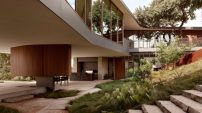
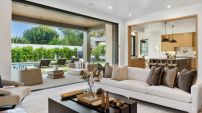
With little mobility in her upper body and an inability to manipulate small objects, the owner of this Vermont house needed some special design features that would make her home support her daily activities. But she also wanted the house to support her spirit with rich natural finishes and easy indoor/ outdoor connections. Her architect, Milford Cushman, knew exactly what she meant. “Accessibility needs go way beyond the physical,” says Cushman. “There should be an emotional and psychological connectivity within spaces as well.”
Visual interaction was the phrase of the day when planning the kitchen. “Because [the owner] can’t reach inside cabinets, being able to see everything still allows her to participate,” says Cushman, who laid out the room like a “big walk-in pantry where everything is in view.” Most storage is below counter height, where the absence of drawer fronts and shallow slide-out shelves allow the homeowner to spot pots or bowls even in back. Windows in place of upper cabinets produce a strong relationship to the great outdoors, and local materials like slate counters, birch cabinetry, spruce floors, and hemlock ceilings bring natural elements inside.
Builder: Conklin Construction, Morrisville, Vt.; Architect: Cushman Architects, Stowe, Vt.; Cabinetmaker: Don McCormick, Woven Wood, Elmore, Vt.; Photographer: Carolyn Bates