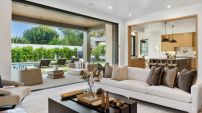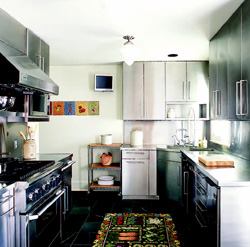
Custom home owners often spend thousands of dollars for a beautiful kitchen, only to clutter it with pots, pans, utensils, and other cooking equipment. The clients for this new home in Annapolis, Md., were determined to avoid that fate. They asked architect Catherine Purple Cherry to design two full kitchens for their 11,000-square-foot house: one for entertaining and casual meals, and the other for serious cooking. “The high cooking activity would be done in the back kitchen, so the front kitchen could stay clean,” says Cherry.
A sliding pocket door connects the two rooms directly, and the difference in their materials reflects their separate purposes. Customized cherry cabinets line the front kitchen, contrasting with the low-gloss sheen of honed granite countertops and heart pine floors. Even its appliances blend into the woodwork for a furniture look. The back kitchen, on the other hand, features a commercial-style range and stainless steel cabinetry and counters. Sealed, volcanic ash floors enhance the room’s industrial flavor.
As Cherry and her client intended, the front kitchen has proved easier to clean than its working counterpart. “The lowest maintenance material you can have in a kitchen is wood,” says Cherry. “I don’t consider stainless steel low-maintenance at all. There’s no product that shows fingerprints more. It works better in a commercial kitchen—because of the floor drains you can wet everything down. But it was chosen here because it was aesthetically unique.”
Project Credits: Builder: Pasquarelli Construction, Annapolis, Md.; Architect: Catherine Purple Cherry Architects, Annapolis; Project size: 260 square feet (front kitchen), 156 square feet (back kitchen); Construction cost: Withheld; Photographer: Celia Pearson.
Resources: Cabinets: Woodmode, Circle 490; Dishwashers: Bosch, Circle 491 and Thermador, Circle 492; Kitchen plumbing fixtures: Franke, Circle 493 and Waterworks, Circle 494; Oven: Thermador, Circle 495; Refrigerator: Sub-Zero, Circle 496.
Details The back kitchen enters into the formal dining room, making it an ideal place for caterers to work during larger parties. The front kitchen opens into a casual dining room and patio, which strengthens its role as an informal gathering space.