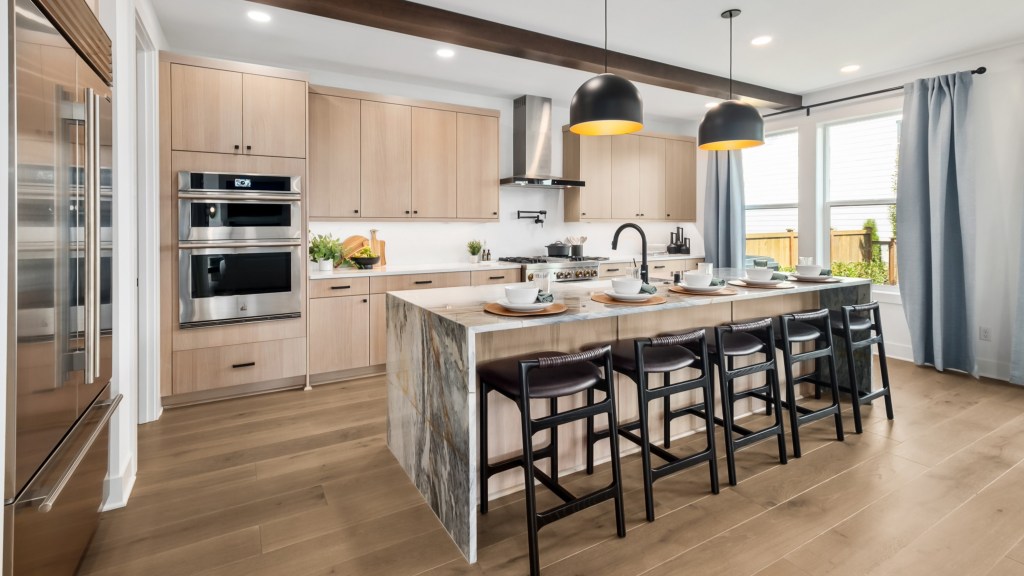
Over the last two decades, there’s one thing in house plans that hasn’t changed: the kitchen is the most important room.
Homebuyer research conducted by Tri Pointe Homes continues to prove that kitchens can be a make or break for most people.
“Dedicating the appropriate amount of kitchen for the size of the home is really critical. It is the hub, the entertainment center, where people hang out, and it’s where the food is, right? So, when you don’t have a successful kitchen, it could be the death of a plan. It’s one of those ‘fatal flaws,’” says Jeff Lake, vice president of architecture & design at Tri Pointe Homes.
“There are a lot of things in homes that homebuyers will look at and live with. If there is a compromise, the kitchen is not normally one of them. We try to keep the same amount of kitchen that we would get in a larger home, because there comes a point where the kitchen just gets too small and it’s not usable anymore.”
That’s why kitchens have continued to stake out a healthy amount of the square footage despite single-family floor plans getting smaller in recent years. Whether single-family for-sale homes, build-to-rent, or the ever-growing townhome sector, builders have made the kitchen a priority in each.
The Elements of a Successful Kitchen
Gone are the days of secluded kitchens—unless we’re talking about the high-end option of an extra appliance or work kitchen. Homebuyers prefer an open space that’s connected to the rest of the home.
“Open-plan kitchens offer the flexibility that allows for more usable space and enable a wider variety of floor plans with diverse appliance placements, varied storage, and pantry sizes, and the choice between small or large islands or peninsulas,” says Chris Yuko, managing director of development at Marquette Companies.
Yuko says Marquette has explored various kitchen styles and functionality while planning The Sylvan in Woodlands, Texas. The planned community has a mix of townhomes, single-family homes, and apartments, all with highly functional kitchens that serve as the showpiece in each.
“In terms of aesthetics, because open-plan kitchens are so popular, people looking for a new home are drawn to finishes that blend seamlessly with the shared spaces around them,” Yuko adds.
Lake says that an island could very well be the key to a successful kitchen. He shares, “You can oversize the island and not have a lot of extra cabinets, but the kitchen will function well, and it will feel like a much bigger kitchen than you would have anticipated.”
A long run of cabinets with a centered island makes a great impression, Lake says.
“Large central islands are a practical solution because they serve multiple purposes. By doing away with breakfast rooms and putting that space in the kitchen, the usable kitchen space gets much bigger, the larger island is sexier, and the room ends up serving several purposes,” echoes Jeff Benach, principal at Lexington Homes. Their Chicagoland for-sale townhomes aim to amplify kitchen square footage however possible.
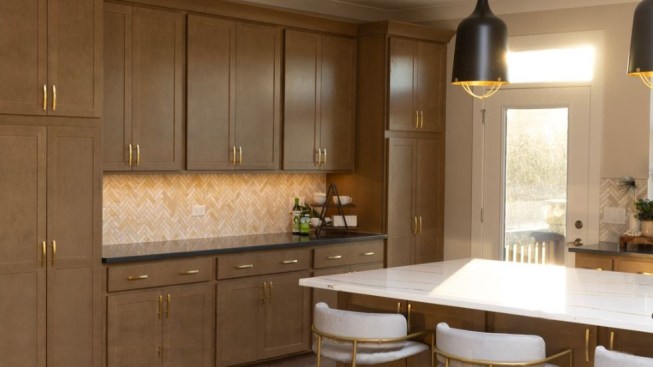
Lexington Homes
“The goal in our new mews was to make the kitchens seem and act larger while keeping the footprint the same. Plus, we wanted to max out cabinets and countertops on all three walls. To do this, we went from sliding glass doors out to the balcony to a single swing door, thus opening another three feet for additional cabinets and countertops. Plus, it allowed us to add a pantry—another perceived single-family only element,” says Benach. “Lastly, we offer an option to bring the upper cabinets all the way to the ceiling, which we show in the model. It really enlarges the feel of the overall size, giving much more storage.”
Walk-in pantries are a desirable element in big kitchens, but incorporated pantries also fit the bill when necessary. In Tucker Development and Wingspan Development Group’s townhomes at The Henry at Harms Woods in Skokie, Illinois, the three- to four-bedroom plans are larger than many single-family homes in the area at 2,014 to 2,529 square feet. While generously spacious, they choose to use a peninsula with a U-shaped layout and integrated pantry storage to improve maneuverability in the kitchen, Aaron Tucker, president and CIO of Tucker, says.
“Ceiling height, length of peninsula, and undercabinet lighting properly installed to illuminate the backsplash can make the kitchen feel larger,” Tucker adds. Tucker notes that open shelving is on its way out in desirability as the need for storage grows. Hidden storage, like cabinets in an oversized island, is a plus, Benach adds.
The top element of any kitchen, regardless of orientation, is natural light. Tucker and Lake both agree on this. “A very bright and light kitchen feels bigger than a dark cave,” Lake says. “While there’s always a push and pull of balancing square footage, we try to create a layout that minimizes unusable footage to dedicate more square footage to the places you need it, like the kitchen, instead of areas that are just wasteful.”
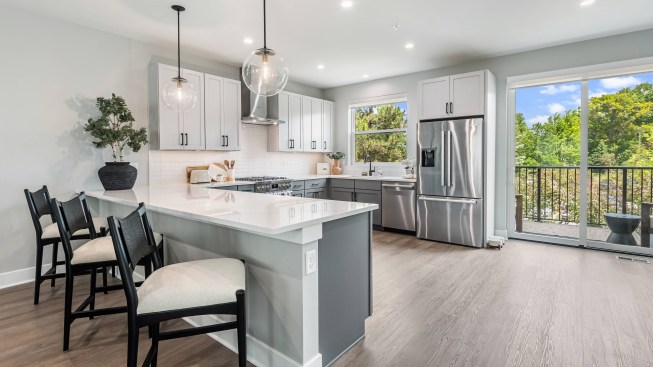
Courtesy of Wingspan Development Group / Tucker Development
What’s Out and What’s Coming
On the contrary, a dark kitchen with minimal light can deter homebuyers. Little storage can also scare them away, but elements that are meant to meet the check list can also do the opposite if done halfway.
“We have found that tiny islands don’t go over as well. Even if you have more kitchen cabinetry, sometimes the island will make the difference in the buying decision,” Lake says.
All white kitchens are also on their way out, Benach says. He believes more people will be reaching for more multi-colored, multi-material designs with two-tone cabinets, mixed metal finishes, and bold lighting. Tucker says that earthy and warm tones and wood grain cabinets are making a comeback, as well as chrome and nickel hardware and thinner, more modern countertops.
But one thing that may not be on everyone’s radar is a change in kitchen location for single-family homes, Lake says. Although most new kitchens live within the L-shape of living, kitchen, dining—or a variation of that—Lake believes kitchens are starting to shift to the back of the house near outdoor entertainment.
“It’s what I call the ‘destination kitchen’ that is still facing the great room or dining area but is also facing the rear yard or view,” he adds. “It takes the number one spot in the house and because it’s on the perimeter, there’s also an abundance of natural light.”
The ‘destination kitchen’ floorplan is a natural fit for many townhomes already with their narrow shape. However, for the next 20 years of single-family kitchens, there’s no doubt they will stay big, but maybe a change of location will be the next expectation.