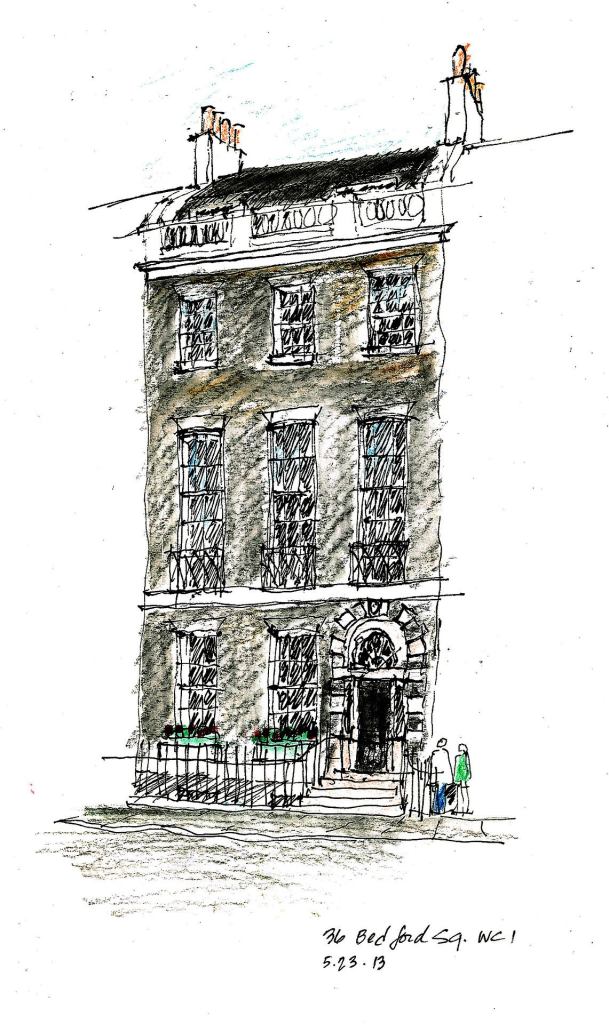
The Duke of Bedford developed his ancestral land on the edge of London in 1770 to cater to the middling classes, families who were neither laborers nor landed gentry. He surrounded a park like square with 53 identical houses. This is one of them, number 36 Bedford Square.
Houses like this became as native to London as a double-decker bus or a pub. Multitudes were built during the Georgian period with a stair and three well-proportioned rooms per floor. Owners painted their yellow brick houses black because the coal fires of London darkened all buildings. With white painted trim, they looked as elegant as a pinstriped suit.
The families of surgeons, barristers, and physicians lived in number 36 for nearly 150 years. Since 1917 it has sheltered a school of architecture. Recently the houses of Bedford Square have been converted to offices and other non-residential uses.
36 Bedford Square reminds us that good structures, reasonably built, don’t have to be thrown away: well-proportioned rooms have many uses. It suggests that buildings don’t have to be different to be good.