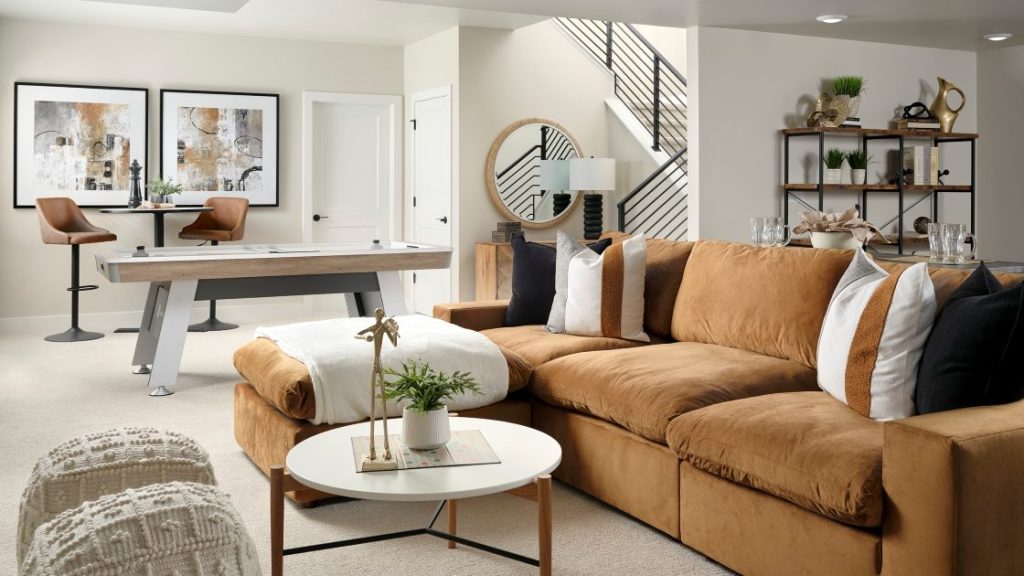
Ask Nick Richmond how to set up a basement for success and his checklist is direct: taller pours, a consolidated mechanical room, and rough-ins where future value lives—bath, bar, and legal egress. Pair that with solid water management and smart duct routing, and the plan stays flexible without costly rework.
Richmond is the co-founder and CEO of Matrix Basement Finishing, operating in Chicagoland as well as Michigan and Wisconsin. When builders make basements that can be used for little more than storage, Richmond’s company turns them into home theaters, gyms, and guest rooms.
“Most builders want to just build the house and move on and leave the basement to the homeowner,” Richmond says. “That’s where we come in.”
His job would be easier if builders would consider how homeowners may want to use their basements in the future. While most newer homes have basements designed for easy conversions, it’s far from standard, he says.
One builder already treating the lower level as a true extension of the home is Trumark Homes’ Colorado division. There, plans call for livability from the start—aiming for an open entertainment area, bedroom, and full bath as baseline, then layering in a second bed/bath, a flex gym, and lighting that makes the space read “main level,” says Tina Martelon-Braunthal, vice president of sales and marketing.
Here, Martelon-Braunthal and Richmond give their perspectives on design moves that turn basements into true living spaces.
Program First: What Today’s Buyers Want
Across markets, the most common ask is still a second family room for everyday living—plus entertainment features that make the lower level a destination.
- Everyday living and entertainment. “An additional family room space is probably the most common. We also get a lot of wet bars, additional bathrooms and home gyms,” Richmond says. Home offices are still in the mix when daylight allows.
- Bedrooms and real baths. Trumark aims for an open entertainment area, a minimum of one ample-sized bedroom, and a full bathroom, with larger plans allowing for a second bed/bath and a dedicated flex room (often a gym).
Aesthetically, some clients want main-level continuity; others want a distinct vibe. Richmond has seen a rise in blacked-out basements—dark ceilings and walls that make screens pop and create a moody lounge feel. “It actually looks really cool,” he says.
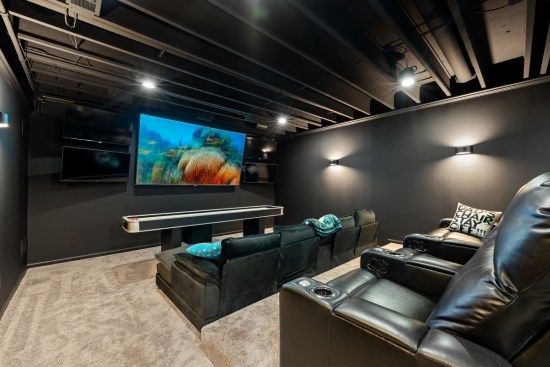
Credit: Matrix Basement Finishing
Rough-In Decisions That Pay Off Later
Both pros agree: Decisions in the shell save headaches later.
- Dig deeper. Push for 9- or 10-foot basement wall heights. Richmond calls depth critical for bigger windows and more forgiving ceiling drops; Martelon-Braunthal emphasizes that wall height “is really important to be able to get a nice finish.”
- Pre-plumb it. In newer homes, Richmond sees bathroom rough-ins “about 75% of the time”—a major boost for future finish quality and cost. Add bar/kitchenette stubs when possible.
- Plan for egress from the start. Getting the egress window (or door, for walkouts) in at the foundation stage avoids expensive retrofits later and matters for bedrooms and valuation.
- Manage water. Exterior/interior drain tile, reliable sump with backup, and well-draining window wells are prerequisites before finishes.
- Route the ductwork smartly. Keep main runs to the perimeter so soffits read as intentional and the primary living area holds its height. “I think it’s really important to do walkthroughs when you’ve done your frame walk and then also your mechanical walk—and then just be flexible to adjust,” says Martelon-Braunthal. Her team recently shifted a run that would have cut through the finished space.
Cosider storage: Smart storage keeps basements adaptable. Trumark Homes leverages the mechanical room and under-stair void; Richmond’s team builds polished storage zones with double doors, sliding barn doors, or hidden doors where it looks like cabinetry. The trick is isolating storage so living zones stay clean and reconfigurable.
Light It Right
Walkouts and garden-level conditions make basements feel light and bright. Where that’s not possible, treat lighting as a design system, not an afterthought:
- Layered electric light: “We use a lot more lighting than most builders,” Martelon-Braunthal says—disc/can fixtures on dimmers so the same room works for both daytime play and evening media.
- Stair integration: Opening the stair can bring sightlines and light down from the main level so the lower level reads as part of the home.
- Window wells: Specify larger, light-colored wells with integrated drains; use clear covers or grates to pull in daylight; align egress windows with primary living zones; and consider terraced wells to bounce light while keeping water and soil off the wall.
Treat the lower level like a product you’re pre-positioning for its second act. The first owner may want a playroom and a Peloton; the next may need a guest suite, studio, or rental. Your framing, rough-ins, duct paths, and wall heights decide how hard or easy that evolution will be. Or, as Trumark Homes proves, engineer the second act up front.
“We embrace the finished basement product because it does add a ton of livability into our homes, especially when we have a lot of walkout conditions or garden level conditions,” Martelon-Braunthal says.