Although the labor issue isn’t new, there is a new sting to the consequences of it as the gap between what we need and what we have continues to widen. “Right now, every market is struggling with the labor issue,” says CR Herro, vice president of environmental affairs at Meritage Homes. “No one has adequate labor, and no one can build as quickly as we used to. No one can build as cost effectively because of the shortage. And it’s even continuing to shrink as the market grows.”
At the moment, urgency is key. Some training programs have been created, but many of them focus on high-school students, which leaves an enormous gap between the need and the demand for the next several decades.
“Even with cutting-edge training programs and promotions aimed at attracting people to the industry, we still need to significantly change business as usual,” says Herro. “The expectations and skill sets of millennial workers to address the essential needs of our industry to provide homes requires a significant evolution in materials and processes from the historic approach.”
The trades that left the housing industry during the downturn haven’t found an easy or profitable path back in. Meanwhile, new immigration policies have reduced the availability of skilled trades, and the graying of the workforce is proof that housing is losing skilled trades faster through retirement than it is gaining young people through new employment.
“If we want to build quality homes, we will need to do it in a significantly different way,” Herro says. “We have to re-envision the way our industry builds quality and builds volume in the future.”
Decrease the Dependence on Labor
The way many volume home builders are approaching the labor shortage isn’t to increase the conventional labor stream, but rather to decrease the dependence on it. Builders are focusing on prefabricating as much as possible to be less dependent on traditional fabrication in the field.
“This is a good first step,” Herro admits. “Most flooring systems and roofing systems are all prefabricated and installed quicker and with less waste on-site.”
How can that work? One answer would be to expand the use of panelization into walls that are constructed and possibly even installed with insulation, wiring, plumbing, and/or cladding prior to shipping them to the site. Panelization helps remove the construction of the home from being affected by weather events and field delays, which can save time in the building cycle.
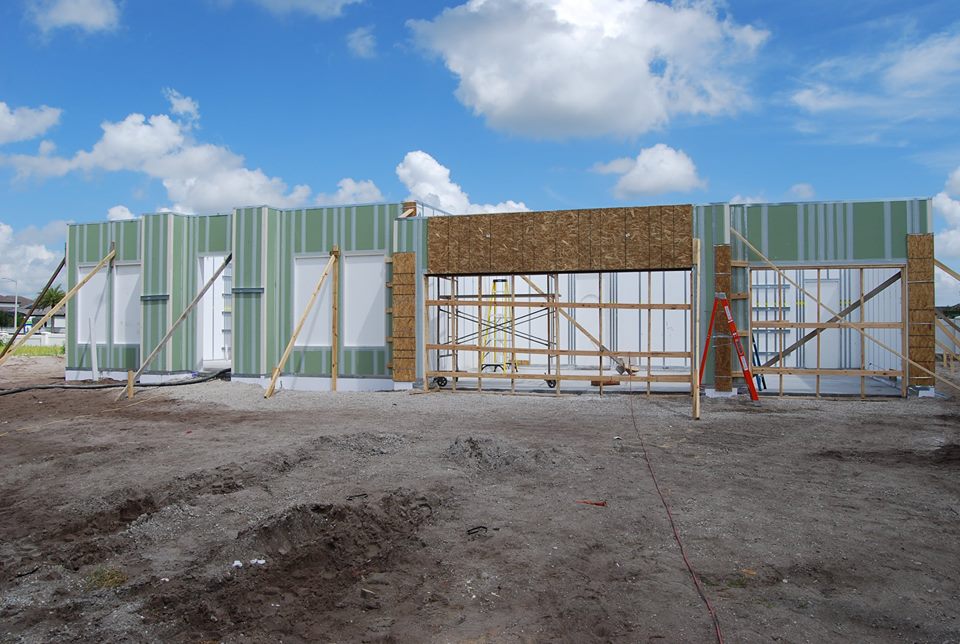
The 2018 BUILDER concept home, the reNEWable Living Home, built by Meritage Homes is constructed with several types of panelization, including a new type of wall system.
“With this project, we have challenged the use of dimensional lumber by replacing it with new products that are more energy efficient, more durable, use more easily sourced local materials, and have easier installation, so it requires less labor on-site,” Herro says.
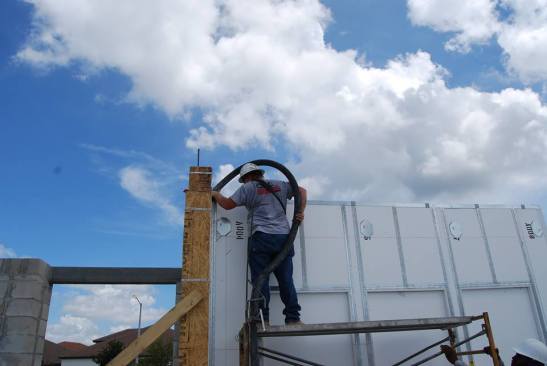
The project is using a new product from HercuTech called HercuWall that is an insulated concrete panel, an improved evolution of insulated concrete forms that required more time, cost, and skilled labor on-site.
Panelization Provides Time Benefits
With the new HercuWall system, the first floor of the 5,188-square-foot home was completed within one day. With conventional methods, these same components would have required two weeks in the construction schedule. But, with panelized walls, Meritage was able to build the entire exterior shell in a fraction of the time.
Meritage Homes
The panelized wall process reduced the construction of the first floor from two weeks to one day.
What are the benefits of that? In both reduced cycle time and improved labor utilization, Herro estimates that this process could save $1 million in holding costs over a 200-home community.
“The reNEWable Living Home is a demonstration that you can cost effectively panelize a home and leverage existing trades to install higher quality at more square feet per man hour than conventional construction practices,” Herro explains. “The best part of this process is that there was not a compromise in the end result. The home is stronger, better insulated, there are less sources of degradation, and it will outperform the stick-built field construction that it replaces.”
This new process saves weeks of time, reduces the potential for weather delays, improves cycle time, reduces unexpected issues in the field that cause delays, and improves predictability for all aspects downstream from design as there is less potential to have to remeasure or to do field adjustments. Without panelization, builders risk thousands of dollars wasted in construction activities compensating for as-built variability.
The panelization process offers post-construction perks, as well. Homes with panelized walls benefit from a high-performance building envelope, and the improvement in materials results in a much lower carbon footprint and lower energy demand. Herro points out that the new materials also set the standard for utility grid optimization by changing the patterns and the way a home consumes energy.
Many prefabrication solutions have existed for years and are available in every market. The impediment to using this improved building process is the commitment of enough volume to make it economical and viable in each market. For panelization to sustain a healthy business model in a market place would take at least 200 units per metro area, Herro estimates. Historically, only the largest builders had significant volume to run a vertically integrated panelization set, but new solutions such as HercuTech are third-party supply sources available to small, medium, and large builders.
Watch the progress of the reNEWable Living Home here and visit the home in Orlando in January 2018.