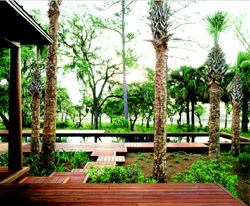
Hurricanes, humidity, and termites, oh my. South Carolina’s island Low Country presents harsh elements that cause flora and fauna to flourish, but leave manmade structures susceptible to all manner of blight. Architect, builder, landscape architect, and homeowner worked closely to ensure this Spring Island house resists Mother Nature’s attacks while respecting and admiring her lush handiwork. “The house was completely developed in context to the site,” says project architect Tim Mohr. He designed a “rambling floor plan that rests lightly on the land,” and “takes advantage of long views toward the river as well as close-up marshes.”
In this flood-prone setting, houses must be set nearly a full story above grade. A house on stilts that “looks like a spaceship landed on the site” wouldn’t achieve the design team’s vision of interweaving architecture and landscaping, explains Mohr. Porches, decks, and terraces asymmetrically rise more than 6 feet above grade, but the ascension is subtle. “The home’s perimeters … shift down and out to become part of the landscape,” says Mohr. “It’s a combination of architectural and aesthetic goals that were dictated by site restrictions, but work really well.”
A grid pattern of wood decking and plantings projects a sense of order and serenity on the natural landscape. “It also adds layering to the porches and rooflines and even the windows,” architect Tim Mohr says, “helping the house extend visually and physically into the landscape.” Photo: Richard Felber Natural plantings interspersed with an expansive hardscape also help blur the distinction between house and site. “We brought the house to the land and the land to the house,” says Mohr. Acclaimed landscape architect James van Sweden used mostly native plants so that the purposeful landscaping wouldn’t look forced. His subtle touch has a calming effect on the sharp geometry of the decks. The greenery even makes its way inside the house in the form of a bright bamboo garden that gives a nod to the home’s Japanese influences while offering direct passage from entry hall to pool deck.
Each intersection in the home’s narrow footprint produces an opportunity for a courtyard. These protected exterior spaces function closely with their interior counterparts. The front entry lies perpendicular to the guest wing, resulting in an intimate court with a welcoming touch. “That deck comes down like a dock to greet people as they approach the house,” says Mohr.
This Low Country home is surrounded by tidal marshes and natural meadows that change dramatically from day to day. Owners and designers wanted to make the most of those varied scenes, so oversized doors slide open to make rooms indoor/outdoor. Plus, the breakfast nook has two walls of windows that drop away, transforming it into a breakfast porch. Long, low overhangs keep transitional spaces well shaded. Photo: Richard Felber Where the living room and master suite wing cross paths, a series of decks surround a biologically active lily pond. The multilevel nook provides a quiet outdoor setting. A wood-fired grill makes the terraces extending out from the dining room ideal for cooking and dining among meadows and marshes. The pool occupies the southeast corner overlooking wetlands and river beyond, and its connection to kitchen and breakfast cubby generates a casual family feel. A long and winding verandah unites these open-air rooms.
(Opposite and bottom left) The pool’s elongated rectangular shape draws the eye toward the tidal marsh and river beyond. The plain shape and subdued materials used for the pool area allow the natural vistas to take center stage. Photo: Richard Felber Lest the termites or humidity be forgotten, all of these graceful moves had to be executed in durable materials. Thanks to the conscientious project team, selections also focused on sensitivity to the 57-acre site. Reclaimed cypress columns support porch overhangs while sustainably harvested danto wood makes up the decking. Builder Duane Constantino explains that both woods are extremely hard and naturally resistant to termites as well as warping. As an added measure, non-toxic capsules buried beneath the wood will slowly infuse it with borate, rendering the material less than tasty for pests. Constantino was careful to protect and preserve during construction. “The crew put down mulch to distribute loads of building equipment and minimize disturbance,” he says. “And we worked with the island’s review board to save existing trees and other natural aspects of the site.” Photo: Richard Felber Project Credits:
Builder: Bay 10 Ventures, Hilton Head, S.C.; Architect: William McDonough + Partners, Charlottesville, Va.; Landscape architect: Oehme, van Sweden Associates, Washington, D.C.; Photographer: Richard Felber; Illustration: Charles Lockhart
The lily pond marks the transition between public and private spaces. Once past the pond, expansive terraces give way to a slim verandah that pulls away from the landscape until it eventually becomes a balcony along the master bedroom wing. Photo; Richard Felber Illustration: Charles Lockhart