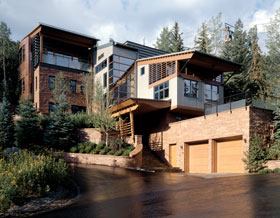
Ski in and ski out reach new meaning in this house perched on the edge of the main run down Aspen Mountain: Four of the seven floors in its split-level layout feature direct access to the slopes. Residents can ski out of the bedroom in the morning, ski into a dining deck with a built-in grill for lunch, and pop off their skis at the end of the day to hop into the raised spa with views of Aspen’s nightlife glimmering below.
“It almost felt like we were designing a hotel,” laughs project designer Lyndal Williams. The owners, who have lived on this site for more than 30 years, have 10 kids and lots of grandkids who all enjoy winter sports. The new structure had to maintain the tight footprint of the original house while adhering to tough height restrictions. Numerous outdoor rooms increase the size of the house by a total of 1,550 square feet. In fact, the multiple outdoor areas resolve several design challenges. Besides adding much-needed square footage, they offer the many occupants a place for individual escape and help the multi-tiered home merge with the site.
The spa deck atop the garage overlooks the town center. Its orientation allows the outdoor spaces to be brightened by the lights of Aspen below. Photo: David O. Marlow Nearly every room has some sort of outdoor space, and most floors have on-grade egress for skiers or hikers, but the dining deck and hot tub patio provide the key spots for outdoor living. These principal exterior areas also cap the two ends of the steep .25-acre site. Although outdoor living options were crucial to giving this large family enough space to be together comfortably, the location is highly public. Siting alongside the gondola line and the biggest ski run, the outdoor rooms begged for seclusion as well as strong ties to the mountain. “It was important to have a connective exterior space at each end of the house,” says Williams, “but these spaces also maintain a certain sense of enclosure, either via being sunken with retaining walls, or via obscure glass railings.”
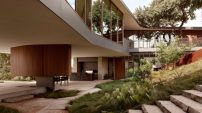
The top-level dining deck and outdoor kitchen (above) has direct access to the indoor kitchen. Photo: David O. Marlow The lower space, called the ski deck, features an elevated spa and adjacent seating area with views down the mountain overlooking the town of Aspen. Translucent glass panels along the bottom of the railing offer wind protection and conceal those soaking in the spa. Above the glass, the railing opens up with steel cables to permit unobstructed vistas. Just below the raised section of the patio, a rock garden doubles as a snow-catching pit. It also keeps guests out of the way of mini avalanches that may occur when snow slides off the sloped roof overhang. According to principal-in-charge Chris Ridings, the house gets more of the white stuff than others in the area because the slope-side locale receives accumulation from snow machines as well as Mother Nature.
Just past the snow pit, the ski deck segues into a large changing room. A wall of glass and the continuation of the stone flooring allow the indoor/outdoor spaces to act as one. Individual lockers and cubbies along with an elliptical changing bench let big groups get out of wet clothes quickly without bumping into each other. The family frequently entertains on the ski deck in the evening, so having the contiguous space of the changing room improves crowd flow. Opening the oversized glass doors transforms the changing room and ski deck into a single social space.
Wraparound steps leading up to the hot tub and wide walls enclosing the snow collection pit offer additional seating on the spa deck. Photo: David O. Marlow At the top of the site, the dining deck runs the entire width of the building’s uppermost level. The long and narrow space encompasses 530 square feet, only a few feet smaller than the ski deck. Two sets of the same transparent double doors used on the lower deck lead to the kitchen and living room. A built-in grill backs up to the living room fireplace with windows on three sides to further enhance the indoor/outdoor bond. The dining deck is the easiest to ski into, with on-grade entrances on both sides. Direct ties to the ski run as well as the kitchen make schussing in for lunch and then heading back out onto the slopes a breeze.
Of course the homeowners prefer not to have strangers skiing into their home, so figuring out a way to let the occupants enjoy open-air spaces without feeling like they were on display challenged the design team. Low, wide retaining walls protect those sitting on the decks yet allow them to see the views beyond. Varying wall heights along the perimeters prevent the spaces from seeming completely closed-in and offer casual seating along the lowest sections. The strategic planting of aspens and other indigenous greenery was a logical way to add natural screening to exterior rooms.
Illustration: Harry Whitver The design team looked again to nature when selecting low-maintenance finishes. Four of the owners’ kids are architects, so they came prepared to the early design discussions. “They were inspired by fall colors and came to one meeting with leaves and rocks and twigs they had collected from hikes,” says Williams. Taking the clients’ wishes to heart, locally found materials dominate the contemporary spaces. Colorado rose sandstone relates to the surrounding environment, both natural and man-made, while variegated slate tiles give color and texture to floors and stairs. Douglas fir, cypress, and copper panels make up the rest of the rugged palette. “Being in snow country, we used strong finishes at the base where the snow gathers,” says Ridings, “and wood and metal up higher to lighten the visual load.”
Project Credits: Builder: Harriman Cosntruction, Basalt, Colo.; Architect: Poss Architecture + Planning, Aspen, Colo.; Photographer: David O. Marlow (except where noted); Illustrator: Harry Whitver.
Overlapping retaining walls around the dining deck conceal one of two ski-in entries and act as an impromptu place to lean skis and poles. Photo: David O. Marlow
Illustration: Harry Whitver