Like many of his builder peers, Branson Fustes arrived at the custom home business in a roundabout way. The Houston-area native majored in environmental biology at the University of Colorado-Boulder, studying ecosystems and wildlife habitats. He spent 10 years living in the Boulder area, working as a furniture and cabinet maker and then as a carpenter. When his parents relocated to the Austin, Texas, area in 1998, he moved there to build their house. “It gave me the opportunity to learn by doing,” he says.
He started Pilgrim Building Co. in 2000, marketing himself to local architects. The word spread among this hard-to-please group about his attention to detail and technical skills. “He was born with a good aesthetic,” says architect Camille Jobe, who’s worked with Pilgrim on two projects so far. “He knows what looks good and what doesn’t. If a detail is not in the drawing set, he and his guys will go over three to four different ways to do it.”
Fustes likes to do things right—and for him, that means building a house as green as the scope of the project allows. He believes that siting and orienting a house properly and choosing high-performance materials and systems will benefit the client, the design, and the environment. Over seven short years, he’s turned himself into one of the area’s top sustainable builders, with a staff to match. “He’s very up on the different [green] techniques and technologies,” says Jobe. “Everyone on his crew works on all the projects—you get to know them really well. They care a lot about the finished product.”
He built his own house out of rammed earth, a combination of earth, cement, and water. Though pleased with the aesthetic results—rammed earth produces striated walls with an uncommon beauty and texture—he admits that the naturally heat-retaining structure might be better suited to a desert climate with high-temperature days and chilly nights. During Austin’s steamy summers, its walls stay a little too warm for comfort. “Where we are in Texas, rammed earth works great 10-and-a-half months out of the year,” he says.
Don’t get him wrong, though—he loves Austin and its environmentally sophisticated attitude. He, his three project managers, and his 10-person framing and carpentry crew regularly attend seminars given by Austin Energy Green Building (see “Knowledge Base”), which he describes as “invaluable.” And his projects embrace the outdoor lifestyle offered by the area’s sunny climate.
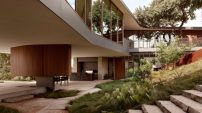
Much of Fustes’ work, including his own residence and office, lies in the rural Hill Country outside the city (see image gallery). “We recognize the irony of building a cutting-edge green house 20 miles from anywhere,” he says, acknowledging the car dependency that usually accompanies a remote living situation. “Green means different things to different people. For some people it means using all recycled materials, for some it means using non-toxic products … A lot of the projects we’ve done out in the country have been for folks who are more interested in being off the grid.” Many of his rural jobs have incorporated rainwater harvesting and purifying systems, which make particular economic sense for sites that aren’t connected to municipal water services. “Rainwater collection is not that complicated,” he says. “Mechanically it’s the same system as a well—the tank is just aboveground.”
As for the future of green building, he thinks prefabricated building components will play a major role. And he predicts that it’s just a matter of time before most environmental building products catch up with their non-green competitors in terms of pricing and performance, if they haven’t already. “Things like low- or no-VOC paint—it was an inferior product when it started, but it’s improving all the time,” he says. “The quality will eventually be equal to or better than standard paint, and the price too. At some point, it will be a no-brainer.” Fustes realizes that green building—and building in general—is always evolving, even throughout a single project. That’s why he named his company Pilgrim Building. “Not to get too heavy or metaphysical, but I believe we should be seekers,” he says. “The name is a way to try and acknowledge that building is a process. There’s a dynamic aspect to doing a home with a client and an architect … it’s not a static thing.”