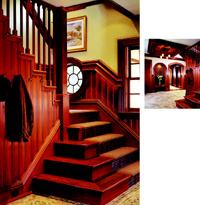
Expanding the breadth and width of treads at the bottom of a staircase for effect as well as ad hoc seating is a practice dating back to ancient Greece, observes architect Steven House. Architect Jan Gleysteen looks back to 1880s Shingle-style houses for support of his theory that “the widening of the lower treads does two things: It creates a flourish that helps establish the stair in a hallway or entryway, and it gives the illusion that the stair is bigger than it actually is.” Practical benefits abound as well, such as providing a place to set down briefcases or books, extra seating for big soirees (with room left over to actually climb the stairs), and an attractive way to mask bulky air vents. Plus, the concept can be applied to virtually any building style.
Photo: Sam Gray Grand Illusion It’s not the main entrance, but this mud room entry is the one most frequented by the homeowners, so architect Jan Gleysteen felt it deserved a casual grandeur of its own. To make more out of the compact back stairwell, he wrapped the bottom stairs to create a double return design often used for sweeping entrances to public buildings. “Each stair returns on itself,” explains Gleysteen, “which encourages people to approach from both directions and also to lounge on them.” The subtly curved risers that support the elongated treads give the illusion that the stair is bigger than it actually is. Custom-made grilles mask air-return vents while also demarcating the climbing section from the “sit and take off your muddy shoes” portion of the stairs. A hand-rubbed oil finish on Honduran mahogany makes a regal statement that is toned down by the stark vertical lines of the balustrades and the wainscoting. A hidden handrail is disguised as molding on top of that wainscoting. Although a full coat closet is tucked underneath the stairwell, Gleysteen speced coat hooks to add a touch of “controlled chaos that is indigenous to mud rooms.” He adds, “The exposure of the hooks adds some warmth and acknowledges the room’s functionality.” Builder: MF Reynolds, Medford, Mass.; Architect: Jan Gleysteen Architects, Wellesley, Mass.; Photographer: Sam Gray.
Photo: Claudio Santini Upwardly Mobile “We wanted the stair to be sculptural because it’s the first thing you see when you walk in the door, but it also has to lead you upstairs where the living spaces of the house are,” says Steven House of the multi-purpose stair design in this San Francisco home. He also used the stair sculpture to hide the air duct and provide seating adjacent to the built-in coat closet. The architect wanted to incorporate all of these elements into something dramatic despite the clients’ tight budget, so he focused on a big bang design implemented with straightforward materials. Clear maple for the coat closet-cum-guard rail contrasts with red oak stairs and flooring. Black painted 2x4s run horizontally between the cabinet and the extra wide baluster. “The horizontal boards mimic the grille lines,” says House, “but the black also almost disappears.” The third tread skips a step on the side to generate a comfortable sitting height of 20 inches while extending out past the handrail about 15 inches. It’s a great place to set your briefcase or yourself as you come in the door, adds House. Builder: Claxton Associates, Nevato, Calif.; Architect: House + House Architects, San Francisco; Photographer: Claudio Santini.
Photo: Bruce Kelley Open Access A center stair in an open plan calls for something distinguished, but for this Bay area home that something had to be in keeping with its modest bungalow setting. Former Navy architect Bruce Kelley likes to work with wood, so he selected salvaged redwood from old wine casks as his medium to design a stair that would be accessible as well as eye-catching from the three rooms open to it. “I used a geometric sleight of hand,” explains Kelley. “By widening the landing so that the lower treads align with the ceiling beams, it allows you to go in three directions and it keeps the stair in proportion to the other public spaces.” The bottom three treads also wrap around the side of the stair connecting the landing to the foyer to offer easy bench seating just inside the front door. Builder: Ridge Greene, San Francisco; Architect: Kelley + Kelley, Berkeley, Calif.; Wood crafters: Fourth Street Woodworking, Emeryville, Calif.; Photographer: Bruce Kelley.