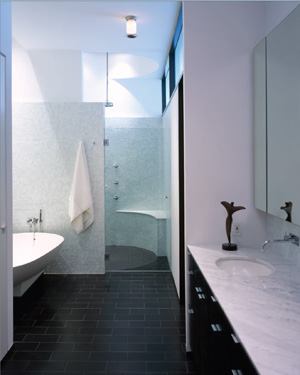
This historic three-story building in downtown Austin, Texas, made an intriguing prospect for a single-family residential conversion, but it came with some daunting constraints. Twenty-one feet wide across its front elevation, the building stretches 125 feet from sidewalk to back alley. Architect Tim Cuppett didn’t mind, however. “Rather than fight that,” he says, “I chose to emphasize it.” The approach is most evident in the third-floor master bath/dressing room, which goes to great lengths in delivering a transcendent experience.
Some 46 feet long, the room organizes functions in galley fashion along a central circulation axis: a wet bar opposite a walk-in cedar closet, a dressing area with a full-length folding mirror, and the bathroom proper. Black-dyed ash cabinet doors and drawer fronts bear a horizontal pattern that underscores the room’s length. The dark floor—stained quartersawn oak in the dry areas, black granite in the wet—leads the eye to the room’s culmination, a glass-tiled cylindrical shower.
While the building’s unusual geometry demanded creative space planning, it posed even greater difficulties in accessing natural light. With no exterior windows—the building’s historic designation precluded new openings—the bathroom borrows light from an adjacent hallway via transom windows along its south wall. A ring of color-filtered cove lighting above the shower mimics a skylight, spilling an inviting pool of light at the end of the room’s long axis.
Builder: J. Pinnelli Co., Austin, Texas; Architect: Tim Cuppett Architects, Austin, Texas; Photographer: Paul Bardagjy.