Downtown Las Vegas isn’t the Strip—and that’s exactly why developer Sam Cherry has bet his career on it.
In the early 2000s, while many builders chased suburban growth, Cherry, CEO of Cherry Development, zeroed in on the city’s long-overlooked grid of small blocks, older commercial buildings and a nascent Arts District. The result: a two-decade run that began with the city’s first true residential high-rise and has since evolved into a laser focus on “missing-middle” rental housing designed for people who make the city run and want to live near the action.

“I fell in love with downtown,” Cherry says, recalling the momentum that started when then-Mayor Oscar Goodman made downtown reinvestment a civic priority. “There’s a long runway of opportunity for growth.”
Cherry Development planted its first flag in 2006 on Las Vegas Boulevard with Soho Lofts—17 stories with ground-floor retail, parking, and top-floor amenities. A second tower, Newport Lofts, followed next door. Those projects proved the market for living downtown, but they also exposed a gap: a city center can’t thrive on luxury alone. “A really thriving downtown has all different income levels,” Cherry says.
After the downturn, Cherry returned with a different playbook: shareDOWNTOWN, a four- to five-story, mixed-use rental model aimed squarely at workforce households.
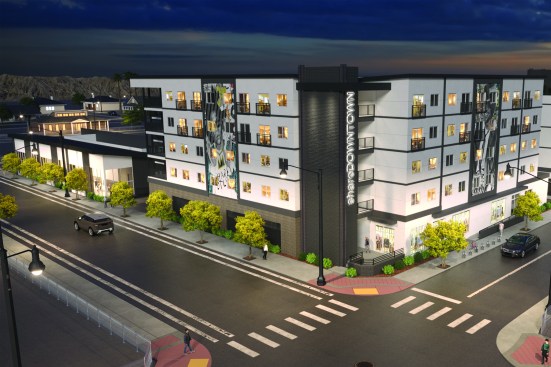
Cherry argues workforce rentals fill the space between restricted “affordable” product and high-amenity luxury. The target resident: service workers on and off the Strip, municipal employees, salon staffers, restaurant teams—people who don’t qualify for subsidized housing but can’t or don’t want to pay luxury rents. In the Historic Westside, for example, a one-bedroom unit is about $1,000 cheaper than a similarly sized apartment a mile away. That’s because shareDOWNTOWN trims costly, underused amenities and instead centers programming around downtown as the amenity.
Two recurring rituals define the brand:
- First Fridays: Each month, staff brings residents from all Share buildings together (soon three and counting), highlights a local restaurant or caterer, hires music, and opens the common kitchen for a free, informal mixer.
- Third Thursdays: A roving field trip to a neighborhood business or cultural spot—a new bar like Pachi Pachi on Carson Avenue & Las Vegas Boulevard, a bike tour, or the Punk Rock Museum—so the crowd isn’t limited to bar-centric socializing.
Turnout runs 30 to 40 residents per event: original tenants who never left; neighbors who moved out, missed the community, and came back; social circles that cook for each other, travel together, and look out for newcomers. “This happens organically with food, conversation, music,” Cherry says.

Cherry intends to keep rolling out shareDOWNTOWN where the numbers and neighborhood fabric align. As the Arts District and Fremont East keep drawing locals and visitors—and as more convention-goers wander off the Strip for a brewery flight or gallery stop—the case for attainable, walkable, near-job housing only gets stronger.

That growth strategy is anchored by hometown partners who understand he’s building for the long haul.
“We work with local businesses. Cox Communities is one,” Cherry says. “They all help us and understand that we’re not merchant developers. We’ve been downtown for almost 25 years. We’re not going anywhere.”
Cox Communities is proud to partner with leaders like Cherry to bring reliable connectivity to downtown living. From pre-installed internet to managed Wi-Fi, we help residents get online in minutes and keep communities running smoothly. Learn more.