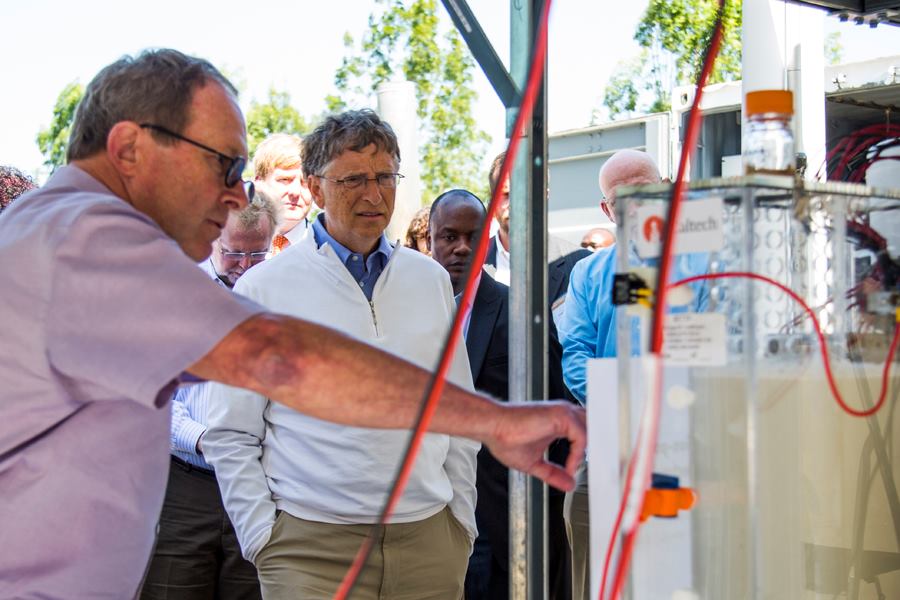
Last year, tech-mogul-turned-social-entrepreneur Bill Gates challenged a handful of researchers at universities around the world to design a toilet that can meet the needs, and work within the constraints, of the 2.5 billion individuals worldwide (about 36 percent of the global population) who lack access to safe and sustainable sanitation. Earlier this month, the teams—representing 29 countries and including researchers, designers, investors, advocates, as well as representatives from recipient communities—unveiled their prototypes at the Reinvent the Toilet Challenge in Seattle.The teams didn’t have to reinvent the wheel to develop the new toilets—they just had to rethink how water would or wouldn’t be used given that their final product would be implemented in areas likely facing a shortage of the resource. First-place winner California Institute of Technology took home $100,000 for a solar-powered toilet that generates hydrogen and electricity. U.K.-based Loughborough University’s design turns human inputs into outputs of biological charcoal, minerals, and clean water—enough to win second place and $60,000. The University of Toronto in Canada nabbed the $40,000 third-place prize, and the Swiss Federal Institute of Aquatic Science and Technology and EOOS team earned special recognition for its toilet user interface design.
“Imagine what’s possible if we continue to collaborate, stimulate new investment in this sector, and apply our ingenuity in the years ahead,” Gates said in a statement. “Many of these innovations will not only revolutionize sanitation in the developing world, but also help transform our dependence on traditional flush toilets in wealthy nations.”
The Bill & Melinda Gates Foundation also awarded a second round of grants totaling nearly $3.4 million to the following projects:
Cranfield University (United Kingdom) is building a prototype toilet that will remove water from human waste by vaporizing it with a hand-operated vacuum pump and a unique membrane system. The remaining solids will be turned into fuel that also can be used as fertilizer while the water vapor will be condensed used for washing or irrigation.
Eram Scientific Solutions Private Limited (India) devised an “eToilet” that will help make sustainable and hygienic public toilets more accessible to the urban poor.
RTI International (Research Triangle Park, N.C.) is developing a self-contained toilet system that disinfects liquid waste and turns solid waste into fuel or electricity through a new biomass energy conversion unit.
University of Colorado Boulder’s (Boulder, Colo.) solar toilet uses concentrated sunlight, directed and focused with a solar dish and concentrator, to disinfect liquid-solid waste and produce biological charcoal (biochar) that can be used as a replacement for wood charcoal or chemical fertilizers.