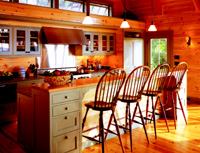
There’s more to a kitchen island than simple work surface. Although a well-designed island is essential for cooking, it’s also useful for homework, a chat over a cup of coffee, casual meals, and as a buffet or bar for a party. An island can also be an important transition and barrier between work space and public space. But to function at its highest, a kitchen island must contribute to the style as well as the substance of the space it serves. These three projects illustrate how an island can be a work place, a gathering place, and a design focal point all at once.
Shaker Style As hardworking as they are, islands are about more than function and socializing. They also can contribute to the style of a space. For this house overlooking Maryland’s Severn River, architect Jim Rill wanted the island to read as a piece of furniture and designed an elegant showpiece. The charcoal granite surface supported by reddish-brown mahogany legs provides a rich counterpoint to the room’s abundant glazing, vaulted ceiling, and walls of white painted siding. To accommodate the clients’ need for storage, recessed cabinets sit discreetly underneath the base, masked by the same V-groove siding found on the walls.
This layout allows the island’s extended top section to read as a simple Shaker-style table sitting in the middle of the room. “It’s the main piece in an open volume,” says Rill. “It really anchors the room.” Builder: Ilex Construction, Easton, Md.; Architect: Rill & Decker Architects, Bethesda, Md.; Photographer: Eric Taylor.
Photo: Brian Vanden Brink Unfitting In Architect Mark Hutker designs with the unfitted kitchen philosophy in mind. Hutker touts the concept of architecturally connecting open kitchens with surrounding public spaces by creating storage that looks more like living room furniture than kitchen cabinetry. This island in a Chappaquiddick, Mass., kitchen makes use of contrasting materials and a three-dimensional face to create the appearance of freestanding pieces. While the raised counter hides the work station, it also works as part of the living room décor. Its painted drawers flanking a natural pine knee space support a polished pine surface that looks like a tabletop. Details like the carved brackets and painted knobs enhance the furniture feel. “It’s these subtle changes that make the look softer to fit with the living room furniture and separate the island from the functional section of the kitchen,” says Hutker.
Photo: Brian Vanden Brink Builder: Vineyard Sound Construction, Vineyard Haven, Mass.; Architect: Hutker Architects, Vineyard Haven; Photographer: Brian Vanden Brink. About Face Kevin Hackett, U.S.-based design director for international design guru Johnny Grey, thinks of islands in terms of their “faces”—the more social side faces other living areas while an internal face looks to the work zone. This San Francisco example designed by Johnny Grey is arranged accordingly. Slim bookshelves at one end of the island are two-faced so that cookbooks are near the stove on the work side and other reading material is convenient to the social side. At the other end of the island a circular kitchen prep area faces off with a dropped desk surface on the social side. Two refrigerator drawers finished in pearwood on the social side put beverages within easy reach of family and guests.
Ergonomics are as important as socializing in this kitchen. The raised bookshelves on the island generate a flat surface ideal for standing and flipping through recipes or glancing over a page while stirring the pot. There’s room beneath the raised and floating prep area to pull up a stool, while the integrated butcher-block wedge sits even a little higher to give leverage when slicing and dicing. Across from the island, dishwasher and companion dish drawer are lifted off the floor to avoid stooping. Hackett says, “We make sure there’s a diversity of openings in height and type so there’s no overuse of any muscle.” Builder: Bauman Construction, Palo Alto, Calif.; Designer: Johnny Grey, San Francisco; Photographer: Matthew Millman.