






Chicago is a terrific place to live. It has the blues, the lake, the steaks, landmark buildings by Sullivan and Wright, and in-town neighborhoods full of character. But there is the matter of the weather. Winters here are famously rough, and summer can be a brute too. All of which makes the quality of Chicago’s indoor environments rather important. Urban houses everywhere must provide refuge from the public life that pulses outside the front door, balancing privacy and security considerations with the need for light, views, and access to the outdoors. But the issue seems especially pointed here. It was very much on the minds of Kim Clark and James Powell as they relocated to the Midwest, where Kim had grown up, from the milder climes of San Francisco. Says their architect, Larry Kearns, “There was certainly some trepidation about moving back to Chicago, with our long winters and limited daylight.” They need not have worried. Kearns and builder Mark Fraser delivered a house that creates its own elegant world without disengaging from either the natural environment or the vibrant city that surrounds it.
Typical Chicago lots are narrow and deep (this one is only 33 feet wide), giving even freestanding houses only a single elevation with which to express themselves. But while its turn-of-the-century neighbors lay on a full wardrobe of cornices, corbels, and bays, this building presents a restrained, finely tailored facade. “We wanted to build a contemporary home,” says Powell, “but we wanted a home that was very conscious of its context. We wanted to build a brick house; that’s very Chicago.” With its orderly ranks of black-steel-framed windows and complete lack of ornament, though, this house represents a hybrid of the city’s residential and industrial architectural traditions. The front porch is a simple steel affair with ipé decking and stair treads. Its canopy is a single sheet of frosted glass. “Some neighbors took issue with the austerity of the facade,” Kearns says. But he wanted to be honest in representing the character of the house, “not to muddy the waters in terms of what we were doing here.”
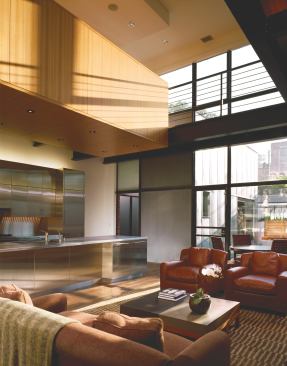
The mix of residential and industrial themes runs throughout the building. The front door opens into a combined entry hall, living room, and dining room. A cabinet-like coat closet veneered in American elm defines the entry hall, resting on the floor as if it had been simply set down there. The walls are white, with no casings or baseboards. The window sashes and frames, like the plate-steel hearth and fireplace surround, are painted black. A black steel bookcase floats against one wall. These basic elements—a simple box, brick on the outside and white on the inside; discrete, wooden containers placed within; and black steel accents floating at the edges—comprise the essential vocabulary of the house. But Kearns used this abbreviated vocabulary to make a couple of major statements.
One problem for houses on narrow urban lots is getting daylight into the center of the building. Kearns solved it here with a bold and simple move: splitting the building in two. The front and back halves of the house consist of twin four-story brick towers that are structurally independent, from the basement slab to the roof. Filling the slot between the towers is a glass-walled, glass-roofed stair hall that is both circulation hub and light well (see “Split Decision,” page 68). The stair’s position, sandwiched between the brick “exterior” walls of the towers, creates the impression of two separate buildings sharing an unusually elegant fire escape. Its side walls are made up of thermal pane glass panels whose two inner surfaces are etched in an alternating, Venetian blind pattern that obscures the neighbors’ view into the house but leaves slanting views of the sky unobstructed. The stair also serves as an organizing device for the floor plan, which locates public spaces at the rear of each floor and the more private rooms at the front.
To address another perennial urban challenge—a shortage of private outdoor space—Kearns turned an existing oversize alley garage into something like a magician’s box. He carved into the existing structure to create a sheltered patio; ramped the garage floor downward to gain space overhead for a series of terraces that step from the garage roof to the patio; and capped the building with a deck, complete with plantings to screen off the alley. A zinc-wrapped volume connects the main building and garage. A fence of frosted glass in a black steel frame completes the garden enclosure. That’s a lot of design packed into a very small area, but the effort pays off. The connected garage, with its heated slab floor, makes for easy arrivals and departures, no matter how ugly the weather. The multi-level complex of outdoor spaces supplies a surprising amount of running room for the owners’ two young children. Equally important, it creates a pleasing visual backdrop for a house whose all-glass back wall would otherwise face an alley.
Fitting this much building into such tight quarters placed considerable demands on the builder. “There’s over 150 yards of concrete in the garage,” Fraser points out, “but there are T-shaped alleys on both sides, so there was no room to get mixers in.” By necessity, he says, “we built the garage first,” parking a pumper truck where the living room now stands. Next to go up were the brick towers. Because the stair landings span the gap between them, Fraser had to crane the stair into place after the towers were built. That was only one of many details that scrambled the usual sequence of rough and finish operations. The welded steel bookcases that line so much of the house’s interior hang 1 inch clear of the walls, on thin steel brackets. Each bracket extends through 4 inches of steel-stud furring and drywall and into its own ¼-inch-wide vertical slot in the bookshelf frame (with virtually zero tolerance for error) and had to be expansion-bolted and epoxied to the masonry wall long before the finish stage. The gallery floor that hangs over the kitchen space consists of 2¼-inch-thick laminated white oak planks laid as an open deck that spans some 4 feet between steel I beams. Of building a solid, squeak-free deck that looks this pretty from both sides, Fraser says, “That was cabinetry work.”
Much of the house is cabinetry work in a more literal sense, as the elm-clad-box motif repeats in a multitude of forms: closets, entertainment centers, the master bath enclosure, and a room-size built-in desk that wraps the edge of a second-floor opening to form the ceiling of the kitchen below. Unlike most Modernist details, which achieve simplicity at a high cost in labor, the box scheme actually expedited construction. Because most of the cabinetry is essentially freestanding, Fraser says, it required no templating. “We were able to get the shop drawings approved and get the cabinetry all finished and in storage, waiting to be installed. So it was really good for the schedule.” With their clean shapes, warm blond color, and handsome parallel grain pattern, these wood pieces are good for the feeling of the house too. (In the kitchen, the approach varies only in material: stainless steel at both cabinets and countertops.) Like the bookcases, they act more as furnishings than as structure, allowing the simple white-walled geometry of the rooms to read through. The effect is quiet, composed, and urbane, just the thing to take the edge off the urban environment without fleeing to the suburbs. When the winter winds blow and forecasters utter the words “lake-effect snowfall,” one could not hope for a better place to hole up.
Project Credits
Builder: Fraser Construction, Lyons, Ill.
Architect: Wheeler Kearns Architects, Chicago
Living space: 5,500 square feet
Site: .1 acre
Construction cost: Withheld
Photographer: Steve Hall (except where noted)
Resources: Bathroom/kitchen cabinets: American Custom Woodworking; Bathroom plumbing fittings: Vola; Bathroom plumbing fixtures: Acorn and Duravit; Brick products: Cushwa; Dishwasher: Miele; Doors/skylights/windows: Hopes; Garage doors: Raynor; Garbage disposer: Insinkerator; Hardware: Accurate; HVAC equipment: Carrier; Kitchen plumbing fittings: Hansgrohe; Lighting fixtures: Bega, Gammalux, and Litecontrol; Metal exterior siding; Rheinzink; Oven: Miele; Refrigerator: Sub-Zero; Wall tile: Bisazza.
The Builder: Staying Power When Mark Fraser builds a house, he is also building on a rich family tradition.
His grandfather founded John Fraser Homebuilders in 1926 and, with a break to fight in World War II, built houses until he died in 1953. His father, Gale Fraser (at left in photo), founded Fraser Construction in 1957 and has run it ever since. Gale Fraser, 73, attributes the company’s longevity in part to its market. “Chicago is a great area to work,” he says. “You can put your hands on a lot of stuff right here, in the way of materials, trades, and so on.” And in the company’s base, the affluent neighborhoods of Gold Coast, Lincoln Park, and DePaul, high-end construction has been “just busting at the seams.”
But location is not everything. As custom homes have grown in size and sophistication, the Frasers have ramped up their capabilities. Mark’s brother-in-law, John Rosenwinkel, a civil and structural engineer, heads the company’s engineering department. The company supports its field superintendents—who act as project managers as well—with an in-house millwork operation. With 12 to 15 employees running four to eight jobs, the company grosses between $10 million and $12 million annually, and has engendered such confidence in the city’s top architects that they are often invited to participate in projects during the design phase.
One thing that has not changed is the value of a half-century of experience on the job. While he hung up his tool belt some 15 years ago to concentrate primarily on sales and estimating, the elder Fraser remains very much a hands-on owner. “He likes to work with the tools,” his son says. “He likes to work in the mill shop.” And when nuts-and-bolts questions arise, “everything from scaffolding to putting a 12-piece crown together, he’s the guy you want to show up and give an opinion.”
Details: Split Decision The stair that divides this house in two leads its own twinned existence. Actually two separate, intertwined stairways, this “scissor stair” offers several distinct advantages over its single counterparts. Stair landings at opposite sides of the house create an easy, circular traffic pattern between rooms at the front and those at the rear. Each landing offers both up and down flights, so one need never cross the width of the house to get headed in the right direction. Because it eliminates the need for hallways at every level, it occupies the same volume required by a single stair. It is also, in a way that is difficult to describe, really fun to use.
But splitting a house in two from the basement slab to the roof does create challenges. Because the stair landings offer no cavity in which to run utilities, every pipe and wire that crosses the gap—AC power, low-voltage lines, radiant hot water, domestic water, sprinkler water, and wastewater—threads through a concrete plinth that supports the stair at the basement level. “There’s a ton of pipes going across here,” says builder Mark Fraser, “and some empty pipes for future things.” The main utility room is at the rear of the basement, but because forced-air ducts would not fit through the plinth, the front of the house has its own utility room with a separate air handler.