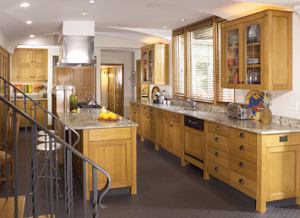
In designing this new kitchen for a Minneapolis Tudor from the 1920s, principal architect Martha Yunker and project designer Anthony Scott did not have far to look for inspiration. “The existing house had a lot of character,” Scott says, which made it just the kind of subject they prefer. “When it’s a traditional renovation like this one, we like to make it look like we were never there.” Kitchens have come a long way since the Jazz Age, of course, and this one reflects that evolution in its openness, efficiency, and sociability. But if homeowners in the 1920s could envision a kitchen that did what this one does, we expect it would look a lot like this one.
In layout, Scott says, “it’s basically a Pullman kitchen,” with workspace shared between the central island and a counter on the north wall. Storage cabinets line the south and west walls and form a backstop behind the island’s range. This double-loaded approach yields a casual kitchen that still distinguishes between cooking and hanging out. “It gives guests an opportunity to be there,” Scott says, “but it gives the cook some defensible space too.”
The cabinetry follows the model of the house’s existing casework, with a flat-panel design executed in rift- and quarter-sawn white oak and fitted with oiled-bronze hardware (including the panelized refrigerator doors). The color and grain of the granite countertops hints at the antique look of marble, while a subtle vault in the ceiling reinforces the sense of age. That impression stands up to comparison, too, Scott says. “When you walk out of here and go into the rest of the house, there is no difference.”
Builder: Anderson-Lindquist Construction, Cambridge, Minn.; Architect: Yunker Associates, Minneapolis; Photographer: Karen Melvin.