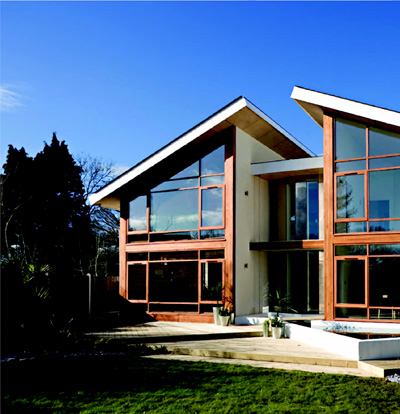
BRITAIN’S DEPUTY PRIME MINISTER, John Prescott, has put forth a plan to increase housing supply by 120,000 units every year for roughly the next decade. Determined to have the homes built as quickly and cost-effectively as possibly (spoken like a true builder), Prescott has advocated for builders to adopt “modern methods of construction,” or MMC for short.
Not surprisingly, builders haven’t been keen to have the government tell them how to build houses. However, the government’s English Partnerships program, keeper of the keys to vast tracts of government-owned brownfield land that is up for bid, will only accept bids that include at least 25 percent MMC houses.
To put the effort in an understandable framework, the Housing Corp. (a British agency that funds and regulates affordable housing) has defined MMC as these five categories of building techniques:
Builders are trying everything from panel construction to houses bolted together on site to factory-built pods trucked in and set by crane. The use of a SIPs system has cut the time to have a house on site and dried in from the British standard of 12 weeks to five. And a process to establish an on-site holding area where wall lengths can be connected and then craned into place could slash the five weeks to five days.
While SIPs are drawing attention, the British trade press says that the fastest-growing building technology in Britain is lightweight steel frames. To increase efficiencies, manufacturers are looking at field factories, using mobile presses to roll sections of steel on site, saving the cost of transporting truckloads of finished studs.
Factory-built housing has been warmly embraced in Britain as well. All of the country’s top 10 builders are looking at off-site methods, and some are investing heavily in their own facilities. The industry is growing at a rate of 30 percent a year, and more than 400 manufacturers operate in the off-site construction arena, according to the British trade magazine Construction News.
One of those is Barratt Homes, a major home builder that runs the Advance Housing factory with pre-engineering specialist Terrapin in Daventry. The factory uses a hybrid of steel-frame panels and prefabricated pods to build houses that are delivered to a site. Once on site, the houses are dried in within five days and are completed in six to eight weeks and look identical to the site-built homes that Barratt buyers have long known. At full speed, the factory can produce 10 houses a day.
Westbury Homes, one of the country’s largest home builders, began working more than a decade ago with Warwick University to transfer best practices from industrial manufacturing to construction. The result was a panelization system called Space4. The factory, located in Castle Bromwich in Birmingham, England, uses Web-enabled supply chain management to accomplish just-in-time production. Capable of producing more than 5,000 houses a year, the factory is the largest of its kind in Europe.
Another manufacturer, Corus Living Solutions, builds housing modules in 90 room sizes with a range of layouts, bath counts, and specifications. Six structural light steel frames are the basis of each module.
The concept of prefabrication has had a lot to overcome in the British mind-set. The last time the country faced a serious housing shortage in the 1950s, more than 15,000 prefabs were knocked together and set up throughout the country. They were short on quality and style, and only a few hundred of them are still standing.
But today, Lovell Homes is building what may be the largest prefab housing development ever in the U.K., Construction News reports. The development, called The Way, in Beswick near Manchester, features 550 townhouses and apartments using SIPs construction.
And as evidence of the willingness to try something new, Glasglow, Scotland, officials have announced that up to 100 flat-pack BoKlok (“Live Smart”) houses from Ikea will be built in an affordable housing community. While the houses are sold at Ikea to DIY types, specialty builders will assemble these houses, which are popular in Scandinavia for their open, flexible floor plans and large windows.