If middle-America gets the economic jumpstart President-elect Donald Trump promises would result from his designs to cut taxes, slash regulation, throttle the export of manufacturing and materials mining jobs to other countries, and start rebuilding worn-out roads, bridges, tunnels, and trains, it could reset bearings on where residential community developers and builders expect opportunity within a 24-month horizon. Smart money–among economists, investment advisors, and business observers– has started to stack up behind belief in a period of growth for at least the near future. Jury’s out on whether that initial surge of mojo is sustainable enough to repay what it’s going to cost to set it all in motion.
If prospects of tax reform, deregulation, and infrastructure stimulus play out with a strong hand in the early days of a new administration, jobs and income growth, household income increases and demand for housing could take shape on a trajectory somewhat accelerated from its prior agonizingly slow, incremental arc.
Conceivably, while new residential construction growth among America’s big public builders has been ever-more-tightly clustering into fewer, more robust geographies, a new, wider swath of the nation could begin to awaken to signs of recovery that more diversified, mostly coastal communities have been enjoying for more than four years now.
This potential stimulus-induced awakening, if it were to get traction and keep it, could introduce a whole geography of opportunity and challenge for home builders, from a land strategy, mergers and acquisitions, product development, and business modeling standpoint. Rust Belt metro areas and other heartland regions tend to be demographically older.
If jobs–good paying jobs–return to those areas that recovery has up-to-now neglected, then we could see migration patterns, long on the decline, inflect back to where more affordable housing options might set off a daisy-chain of virtuous economic cycles.
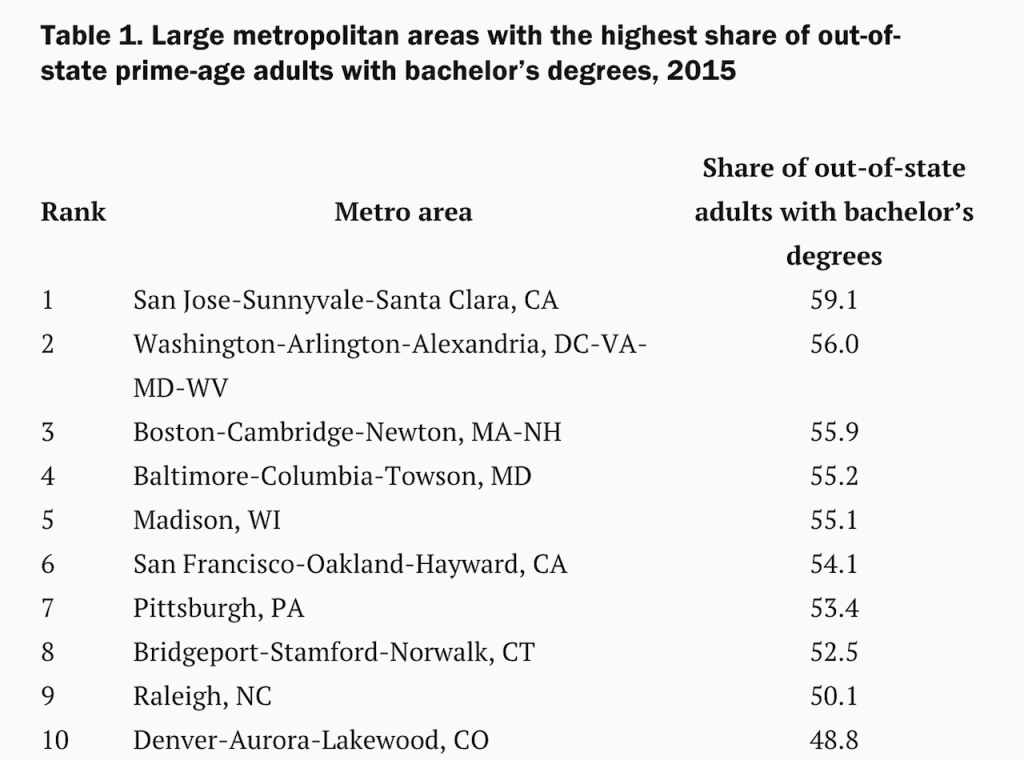
Have a look, though, at the inverse trend that has been playing out, sculpting a landscape based on the positive magnetic attraction of more-educated people to more-educated, higher-earning places.
This analysis, from Brookings Institution fellows Alan Berube and Natalie Holmes looks at patterns and possible scenarios around an important gravitational force playing out in American cities everywhere: the powerful driver that more educated people living in a locality exert on those thinking of moving from their current metro area.
This piece dissects the relationship between human capital and migration, starting with the notion that “the stock of human capital in a region depends not only on which individuals that place is able to attract, but also on its success in nurturing and retaining a highly educated ‘home-grown’ population.”
Cities and regions would be mistaken, the writers suggest, to invest heavily in marketing and messaging aimed to get young talented workers to move in to their environs without paying at least equal attention to and devoting resources to training and re-training locally grown talent. Berube and Holmes write:
It may be that in-migrants disproportionately create and fill new, higher-tech jobs and industries in these metro areas. At the same time, this trend could signal that relatively low rates of degree attainment among much larger local-grown populations are insufficient to power high-tech growth. Notably, Atlanta and Charleston—two urban centers of the “New South”—exhibit a similar pattern of above-average educational attainment among in-migrants, and below-average attainment among native residents of their respective states.
There are, Berube and Holmes assert, risks to becoming out-of-state talent magnets, among them bigger, faster economic disparities, and, secondly, over-reliance on a trend–mobility across state lines–that has been on the decline.
Net, net newly initiated economic stimulus programs will bring with them tough choices if they play out as designed, choices about how to channel resources, which will always be a source of constraint, even if they’re expanded.
Like it or not, a clarifying, high-priority challenge that election season and its outcome exposed is a need for retraining many, many people for jobs and livelihoods of the present and the future, vs. the past.
One way or another, we may soon see a counterpoint opportunity crop up in the near future–less than two years–as stimulus programs create job growth, retraining programs, and future viability in many flyover zone communities given up as non-starters for home builders and developers.