

Clearly, the housing market continues to struggle. By the end of 2006’s third quarter, new-home sale prices were nearly 10 percent lower than a year earlier; foreclosure rates were up 43 percent from 12 months earlier; and permits were down around 30 percent. While there is a lot of debate about how bad things will get, undeniably, the housing market is inherently cyclical. It’s one thing to know it, but being truly prepared for a downswing requires a different set of tools, thought processes, and actions.
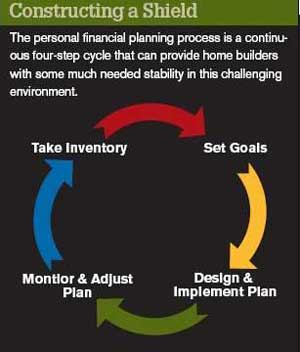
Step 1: Take Inventory
Other items needed to round out the inventory are estimates of expected income and expenses. This determines free cash flow. Builders often find that nearly all of their net worth and income derives from one source: their business. Outside investments are often real estate holdings, exposed to the same risk factors. It’s a classic case of “over-investment” of assets in just one segment.
Step 2: Set Goals
Determining investment goals and time frames for achieving them is the second step. But in order to get where you want to go, you have to decide where you want to go.
Ask anyone what he wants most from his financial life and the answer is usually independence. Financial independence is a result of accomplishing several smaller goals that, with effort, can be quantified. Typical goals include ensuring that family members are protected from economic distress in the event of your death, providing retirement income that will not require a “step-down” in your lifestyle, and planning for business succession.
Step 3: Design & Implement Plan
Creating and implementing a plan to achieve goals is step three, and it requires action. As Will Rogers said, “Even if you’re on the right track, you’ll get run over if you just sit there.” A clear and comprehensive plan for spending, investing, and saving should help ensure that your financial behavior aligns with your goals. For a builder, this often means moving assets out of the business and investing them in the financial markets in order to potentially provide stability and support in times when the building business is weak as well as growth that will deliver success in meeting long-term goals.
Step 4: Monitor & Adjust Plan
While no one can predict the future of the housing market, we do know that the current soft spot is typical and will likely be repeated at irregular intervals in the future. Builders have the ability, through the financial planning process, to make themselves less susceptible to such fluctuations. Planning requires forward thinking and, most of all, the discipline to follow through when the good times are rolling. However, the reward for such discipline is the hope of less volatility in any environment that few others in the industry will have.
–Zack Sadler is a financial advisor at Raymond James & Associates in Atlanta.