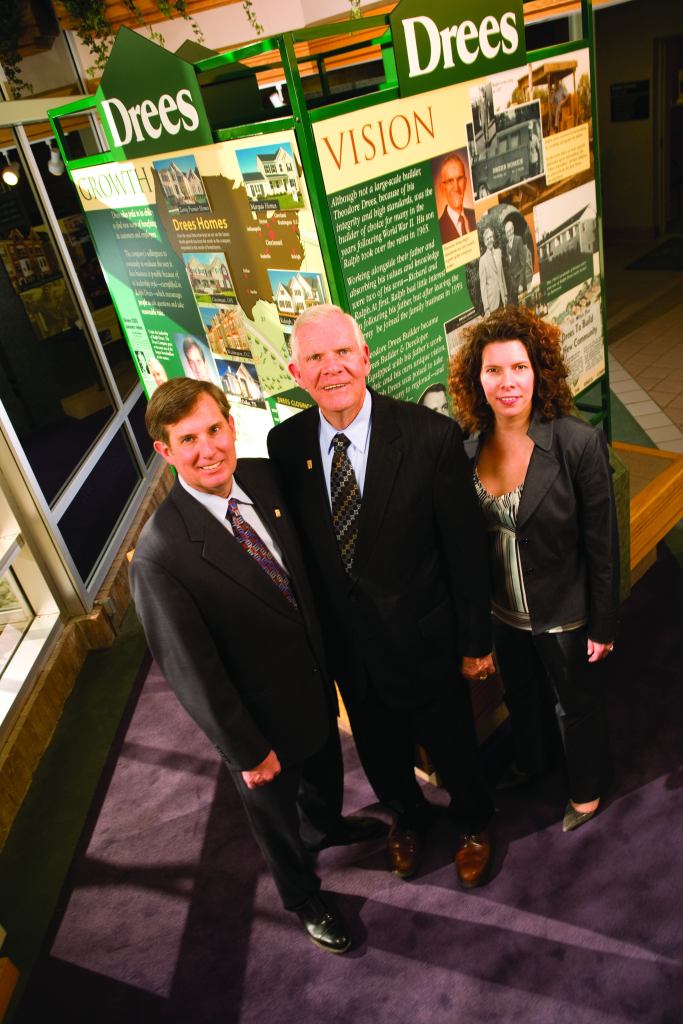
Drees Homes, Ft. Mitchell, KY.
3,031 Units
A Builder Evolving
With roots firmly planted, Drees adapts to a new market.
For a builder with such humble beginnings—late 1960s, Northern Kentucky, working out of an old trailer, his wife handling payroll, his father doing the books as a hobby, and his kids sweeping the floors on weekends—Ralph Drees’ company has evolved.
Named one of America’s Best Builders for the third time, Drees Homes now uses technology to drive business process improvement and financial stability.
Still, one thing Drees hopes never to see his company change into is a public one—especially in light of the current housing recession.
“There are a few companies in this country that have stayed private no matter how large they got, and that’s what I would hope for,” Drees says while visiting the office on a fall morning. Though he relinquished control of day-to-day operations to his son David in 2000, the role of chairman of the board and office morale booster keeps him around.
“Luckily, we’re not a public builder; we don’t have to show that we’re making more money this quarter than we did last quarter,” he says. “To be in that kind of whirlpool, that would take a lot of the fun out of it.”
And while many public builders posted huge losses and had to live with rumors of bankruptcy or buy-out, Drees posted profits of over 10 percent in 2006 and almost 5 percent in 2007, and saw solid closings numbers both years. And the company wasn’t forced by Wall Street into shuttering large numbers of divisions, massive land sales, or giant financial losses.
For 2008, David has a three-pronged plan: Invest in sales and marketing, sell and build homes for less, and reduce land holdings and speculative inventory. The end goal is to reduce debt and get out from under carrying costs, David says.
“That’s what we’ve been communicating to our managers and our employees what the company is doing to put ourselves in a position to win when things come back,” he says.
Process Improvements
Perhaps the most impressive aspect of Drees’ operation is how a company with such veteran leadership understands the need to change and adapt and is using technology to drive process improvements, both for corporate managers of its many divisions and also field personnel. This is a company that takes how it does things seriously.
Drees developed a program and designed software specifically to manage its field purchase orders, says Larry Herbst, vice president, secretary, and treasurer, and also the individual who started Drees’ information systems and helped develop many of its software systems.
“We were getting field purchase orders from subs, and we’d have like 45 of these a house,” Herbst says. “And nobody was analyzing these. Was this an estimating error? Why are we getting billed extra for this?”
But now the company can pinpoint the problem, save supplies, and keep its costs down. As a result, Drees sees lower costs and variances, fewer purchase orders, and supplies in the field are being used more efficiently.
Another successful Drees process, put in place 20 years ago and often called evenflow building, is building by predictability and scheduling, says executive vice president of operations and CFO Mark Williams. The idea, Williams says, is that subcontractors will never have to sit around on a jobsite and will want to work with Drees.
“They will not show up to discover that the site is not ready, that the material isn’t there,” he says. “They can depend on us being on schedule, thus increasing their efficiencies and ultimately improving our pricing.”
That philosophy extends to slotting starts and land purchases as well and allowed the company to get out ahead of itself on land acquisition during the waning stages of the boom and into the downturn, Williams says. But Drees is actively working to move its land and has already sold some; and its position as a privately held company will allow it to do so without taking the public beating that many big national companies have.
Cost-Reduction Strategy
Drees has tackled value-engineering as well by drawing on relationships with its trade partners. Drees involves its trade partners along with its in-house architects in helping the company value-engineer its product and includes all parties on walk-throughs of a prototype of each new design.
“They will help identify where things can be changed to become more efficient and cause less problems,” Williams says. “Looking at the drawings is great, but seeing the drawings [come to life] improves the likelihood of detecting short-comings.”
Drees is not afraid to use technology to learn how to be more efficient. A software system from J.D. Edwards enables the company to view financial reports on a given home design, historically for a division, a city, or multiple cities.
Seeing that data clued Drees in to other inefficiencies. Why do identical faucets cost different amounts in different markets?
That insight led the company to seek national contracts, and already it is buying plumbing fixtures and putting them on site for plumbers to install, instead of allowing the plumbers to supply the fixtures.
More national contracts are coming for Drees, and more cost savings with them. The man in charge of cost reduction at Drees, David Metz, vice president of national purchasing and operations, is visiting all of Drees’ locations, identifying best practices, and implementing them where possible. Metz is also seeking national contracts to get better cost efficiencies.
And on top of all those improvements, Drees is spending more on sales and marketing than ever before. The company added a national sales director and a market research director under vice president of marketing Barbara Drees-Jones, David’s sister. Some new initiatives involve Internet marketing and working with outside advertising agencies to bring a fresh perspective in wooing customers.
One thing is certain with Drees, it never stands still and is never satisfied with the way things are. Operations at Drees are constantly under review and always improving.
“It’s an incredible transformation over almost 40 years,” says Jack Herbstreit, vice president of production.
Learn more about markets featured in this article: Cincinnati, OH, Naples, FL.