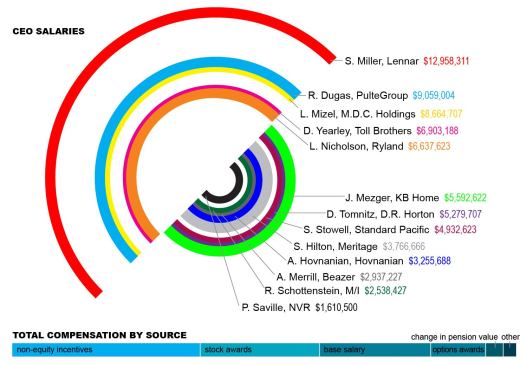
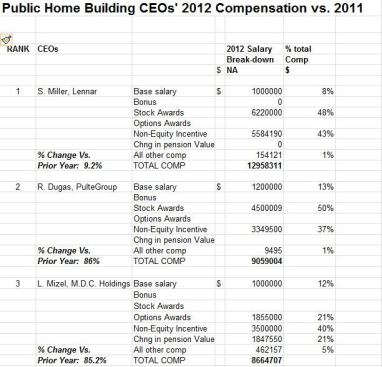
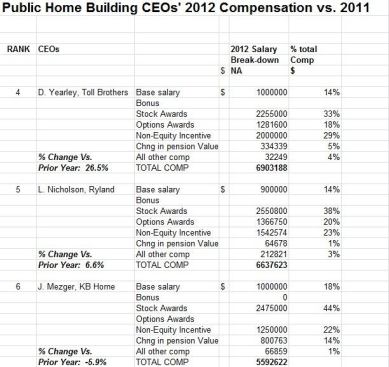
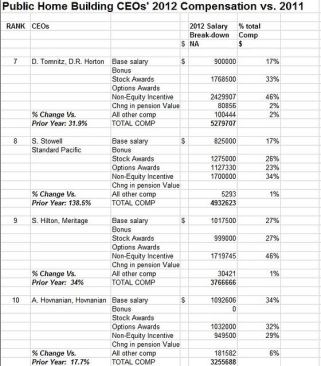
Thirteen public home building enterprise chief executives, their respective boards of directors, and a growing host of outside compensation experts agreed during the past year to raise the collective ante for the ceo cohort by $18.7 million (just shy of 34%) for 2012, based on an amalgam of performance and baseline factors considered fair and balanced. Here, BIG BUILDER takes its annual look at the CEO pay packages in the light of several new challenges, both regulatory and operational, by which named executive officer compensation will be measured in the sooner-than-later term future.
Barclays home building equities analyst Stephen Kim did an extensive study of executive management compensation among public companies over the past six years and highlights the following big take-aways:
- Homebuilders used industry-appropriate incentive metrics given 2007-2012’s challenging industry environment.
- Pre-tax income, adjusted EBITDA, revenue, working capital efficiency (usually SG&A ratio), and customer satisfaction survey results were most commonly used.
- Unlike other industries, FCF and EPS were not commonly used.
- Executive compensation has little correlation with absolute stock performance. However, CEO compensation is correlated to certain cycle-dependent metrics such as % change in EPS.
- Industry compensation has declined from 2007 to 2012.
- Salaries and stock awards have increased as a % of total compensation, while the use of option awards has declined.
- Surprisingly, there is little correlation between CEO compensation and market cap.
Clearly, the Dodd-Frank era heralds new levels of both transparency and structure for named officer compensation. As publicly traded company titans ascend to cultural and societal rock-star status, scrutiny, activist and labor union opposition, and citizen-journalism coverage of the cohort will intensify. Some go so far as to suggest term limits for public company ceos as a means of reining in natural tendencies toward self-interest, short-sightedness, risky behavior, and, sadly, burn-out.
Here, we’ll set up a thread, hopefully involving offered insight from trusted critics, commentators, and community observers, on what should go into a public home building company’s named officer compensation and why.
We believe that transformational times in the landscape of home building, residential real estate, technology-driven manufacturing, household formation, and job formation require skill-sets that reframe strategy, talent casting, leadership, decision chains, investment of resources, and tough choices.
Here’s a look at the 2012 vs. 2011 CEO Compensation packages, and how they’re divvied up by baseline measures and performance pay.