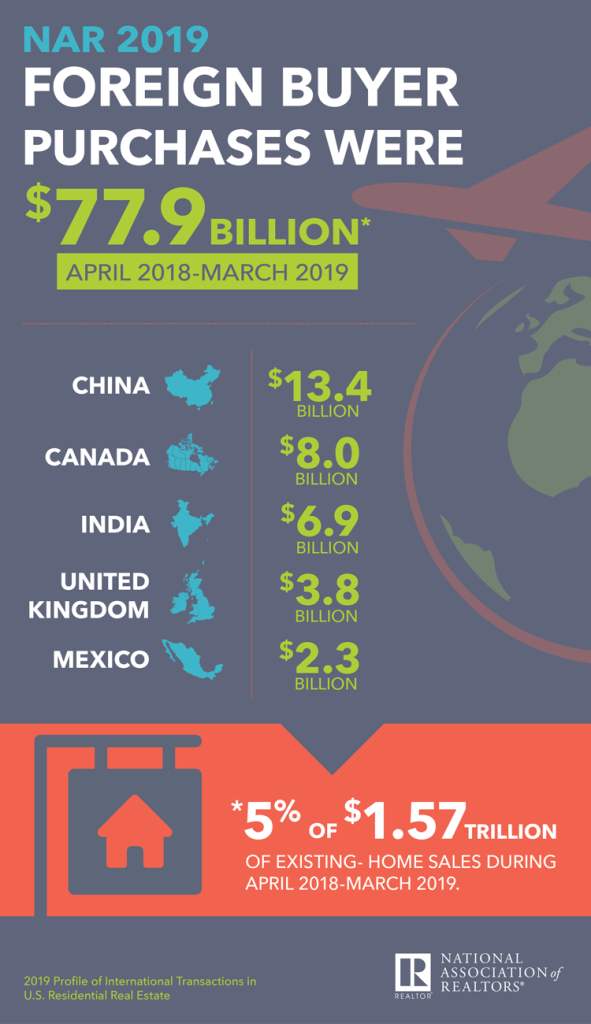
A decline in global growth and low housing inventory contributed to a steep drop in foreign investment in U.S. residential real estate over the past year, the National Association of Realtors reported Wednesday.
NAR’s Profile of International Transactions in U.S. Residential Real Estate 2019, released Wednesday, revealed that foreign buyers purchased $77.9 billion worth of U.S. existing homes from the 2019 survey reference period, a 36% decline from the level reached in the previous 12 months ($121 billion). Non-resident foreign buyers accounted for $33.2 billion of U.S. existing-home sales, a 37% decline from the prior level of $53 billion. Resident foreign buyers – that is, recent immigrants – purchased $44.7 billion of residential property, a 34% drop from the prior level ($67.9 billion).
Dollar volume saw a decline as the number of purchases, as well as the average price, decreased from the previous year. Foreign buyers were able to buy 183,100 properties (266,800 in the previous period) at an average price of $426,100.
“A confluence of many factors – slower economic growth abroad, tighter capital controls in China, a stronger U.S. dollar and a low inventory of homes for sale – contributed to the pullback of foreign buyers,” said Lawrence Yun, NAR chief economist. “However, the magnitude of the decline is quite striking, implying less confidence in owning a property in the U.S.”
For the seventh consecutive year, China exceeded all other countries in terms of dollar volume of purchases, buying an estimated $13.4 billion worth of residential property, a 56% decline from the previous 12 months. The Chinese economy is growing at a slower pace compared to past years, slowing to 6.3% in 2019 compared to 6.9% in 2017. The Chinese government has also tightened the monitoring of dollar outflows since 2016 to manage its foreign exchange reserves.
Following China, the next top foreign buyer for 2019 was Canada at $8.0 billion. While Chinese investors and Canadian investors tied concerning the number of purchases, on average, Chinese buyers bought properties at a higher price point. Therefore, China ranked ahead of Canada in terms of dollar volume. The third top international buyer was India at $6.9 billion, the United Kingdom was fourth at $3.8 billion and in fifth was Mexico at $2.3 billion. Each of the top five buyers experienced a decline in the dollar volume of purchases.
Following historical trends, Florida was at epicenter of foreign investment. The state attracted 20% of foreign buyers. 42% of Canadians purchased property in Florida.
“Many Canadians and other foreigners found Florida so enticing because of its lenient tax laws,” said Yun. “Additionally, many Florida metro areas have an inventory of cheaper properties, relatively speaking – a combination which makes the state a very popular destination.”
California followed Florida, accounting for 12% of international purchases. 34% of Chinese buyers purchased property in California, which represents a decline from one year ago. The third most popular destination among international buyers was Texas (10%), particularly desirable among Indian and Mexican buyers. Arizona accounted for 5% of international buyers, popular for Canadian and Mexican purchasers, followed by New Jersey (4%). New Jersey appealed to a mix of international buyers, especially those from the United Kingdom. A few other significant destinations were North Carolina, Illinois, New York and Georgia. Each of these states accounted for 3% of all foreign buyers.
44% of foreign buyers purchased in a suburban area, while 76% purchased single detached family homes and townhomes. The median purchase price for foreign buyers was $280,600, slightly higher than the $259,600 average for all U.S. existing homes sold. According to Yun, the price difference is a reflection of the choice of location and the kinds of properties desired by foreign buyers. 8% of international buyers paid $1 million or more for their property, compared to just 3% of all U.S. existing homebuyers.
Resident foreign buyers – those living in the United States either as recent immigrants or those holding visas for professional, educational or other purposes – typically purchased properties at a slightly higher price point ($282,500) compared to non-resident foreign purchasers ($277,700).
The survey also showed that international buyers are more likely to purchase their homes in cash than all existing home buyers. 41% of the reported transactions were all-cash sales, in comparison to 21% for all existing-home purchases during the 2019 assessment reference period.
Non-resident foreign buyers are more likely to pay in cash than resident foreign buyers, who are more likely to acquire mortgage financing from U.S. sources. 63% of non-resident foreign buyers had an all-cash purchase transaction, compared to 25% among resident foreign buyers. Canadian buyers, who primarily live abroad, were the most likely to pay all cash (75%). The majority of Asian Indian buyers, most of whom resided in the U.S. as recent immigrants or visa holders, obtained a U.S. mortgage. Almost half of Chinese buyers made an all-cash purchase.
NAR’s 2019 Profile of International Transactions in U.S. Residential Real Estate was conducted April 5 through May 3, 2019. A sample of Realtors® was surveyed to measure the share of U.S. residential real estate sales to international clients, and to provide a profile of the origin, destination and buying preferences of international clients, as well as the challenges and opportunities faced by Realtors® in serving foreign clients. The survey presents information about transactions with international clients during the 12-month period between April 2018 and March 2019. A total of 11,812 Realtors® responded to the 2019 survey.