
Even as interest rates rise and affordability conditions tighten, a lack of for-sale, single-family inventory remains the defining characteristic of most of the nation’s housing markets. It is this lack of inventory that continues to cause home prices to rise faster than income growth. The solution, from both market and policy perspectives, is to add additional housing supply via new-home construction. That is easier said than done given rising costs and pressures to acquire and develop land, purchase building materials, contract with workers and subcontractors, and comply with government regulatory requirements.
These market challenges are not new. In fact, over the past two decades there has been a dramatic shift in sales for both the total count and market share of newly built single-family homes at lower price tiers.
For example, in 2002 (a good year to establish baseline conditions in a relatively normal market), there were 782,000 new homes sold priced at $300,000 or lower. This is a striking total given NAHB’s 2018 forecast for total single-family starts (at all price points) is just over 900,000. For the past four quarters (ending with the first quarter of 2018), there were only 268,000 single–family homes sold at a price equal to or less than $300,000.
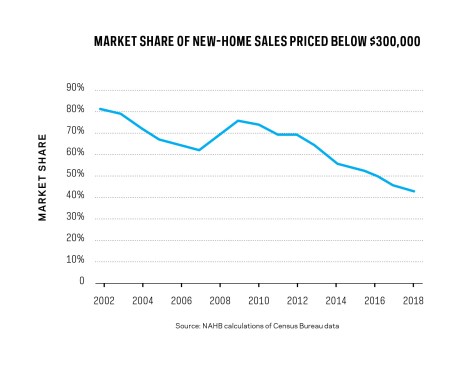
What about market share given that the overall market is smaller? The share itself has declined as well. At the start of 2002, 81% of new-home sales were priced in the below-$300,000 range. Compare that percentage to recent data. For the start of 2018, this market share was just 43%.
Without a doubt, the inability to supply homes at lower price for the entry-level market represents a significant headwind for prospective home buyers. While in recent decades it has not been the case that new construction was a major source of first-time buyer inventory, the shift away from starter homes will nonetheless limit the ability of today’s renters to become homeowners.
Historically, about 30% of new construction was purchased by first-time buyers, while today that share is roughly 20%.
However, it is wrong to blame the market for this distribution of development. Rising costs—exacerbated by deliberate and inefficient policy choices—have increased the cost of land development and home building, with the natural consequence being fewer entry-level homes built. Communities that can break this cycle by enabling higher density, single-family development will in turn offer affordable housing conditions for younger workers, thus fostering long-term economic growth. This is the reason why on-the-ground advocacy by the industry through local and state home builder associations is key to future growth.