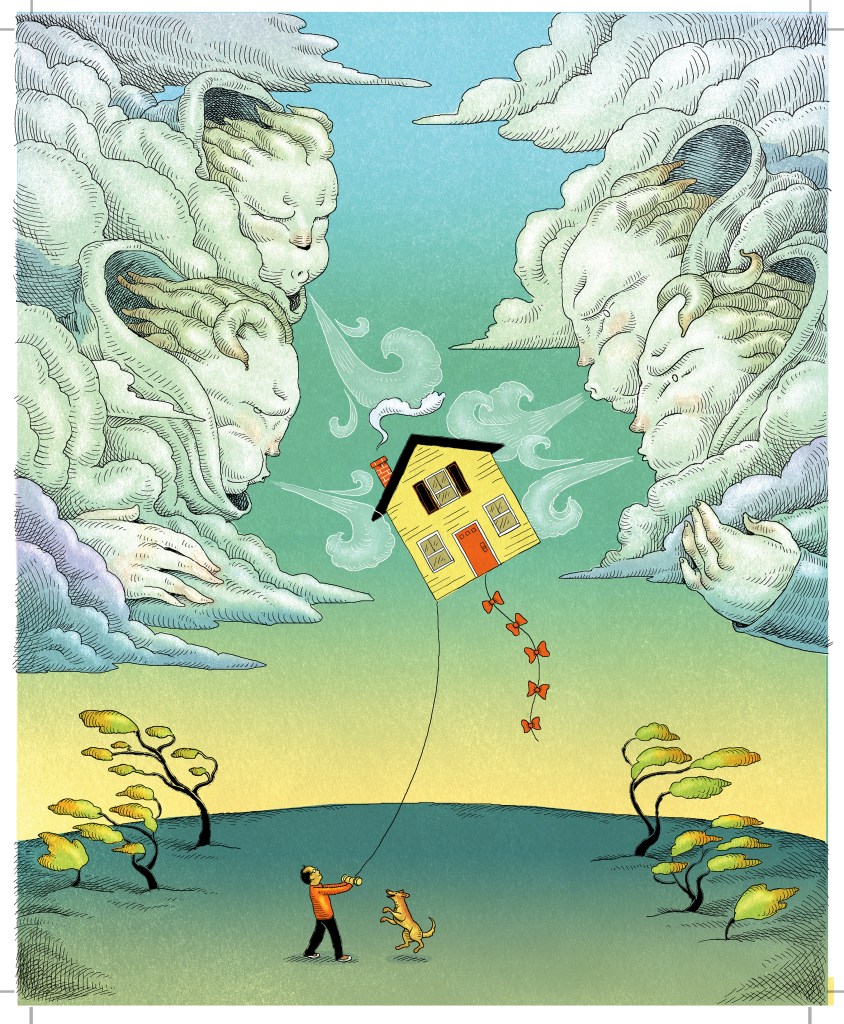
Certainty is a firm conviction something is the case.
To speak to certainty’s qualities, we use terms like sureness, confidence, and the absence of doubt. For housing and its disproportionately important subsystem of home builders—especially since the Great Recession—not much is, has been, or ever will be a sure thing, nor do its more experienced denizens put a heck of a lot of stock in expectations that things will go reliably one way or another.
In other words, home builders—and the ecosystem of land sellers and developers, investors, lenders, trade partners, manufacturing and materials suppliers, real estate agents, and others connected to home builders—live with the opposite of certainty very nearly always.
A thousand and one reasons may favor a new-home sale and settlement at any instant, but only a single reason needs to be enough to clinch the deal. Too, while many forces may conspire against a completion and closing of that very same deal, one showstopper is all it takes to derail it. Fact is, real estate may be one of the few “sure bets” people constantly lose money on, largely
because of two wildly mercurial stars that must align to win: timing and location. Still, shrewd judgment on the right deal in the right place at the right moment merely reflects outwardly an inner system of three essential skill sets home builders must do exceedingly well—in addition to actually building houses.
Buying: Builders buy real estate, labor, building materials and products, and myriad services that complement their management of construction projects and programs.
Selling: Builders sell homes, neighborhoods, the value of customer experience, the dream of homeownership, and the preference of new homeownership to consumers. Builders also sell their track record of reliability to lenders, their reputations to developers, and their credibility to municipal officials essential to green-lighting new local development.
Finance: Builders work with capital flow in and out—whether it’s other people’s money or their own—to finance projects, operational costs, new land, mergers, and acquisitions. Income needs to exceed outgo for a going concern to thrive tomorrow and the day after that.
All in, when builders do what they do best, they excel at mitigating cost risk and expanding revenue opportunity in the present, and sustaining profit-making use of capital for the future. Now, to try for a 40,000-foot view of what’s
going to work differently for housing in an era—post-inauguration of America’s 45th president, Donald Trump—where current federal policy and law around taxation, finance, health, defense, infrastructure, commerce, education, housing, immigration, and any number of other societal pillars may all be up for grabs leads to one critical vanishing point question.
What is the causation or correlation—if there is any—between federal policy and those whose business models and livelihoods depend on new single-family, for-sale residential construction? The reason the question matters is the still-lingering thought that if the election had had the other result, structural federal policy around all of those societal pillars would essentially have stayed intact.
At the same time, real estate and home building is ever dynamic, so one assumes that if there were fundamental continuity in policy—rather than the promised discontinuity—we would have been looking at essentially uninterrupted trajectories, outlooks, predictions, and projections in areas such as job growth, household formations, family formations, interest rates, AD&C lending, mortgage availability, house prices, existing-home sales, construction labor capacity, new-home sales, and new community openings.
Despite the path of policy continuity that a Hillary Clinton administration might have pursued, a fair amount of uncertainty nevertheless lurked in the wings around the likely increase of interest rates, incipient inflation forces, ongoing questions on the worldwide fossil fuel–based energy glut and its domestic impact, and, maybe most important, the overall stamina of an economic recovery some would claim to be “long in the tooth” despite its rather anemic showing since 2009 or so, when the Great Recession officially ended.
This notion, then, of uncertain certainty is this: During his candidacy and prior to his official standing in the office of the presidency, Donald Trump emphatically promised that virtually no assumption on policy and government at the federal level will go untested. He vowed that economics, defense, and social policy is on the table, and—in a sense—every application and deployment of Uncle Sam’s investment of resources will need to “reapply” for a new job in a newly retooled, right-sized government complex.
With these promises, Trump introduced an uncertainty of both a new magnitude and composition—one that he intends to transform into his “make America great again” legacy. For home builders plying their trade during the next four years, what the president says, what the president does, and what implications the president’s actions have on macroeconomic trends and housing economy trends tread a narrow path between opportunity and risk, between tailwind and headwind, and between a wished-for and reality-checked future.
Clarity on this came the moment election results clocked in. In two separate gatherings in New York City that week, senior executive–level home building, investment, and real estate players were digesting the election results in real time. To a person, each admitted to not knowing what to make of an outcome that compelled almost all to suspend disbelief in what just happened.
At the very moment of the Trump election triumph and the Republican party romp across a broad swath of America’s electorate, a kind of total eclipse swept across the faintly lit ecosystem of new residential investment, construction, design, and development, sewn as it is of a complexly knit weave of localism, industry practice, domestic taxation and regulation, immigrant labor, and global capital flow.
Assumptions? All out the window.
“It was eerie,” one of the NYC conference attendees told BUILDER. “Even some of the more aggressive deal-makers were saying, ‘Let’s take this deal off the table for the time being and see what happens.’” Business as usual checked up. Big investments and strategists shifted into wait-and-see mode.
Assumptions reset. One housing executive expressed the moment this way: “Trump has said many things that could be taken as scary, as threatening to the people we’ve aimed to serve and the resources we’ve been using to serve them, as challenging to our basic assumptions about those resources,” she says. “Maybe, though, we’re not shooting high enough. Maybe under this new administration we need to recalibrate what we ask policy to do, and redouble our demands rather than to accept the minor incremental increase we might have expected under a Clinton government.”
Change won. That’s saying something important to us in the home building and development business community. People want change. The call is for greater strength and the pride that stems from being and growing stronger. What that means in terms of change—from what, and into what?—can take a lot of different forms, cost different amounts, and yield different results. What Inauguration Day could mean, however, is that perhaps it’s time to pencil in new assumptions from scratch, rather than to port all of them from the past into a scenario under a new administrative regime.
What the winning party and its leader have succeeded in doing is to mobilize heartland support around a narrative of renewed hope, and the flexing of muscle, in answering four questions that mean everything to what comes next for housing:
Is my job (or career prospects) safe?
Is my ability to make enough money to live
decently safe?
Is my family safe?
Is my home safe?
The power of the story in those four questions is what anybody who’s trying to sell anyone anything of value needs to keep top of mind. If answers to them begin to turn a flicker of hope into anything close to reality, other
assumptions about how construction works and what it needs in terms of labor capacity can begin to look very different than they do today.
For now, admitting uncertainty and being open-minded to hopefulness, we see five essential, immediate, and profound takeaways from the momentous goings on, no matter who occupies the Oval Office.
1) Believers that demographics is destiny need to check their belief system. Conventional wisdom suggested that demographic shifts would surely cause a political outcome that didn’t happen. The same missteps can occur if you count on demographics to make or break a housing demand curve, be it millennials, baby boomers, or anybody else. Demographics may one day be destiny, but not without a lot of zig-zags and hairpin turns along the way.
2) What some call fringe may actually be core. Unmet need—the working-class worker—is where a powerful force rose up to demand change. To some, whether it’s in single-family, multifamily, or workforce housing, the opportunity to respond to this heretofore “silent” force is game-changing.
3) Data models are broken. Data is valid if two things happen. One, it needs to measure the universe of people it aims to measure (not impaired by nonresponse bias, nor head-fake responses), and two, it needs to interpret only the data it has reliably harvested correctly. This goes for real estate advisers, as it does for political pundits.
4) There’s no such thing as unfixable. What has long been doesn’t need to continue to be. Chronic, deep-set inefficiencies and practices—even in construction—may be susceptible to a new look, a fresh take, and a solutions-oriented approach to fixing what many assume is unfixable.
5) Mistrust is not the answer. Polarizing got us to where things had become unmanageable, in business, society, culture, and politics. Answers to those questions about safety above—if they’re going to begin to change from “of course not,” to “yes, with some time and collective focus”—will only change if people in home building begin to close the us vs. them gap.
Of these takeaways we can be certain, despite the uncertainty.