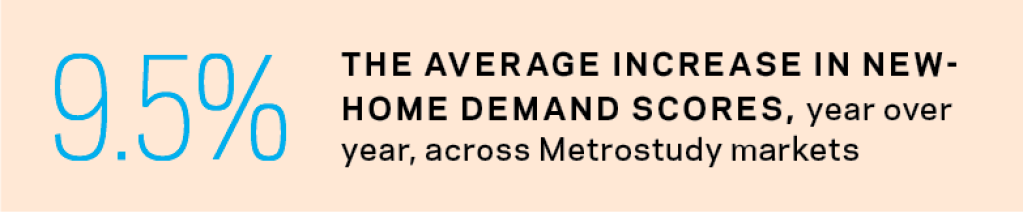
Our monthly Metrostudy–BUILDER Demand Index gauges consumer demand for new homes, and builder demand for new lots in 32 major markets across the country. In June, the average demand for new homes across all markets was 7.18 on our 10-point scale, a 0.54% increase month-over-month, but nearly 10% higher compared to a year prior. As seen in previous months, regional directors in Seattle, Denver, Dallas-Fort Worth, and the Bay Area continue to report strong demand for new homes, and low supply of building lots.
The most recent release (April 2016) of the S&P/Case-Shiller 20-City Composite Index, which benchmarks the value of existing housing stock over the past 12 months in 20 major markets, complements commentary from Metrostudy regional directors—despite the clear difference between new and existing housing stock. Gains in the 20-City Composite Index continued in April, rebounding to winter 2007 levels.
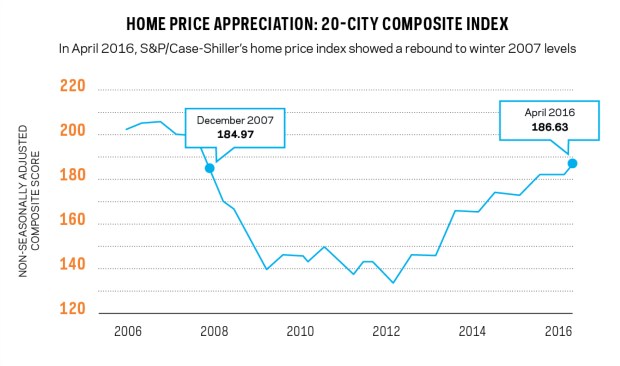
Ongoing growth in the value of existing homes is largely due to low mortgage and unemployment rates, but the tight supply of existing housing available in housing’s leading markets plays a bigger role. Dallas, Denver, San Francisco, and Seattle are setting new highs in 2016, for both existing homes and new homes. According to John Covert, regional director for Metrostudy in Denver, “both figures are expected to move higher, as inventory remains incredibly thin on both fronts, fueled by strong demand for housing.”

Price appreciation is not equating to higher margins for builders in markets like the Bay Area, Dallas, Los Angeles, and Tampa, where some builders are reporting that construction costs are rising as fast as home prices. According to Tampa regional director Tony Polito, the Florida area has hit an “affordability ceiling,” and the growth in new-home price growth is primarily due to land prices. Builders in Dallas appear to be in more dire straights, however, as they are reporting “all cost increases: land development and construction, [which is] being passed through to the buyer in the form of higher prices.”