There’s a lot of talk about income disparity in the United States. The total income of the top 10% of those who earn money is nine times as much as the bottom 90%. And the top 1% earn on average 38 times more than the bottom 90%.
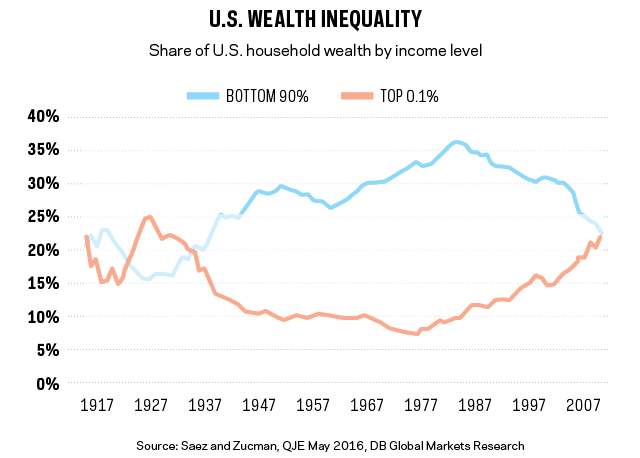
There’s less talk about wealth disparity, but as the chart below shows, it’s just as extreme. The richest U.S. households (the top one-tenth of 1%) have as much combined wealth as the bottom 90%. I played with the numbers and came up with this: There are 125 million households in the U.S. That means the 125,000 richest households control as much wealth as the 113 million households in the bottom 90%. Wow. Or maybe ouch.
I then thought about other points in history where there were such disparities between the haves and the have nots. France in 1789 came to mind. As peasants protested against widespread hunger, Queen Marie Antoinette famously (or supposedly) said, “Let them eat cake.” The peasants chose instead to revolt and cut off the heads of the king and the queen. The ensuing political turmoil persisted for almost another 100 years, and even then the glory that was France was much diminished.
In the 19th century, the Industrial Revolution in England created wealth for a relative few, as well as millions of paupers. The divide between rich and poor engendered low-grade class warfare that weakened the country and didn’t end until the creation of an English welfare state after World War II. Still, England no longer rules the sea and controls an empire.
Which brings us to the 20th century, when in Russia the poor masses, not long removed from feudal serfdom, rose up and assassinated Tsar Nicholas and his family. Until a generation ago—and this is true—millions of Russians still didn’t have hot running water and today, nobody really wants to drive a Russian car.
And here we are now, the 21st century. In the U.S., the outcome of the latest presidential election seems to have been influenced by frustration over income and wealth disparity. This is the U.S., so her defeat did not cost Hillary Clinton her head. And, while there are protests against President-elect Donald Trump, Trump Tower is not under siege and Trump can still, unescorted by Secret Service, walk into his favorite New York restaurant and order a burger.
Most political analysts seem to think Trump won by capturing the hearts and minds of voters who feel they’ve been left behind or excluded from either the economic recovery or the shift to an economy controlled by technology and white collar plutocrats. Trump promised to create jobs and increase the earning power of the country’s not-so-rich 90% by reducing government regulations, lowering taxes, improving public infrastructure, controlling immigration, and jawboning American companies to keep manufacturing plants in the U.S.
Like him or not, those in the housing industry should wish Trump success because both the American promise of all people having at least decent shelter and the American dream of owning a home really depend on more than one-tenth of 1% of 125 million households living almost like kings and queens.