
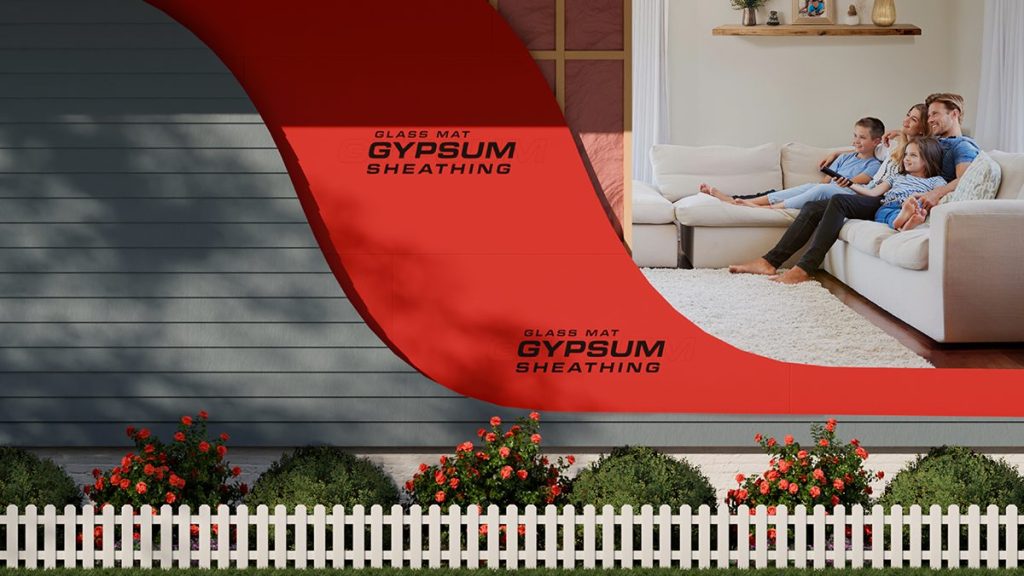
Glass mat gypsum sheathing is becoming a trusted solution for exterior wall assemblies in residential construction. Developed in the 1980s, this specialized gypsum panel is designed for installation on the exterior face of wood or steel framing members, serving as a reliable substrate for a wide variety of cladding systems.
According to ASTM C1177, Standard Specification for Glass Mat Gypsum Substrate, glass mat gypsum sheathing provides a consistent level of product quality and performance. The standard, which is referenced in both the International Building Code (IBC) and the International Residential Code (IRC), assures builders that the material is manufactured to stringent requirements.
Why Builders Choose Glass Mat Gypsum Sheathing
Much like standard gypsum board, which has been a staple in residential construction for more than a century, glass mat gypsum sheathing is based, as the name implies, on gypsum. This is a mineral that is safe, abundant, and naturally fire resistant. Glass mat gypsum sheathing combines these inherent benefits with enhanced performance for exterior applications.
Glass mat gypsum sheathing is less susceptible to water thanks to its fiberglass mat facers and enhanced moisture-resistant core. Even when exposed to moisture, it will not swell or warp like other materials. Beyond its superior fire, mold, and moisture resistance, it is also unappealing to pests.
With these qualities, it is easy to see why the medium is relied on by builders who want durable, cost-effective, and widely available sheathing across North America.
Installation and Application
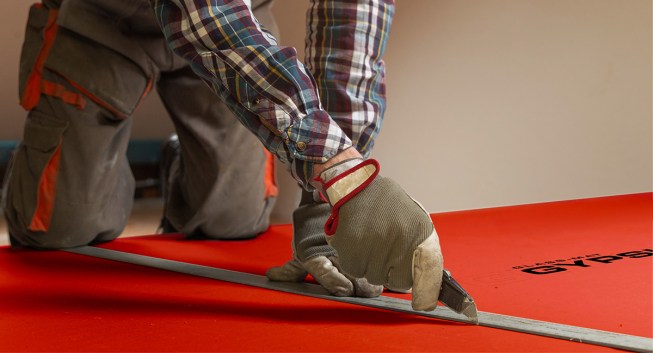
Contractors who work with interior gypsum panels will find familiar the installation process for glass mat gypsum sheathing. The product is applied in accordance with ASTM C1280, Standard Specification for Application of Exterior Gypsum Panel Products for Use as Sheathing, or GA-253, Application of Gypsum Sheathing. In fire-rated systems, installation must comply with the assembly details shown in GA-600 Fire Resistance and Sound Control Design Manual.
Because these panels are dimensionally stable, panel edges and ends do not need to be gapped. Fastening is straightforward with screws or nails, just as in other sheathing systems. Depending on the cladding system, joints may be left untreated or sealed with mastics. Barrier system products can also be used as specified by the manufacturer.
Glass mat gypsum sheathing provides a continuous surface that works well with adhesive-attached systems, such as Exterior Insulation and Finish Systems (EIFS). Fastener-attached claddings can also be used, provided the fasteners penetrate framing members.
In residential applications, exterior wall systems must insulate the home, maintain structural integrity, and protect against Mother Nature. When used as part of the building envelope, glass mat gypsum sheathing contributes by allowing for stud cavities to be insulated or serving as a substrate for rigid insulation. The material can also keep moisture out, provide a lateral force-resistant element in structural applications, and create a wind-resistant barrier.
Structural and Code Considerations
The IRC recognizes gypsum sheathing as a bracing element in Braced Wall Panels (BWPs), which form Braced Wall Lines (BWLs) that resist wind and seismic forces. Method GB of the IRC allows gypsum panels to serve as the bracing element on the exterior face of BWLs if gypsum panels are also applied to the interior.
The code specifies requirements for panel width, placement, fastening, and joint treatment. For example, minimum ½-inch-thick gypsum panels must be installed on one or both faces of BWPs. Standard manufactured sizes of the interior gypsum panels must be installed on one or both faces of BWPs. Standard manufactured sizes of interior gypsum board and glass mat gypsum sheathing meet these requirements, making them readily compatible with IRC provisions.
Beyond standard residential use, glass mat gypsum sheathing has relevance in areas where wildfires are a concern. The International Wildland-Urban Interface Code (IWUIC) permits its use in exterior wall construction because the panels comply with its Chapter 5 requirements.
In locales that require fully rated exterior walls, fire-resistive designs are available in the GA-600 Fire Resistance and Sound Control Design Manual.
Specification
Glass mat gypsum sheathing provides builders and designers with a high-performance exterior substrate that is code-recognized, structurally reliable, and well-suited to a variety of claddings. With attributes that enhance durability, resist moisture, and contribute to fire and wind safety, it is a practical choice for modern residential applications.