Summer is here—and so is the heat. To stay cool, you’ll have to know how to choose a quality air conditioner.
For decades, the comfort and convenience offered by air conditioners have provided a much-needed respite for us when the heat and humidity of the outdoors becomes too much to bear. Who hasn’t spent any amount of time under the sweltering summer sun—whether gathering with friends for a backyard barbecue, or mowing the lawn, or simply out and about—only to finally retreat into the confines of an air-conditioned home and experience that blissful feeling of cool, crisp, dry air? The feeling of relief is beyond sublime.
But before you can experience the benefits of an air conditioner, you want to know which one is right for you and your needs. Here, Appliances Connection is offering a quick primer on how to best keep cool in the coming months.
ENERGY AND EFFECT
A standard measurement for heat is the BTU [British Thermal Unit]. Knowing the correct level of BTUs needed to properly cool and condition the intended room or indoor space will help you choose an AC unit that operate efficiently and cost-effectively. The list will help you work out the correct BTU needed for your square footage.BTU ROOM SIZE (sq. ft.) 5,000 100-150 6,000 150-250 8,000 250-350 10,000 350-450 12,000 450-550 15,000 550-700 18,000 700-1,000 22,000 1,000-1,400 24,000 1,400-1,500
Air conditioners are consistently used for extended periods of time, working for hours, even days on end. That much usage can really rack up on your utilities. So, you may want to consider purchasing an Energy Star Certified air conditioner which is at least 10% more efficient than minimum government standards. It’s not just environmentally sound, it’s also considerably kinder to your electric bill. Also keep in mind that there are multiple types of electrical plug used for air conditioners. Make sure you have the proper outlets and wiring to handle the larger energy demand required by some AC units.
TYPES OF AIR CONDITIONERS
Air conditioners come in a large range of styles, sizes, and BTU levels to fit even the most unique space and installation requirements. But you’ll most likely find the AC unit you’re looking among the following configurations:
- WINDOW – These units are the easiest to install and some of the most common in the country. They typically rest on the bottom of the windowsill, with flexible side panels to close off the rest of the window opening and insulating materials for added efficiency. This allows for more options as regards to placement as well as quick removal and storage when not in use. With window units installed in apartments, a set of exterior support brackets to hold up the unit may be required.
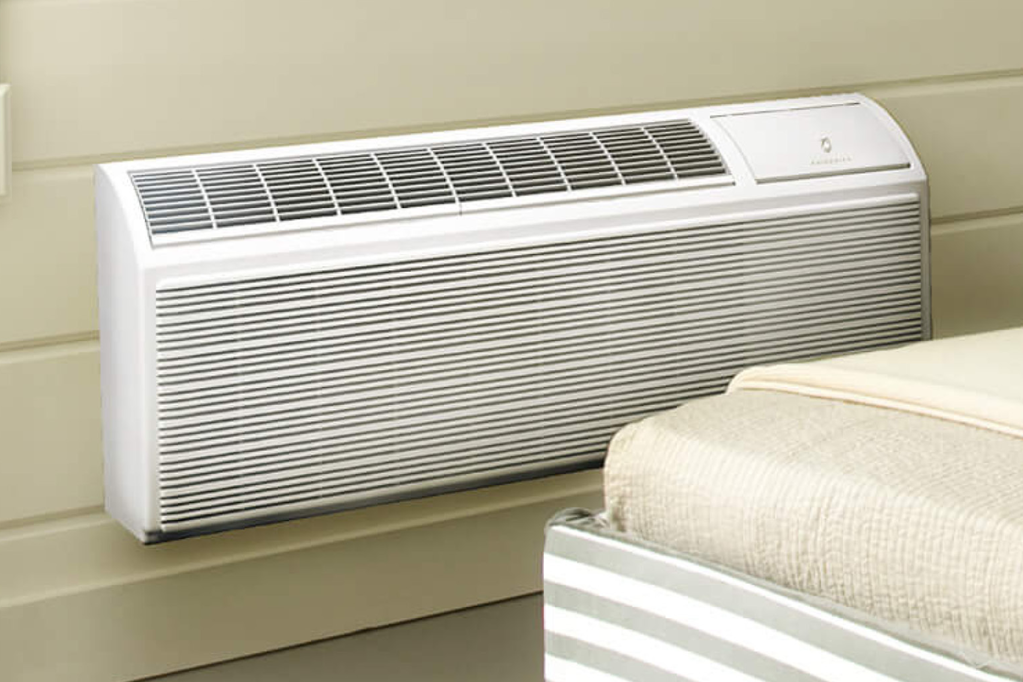
- WALL – These permanent units are built directly through an outer wall and set in a frame, or chassis, that vents exhaust outside while conditioning the cool air inside. A benefit of this type of AC unit is that it can be installed higher up on the wall, allowing the cool air to sink naturally throughout an area.
- WINDOW OR WALL – These versatile units can be installed through a wall when installed with a slide-out wall sleeve.
- PORTABLE – These wheeled units are energy efficient because they don’t use a refrigerant to cool the air. They use the cooling effect of water evaporation. When water evaporates it takes away heat, the way sweat cools you off on a hot day.
- SPLIT – This type is aptly named as it consists of two parts—a condenser located outside and an air handler to distribute the cooled air throughout the interior space. It works well in homes without ductwork as an addition to an already functioning heating and cooling system.
- COMMERCIAL – Larger and more powerful than residential units, these typically cool a much larger area occupied by several people. Many models are set on wheels for flexible placement.
CONVENIENT FEATURES
SMART AIR CONDITIONERS – These units contain Wi-Fi technology which allows you to monitor and program your AC unit with your smart device on a variety of platforms as well including Amazon Alexa and Google Assistant with which you can control your AC via voice command. It doesn’t get more convenient than that.
WIRELESS REMOTE CONTROL – Many models of contemporary air conditioners come with a wireless remote control so you can adjust the temperature or fan speed with the push of a button. Minimal effort, maximum control.
As a professional in the construction industry, it’s important to know the different types, configurations, and necessary power levels of the air conditioners you may offer or install in your project. And at Appliances Connection we’re more than ready to help you find the perfect solution to your AC needs whether you’re refurbishing a single room or an entire apartment complex.