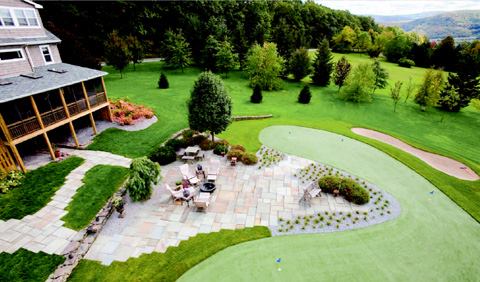
When Geoffrey and Kathy Harris’ children outgrew the playset in their upstate New York backyard, the couple decided to replace it with something more grown up. But instead of a tennis or basketball court, they opted for a 12-hole putting green. The new golf green snakes around a large, irregular patio the Harrises expanded near the house. “Our boys, Justin and Kahle, just live and breathe golf,” says Kathy Harris. “We usually go out at night and have cocktails around the fire pit, and the boys will putt around with their friends. It’s very pleasant.”
Like the Harrises, many avid golfers aren’t content just to head to the local club to practice their chips and putts anymore. They’re building lush backyard landscapes that blend seamlessly with undulating putting greens, many of them complete with sand traps and water features. Baltimore landscape designer Brian Burdette says he’s installed nine residential putting greens since purchasing Southwest Greens, a synthetic turf franchise, last year. “There are some people asking for them, but this seems to be a product people don’t realize they want until they see it,” he says. “It’s the people who golf. Once you get their attention, it’s not a hard product to sell.”
The elaborateness of a putting green, of course, depends on the available space. Ben Lasseter, a design/builder at Root Design in Austin, Texas, says 500 square feet is about the minimum area for a golf green players won’t get bored with—large enough for three holes roughly 8 feet apart. On large projects, he likes to emulate the pastoral look of a commercial course by weaving in trees and shrubs, while keeping in mind that natural-turf greens need full sun and good air circulation. But maintenance is the biggest issue for creeping bent-grass—the recommended grass species for golf greens. The blades must be mowed to ¼ inch four or more times a week, so it may be practical only for clients who have full-time caretakers.
With the latest advances in synthetic turf, the low-maintenance option has gained widespread appeal. Landscape architect Sunny Scully, a partner at Lewis Scully Gionet in Tyson’s Corner, Va., recently designed a 10,000-square-foot putting green for a home overlooking the Potomac River. “We looked into natural turf, but found that even the tour pros who have lots of money and demand the best were using these artificial-turf putting and chipping areas in their own homes,” Scully says. The design, which unfolds behind the tennis court among trees, included three greens and nine holes that allow the owner to move around the property as he plays. Scully edged the course with gravel and used banks of shrubs to partially screen it from view of the house, so that the greens simply read as open space.
Par for the Course. At the Harris property, landscape designer and contractor Rod Frazier of Frazier Landscapes in Oneonta, N.Y., built stone walkways, walls, and an enlarged terrace that connect the course to other parts of the 5-acre property. The 3,000-square-foot green sits roughly 100 feet from the house and is kidney shaped, allowing a range of positions for angling shots away from the house. But “the biggest issue was handling all the grading and drainage,” says Frazier, who worked with FieldTurf by M7 in Clinton Corners, N.Y., to build the course. David Mongon, owner of FieldTurf by M7, says contouring does the job of directing most of the water off of putting greens. “Any excess runoff coming toward the green is dispersed with gravel and perforated pipe so it doesn’t undermine the foundation,” he adds.
Artificial greens are built from the ground up. The synthetic material is laid like a carpet over a 6- to 12-inch compacted gravel base, which is typically raised 6 inches above grade to channel water away from the surface. Layers of sand are added inside the turf to absorb water and help keep the fibers upright. A taller border of artificial grass—the fringe—forms a 2-foot-wide collar around the putting area, and, if space allows, a second “rough” cut, a little taller than the fringe, rings the perimeter.
In all of these projects, the key is to mimic commercial conditions while creating a custom backyard fit. “We try to keep the natural landscape look and don’t change the slopes too much,” says Kerry Woodson, owner of Southwest Greens in Orlando, Fla.
All that engineering and construction doesn’t come cheap: Costs for synthetic greens range from $15 to $20 per square foot. Over time, though, it’s more economical than keeping real grass looking pristine. “It’s more expensive up front than natural turf but the maintenance costs are lower,” says landscape architect Susan Hall of Hall Bell Aqui in Merritt Island, Fla. She recently designed a 2,000-square-foot putting green for a private client. “When we ran the numbers on it, we figured it would pay for itself over about a five-year period in maintenance savings,” she says.
The golf course sits in the center of the park-like 9-acre property. Four tee-off areas, 6 feet by 8 feet, are bordered in brick. The playing course winds in and out of mature trees, and canna lilies add a bright fringe of yellow color several times a year. “The landscaping flows through the greens,” Hall says. “If you’re not paying attention, you may not even notice what it is. But if you’re a golfer, you wouldn’t miss it.”—Cheryl Weber is a freelance writer in Lancaster, Pa.
Landscape contractor: FieldTurf by M7, Clinton Corners, N.Y.; Designer: Frazier Landscapes, Oneonto, N.Y.
Landscape contractor: Southwest Greens, Naples, Fla.; Designer: Hall Bell Aqui, Merritt Island, Fla.