Though it costs about 30 percent more than natural gas, propane is just as efficient and convenient to use and contains about twice the energy content per cubic foot, according to Harris Baker, president of propane supplier HBH Gas Systems in Austin, Texas. Also, the fuel is more efficient than electricity and about 50 percent less expensive, he asserts. The main difference in using propane is that it is stored at the home site in a tank rather than piped from a utility, and the tank reservoir must be replenished periodically.
Range of Power. The fuel can be used to run gas ranges and ovens, water heaters, home heating and cooling systems, clothes dryers, and some refrigerators as well as fueling outdoor features such as radiant heating and snow-melt systems, fireplaces and fire pits, gas lighting, pool and spa heaters, pest-control systems, and cooking appliances. Stand-by generators also are becoming must-haves in storm-prone areas, using propane to supply electricity when grid power goes out. Aaron Benson, renovations specialist for building and remodeling company Croom Construction in Vero Beach, Fla., has noticed that his clients appreciate the convenience that propane pool heaters lend to their homes. On the way home from work, he says, his clients can call their home automation system and activate the pool or spa heater so the water is warm and waiting when they arrive.
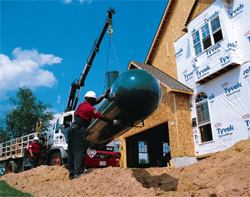
Above or Below. The most common way to supply propane for whole-house and outdoor use is by installing a large steel tank on the home site, usually above ground and concealed by landscaping. Underground installation is an increasingly popular option, however. Underground tanks have an aesthetic advantage over above-ground installations; the only portion visible is a small dome a few inches above the ground that contains valves, gauges, regulators, and the fuel inlet. A corrosion-resistant coating protects the tank. Properly installed, a propane tank can last upwards of 30 years, according to PERC.
Installing an underground propane tank is not always feasible; some sites are simply too difficult. On the island of Lana’i, Hawaii, individual propane tanks must be placed above ground because the volcanic rock just below the soil makes excavating extremely difficult, according to Douglas Pearson, vice president of construction for Castle & Cooke Homes, Hawaii.
Distributed Fuel. In planned custom home communities individual propane tanks are increasingly being shunned for central propane distribution systems, which deliver fuel to each property in much the same way that utilities deliver natural gas to individual homes. A tank large enough to service the entire community is installed in an unobtrusive spot and supply lines are run to each house, where a gas meter tracks usage. With a central propane distribution system, homeowners are not bothered by propane suppliers periodically refilling individual tanks or with tank maintenance. “In terms of the customer’s experience, it’s seamless. It’s like it’s being provided by a local utility,” says Mark Richards, president of Hawaii-based builder the Maryl Group. Many homeowners do not even realize that the fuel they use is not natural gas when it comes through a centrally distributed system, HBH’s Baker says. “They have no sense of differentiation between the products. It smells and burns the same.”
Builder Considerations. While homeowners may experience little difference between using propane and natural gas, builders need to understand propane’s requirements. Appliances and other systems must be set up specifically for propane use with a special fitting that properly meters the supply of fuel. Because propane’s energy content is richer, less fuel needs to be delivered to the appliance, according to Baker.
Codes regulate propane tank installation on a residential site. Typically, the tank must be located within 100 feet of a street for fueling and maintenance purposes. Codes also determine tank proximity to structures. In St. Luis Obispo, Calif., and surrounding areas, for example, where builder Turko Semmes of Semmes & Co. Builders operates, propane tanks must be situated at least 15 feet from any structure. These requirements can sometimes be difficult to reconcile with aesthetic considerations.
Like any other energy source, propane has its hazards. It is heavier than natural gas, and leaking propane will settle to the lowest point it can reach rather than rising and vaporizing. If it settles into an area with an ignition source, such as a pilot light, the fuel could ignite and cause an explosion. Propane has no natural odor, so as a safety precaution producers add a foul-smelling scent, making it easier to detect gas leaks.