Waterfront properties often face strict setback requirements, so for homeowners who want to lounge at water’s edge the boat dock is the place to be. Since dock designs also adhere to shoreline-preserving guidelines, these projects all rest lightly on the land, protect kayaks as well as luxury cruisers, and provide unobtrusive outdoor living. “It’s a place to store boats, but also the dock is a destination,” says architect Miguel Rivera. “People like to hang out and watch the skiing or other activity on the water.”
Light Shed
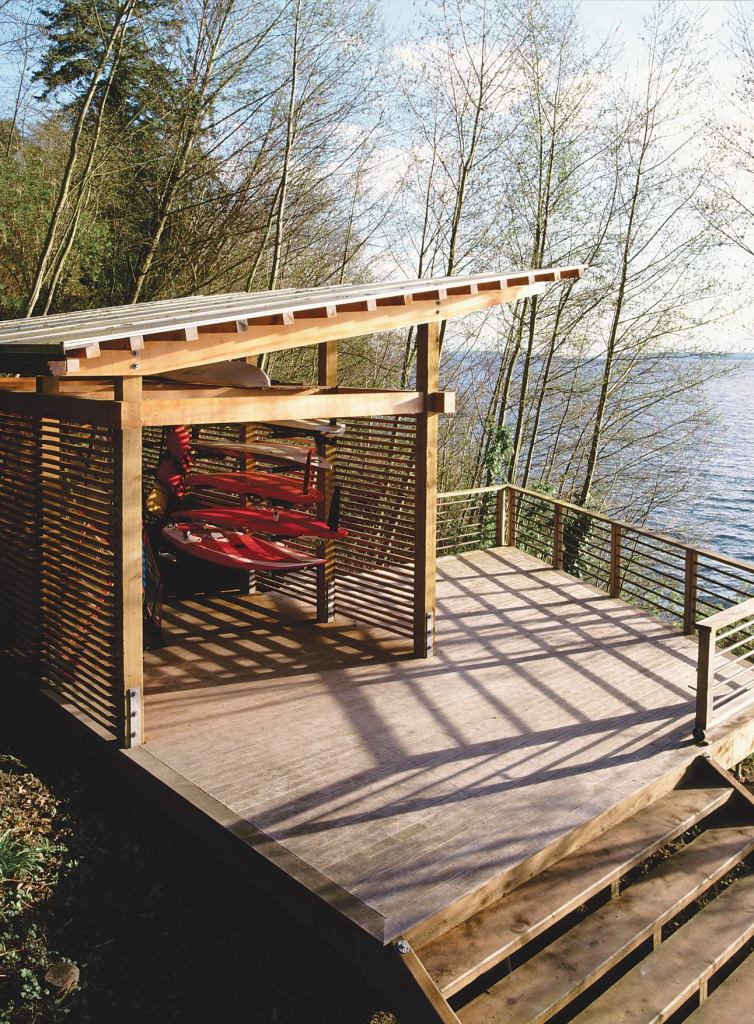
Built on a natural plateau on a waterfront bluff, the location drove the design of this kayak and sailboard shed in two ways. Architect Thomas Isarankura explains, “We had to choose materials that could be carried down manually, and we wanted the structure to appear transparent because it’s such a sensitive environment.” Concrete couldn’t be brought down, so the foundation consists of a steel plate welded onto metal piles driven into solid rock. The deck and shed are angled in response to the location of the piles and surrounding trees. Both pieces total 750 square feet. “One thing we had to do was make sure a standard sail could be spread out on the deck, so that set the size and geometry of the deck as well as the shed,” says Isarankura. Symmetrically spaced 2×2 planks generate transparent walls and create shadowlines “that help the building to disappear into the landscape.” Ironwood decking and cedar pickets wrapping the shed can withstand prolonged outdoor exposure. Clear Lexan with UV protection spans the boat shed and extends over part of the deck. Copper pipe railings and PVC-coated, galvanized pipe board pegs complete the “fairly industrial, off the shelf” material list.
Builder: An Urban Company, Seattle; Architect: Heliotrope Architects, Seattle; Engineer: Swenson, Say, Faget Structural Engineers, Seattle; Photographer: Thomas Isarankura
Hang Over
Embraced by two large cypress trees, this simple boat house fits into long views down Bull Creek inlet rather than competing with them. Architect Sinclair Black started with a “perfect rectangle” measuring 12 by 25 feet and then cut out a slip for a boat leaving twin docks on either side. A two-story enclosure spans the same width as the slip and offers storage on the lower level and a gathering spot above. The roof extends about two-thirds of the way down the rectangle and hangs over open decks on both sides. “In Texas, the first thing you learn is to protect homeowners from the western sun, and the sides [of the boathouse] face east and west,” explains Black. A partially enclosed plane along the wrap-around stair creates a little shelter underneath. The boathouse stops just shy of land so a canoe can slide into place and not be knocked about by wake or winds. Exposed Western red cedar attached to a steel frame supported by steel piles driven into the lake bed make up the easy-care palette. Builder: David Dalgliesh, Austin, Texas; Architect: Black + Vernooy, Austin; Photographer: Paul Bardagjy
Lean and Clean
A slim steel plate walkway connects a steeply terraced site to this screened living room on the water. Custom screens swing up or out so that 10-foot-tall walls disappear. “You can literally open up all of the screens and leap off the end into the lake,” says Arthur Andersson, who worked with partner Chris Wise to design the sleek space. Zinc-coated steel framing supports the upper level while stabilizing the dock below with parking for a jet ski and motor boat, plus a dropped platform for a rowing scull. Ipe was Andersson’s sustainable wood of choice on this project because it’s weather resistant and rigid. Fine architectural details also serve a practical purpose. The grid along the western front mitigates afternoon sunlight and vertical cut-outs in the walkway allow for drainage. By having most of the structure prefabricated in Houston and installed from the lake, this organic site experienced little disturbance during construction. Photovoltaic safety lights allow the structure to stay off of the electrical grid for a naturally relaxing experience.
Builder: Four Corners Construction, Austin, Texas;
Architect: Andersson Wise Architects, Austin;
Photographer: Paul Bardagjy