It took awhile to get used to the idea, but home builders have started to embrace structured wiring as more than just a passing fad. Roughly half of new homes built today boast structured wiring, bundles of high-bandwidth video and data cable that homerun to a centralized location in the home and make possible home computer networks and whole-house video systems.
But no matter how much a homeowner tries to anticipate technology needs, there are nooks in the home where wire just won’t go. And more and more, consumers want to tap into the Internet from wherever they are. They don’t want to be tethered to a cable in a corner of the room when they can surf the Net from the patio or the living room couch. Despite the best-laid plans, a nursery later becomes a home office or someone wants to answer e-mails in bed where no data jack is available. That’s where wireless networking comes in.
The primary draw for a home network today is to share a broadband Internet connection. People use the Internet for everything from finding directions to downloading music. They don’t want to have to go into the office to look up a movie schedule. Most laptops these days come network-ready thanks to the Centrino chip found in PCs, and for older models a networking card is an easy add-on. Consumers want the same flexibility to jump on the Web wirelessly from home that they have at the local Starbucks.
“We do lots of wireless networking,” says Ray Lepper, president of Home Media Stores in Richmond, Va. “We show it to people as an accessory to their wired network, not as the network.”
Wired is always the medium of choice for networking because of the security and reliability a hard-wired connection delivers. Wireless transmission can’t promise either. The most prevalent wireless networking technologies, 802.11 b and g, operate over the 2.4-GHz band of the radio spectrum where their signals compete with 2.4-GHz cordless phones, microwave ovens, and other common household devices. Building materials can also impede the performance of a wireless network. Steel, concrete, and wire mesh all can stop the transmission of radio signals from one side of the house to the other.
Entertainment services such as video networking of TiVo recorded TV programs or distribution of music from a PC hard drive to other rooms in the house is typically done via wired networks which offer the higher speeds necessary for larger file transfer.
Still, many installers encourage clients to combine wired and wireless networking. “If they already have networks for a digital music server, TiVo server, and computer, we say to clients, ‘Why don’t we put in a wireless access point and wireless router, and then when you bring your laptop home from work you can just sit in the family room or out on the deck and answer those e-mails while you’re sipping a beer,’” Lepper says. “People think that’s cool.”
Cost is one of the misconceptions homeowners have regarding wireless versus wired networks. “People think that going wireless is a way to save money,” Lepper explains. “Not exactly. They think they’re going to save labor.” To a degree, that’s true when it comes to places where it’s difficult to run wire. If wiring is in and someone decides after the fact to add the kitchen to a network, a wireless add-on is the only option. “But I don’t see wireless as a replacement for wired. I see it as part of the network,” he adds.
Wireless networks carry a degree of vulnerability if people don’t use encryption to protect their networks from outside intrusion. Most wireless routers, which serve as home base for a wireless network, come with protective encryption turned off because encryption makes it more difficult to add other products to the network. It’s a dilemma, Lepper notes, and it leaves consumers confused.
“People are both under-secured and over-paranoid about wireless networks,” he says. “People should make their networks secure because even the local teenage hacker could have fun and lock you out of your own router. But if you get paranoid and put in a lot of encryption, that creates a level of inflexibility, which means the integrator has to come back to add new things when you want to expand. Minimum security is mandatory but don’t get paranoid.”
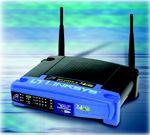
Microsoft is one router manufacturer that ships product with encryption enabled. Most other router suppliers, including Linksys, D-Link, Buffalo Technologies, and NetGear, leave it up to users to set encryption keys. Adding repeaters, media and game adaptors, and wireless bridges is typically easier without encryption.
“Wireless is definitely the wave of the future,” says Larry Dashiell, president of custom installation firm Hometech, based in Santa Rosa, Calif. Dashiell says wireless networking meshes easily with the networks typically installed along with a structured wiring system during new home construction. “We typically put a broadband router at the wiring panel and feed the wires to jacks throughout the house where the homeowner wants Internet access,” he says. “We also put in wireless nodes throughout the house at different locations to give coverage where necessary.”
Clients vary according to their desire for ubiquitous access to the Web, but with e-mail becoming as common a form of communication as the telephone, the more access the better. “Some people may only want wireless coverage in the kitchen so they can come home with the laptop and answer e-mails while they’re getting dinner ready,” Dashiell says. “Other clients don’t care about the wiring. They just want to take the laptop wherever they want to go. The wireless nodes we put in tie in to the wired system and use the same IP address. When clients walk around the house it’s almost like using a cell phone where they’re jumping from node to node seamlessly,” he says.
Past experience has taught many installers to look at wireless technology with a wary eye. The concept of wireless speakers has been around for years but no one has delivered a system that actually sounds good and works reliably. “If someone walks in the way suddenly your speaker drops,” says Marty Hayes, director of purchasing for Dennis Sage Home Entertainment in Phoenix. “But networking is different. That technology works much better for transmitting the signal because you’re just sending data.”
When it comes to security, Hayes says, some windows and areas just can’t be wired. “If we can’t do it and you need the protection we can do it wirelessly,” he says. “Is it as good? No. Wireless security products are battery operated and they have transmission problems. I don’t think you’d find anyone who’d say wireless technology is as good as wired, but if you want the technology and you can’t get a wire there, you’ll take wireless.” —Rebecca Day specializes in writing about home electronics. She can be reached at customhomerd@aol.com.