
Home ownership, after all, is one of a household’s options. Preference makes it a goal, and means make it an achieved goal.
Home ownership in America has come to mean other things, social, cultural, and economic. In home-ownership rates, we vested a sense of national well-being, exceptionalism, economic health and mobility, lower crime rates, and societal competence at producing and ongoing stream of upstanding community members.
It was, as well, a near-term destination six or more of every 10 young adults tried to map to as they navigated lives of early careers and brand new families.
Those who design, develop, and build new homes look at home-ownership rates as a business benchmark, a quantity from which they can calculate varying challenges and opportunities in supply and demand. Home-ownership rates, in fact, are the raw material data points–as they change over time–for understanding demand writ large.
Fact is, though, what residential architects, developers, and home builders base their vocational mettle on each day they go to work is their sense, as faint as it might be, that home-ownership rates may be what they may be, but the fact of them can not change the reality that people out there want to buy new homes.
In other words, home and neighborhood builders may work within statistics, but they constantly work to change them, one purchase at a time. Home and community builders work in the margins of intention, value, and risk aversion, and when they do what they do very well, their products and messages can change people’s minds, change what they intend to do, what they value, and what they’re afraid of happening.
Now here are some resources and some insights on home-ownership rates today, underlined, of course, by our still abiding question of whether it’s as compelling a near-term destination on young adults’ road-map of household preference or not.
Did the Great Recession dislocate a generation’s household formation behavior, or did the generation dislocate a longstanding assumption that 65% or so American households will be owner-occupied?
Here, the National Association of Home Builders economics research associate Carmel Ford looks at home-ownership rates on a county-by-county level of specificity. Ford creates a helpful matrix of data points around four key household characteristics tied with higher or lower home-ownership rates: age, marital status, home value, and income. What’s fascinating in the revelations of this detailed analysis is how important the institution of marriage is as a key factor in understanding whether a particular county will have a higher rate of home ownership or not.
Zeroing in, Ford notes that for counties whose households are 10% higher for married-couple households than the national average (61%), home ownership tends to show up disproportionately higher–at a 76% rate vs. a “mean case scenario” rate of 71.5%. In counties whose households clock in at 10% below national means for marriage (41%), the home ownership rate clocks in at 65.2%, well below the “mean case scenario” rate of 71.5%.
In other words, of all the factors Ford looks at, marital status is the most determinant characteristic as regards current home-ownership rates.
One could infer, as a builder or developer, that counties with lower-than-normal households with married couples would be ones to avoid investing in, or as some housing observers have asserted, that the decline in married couple households is eroding home ownership. That may or may not be true.
What we do know is that there is a higher and higher non-married couple household composition rate, and that that rising rate of non-married couples correlates with lower home ownership. But since that is a recent phenomenon, it would be a mistake all to assume that non-married couple households will never increase in their rates of home ownership. Single-person households, particularly among females, post-married couples, unlikely-to-marry couples, and multi-generational households where the head of household is not married might well emerge as a measurable upside for opportunistic players.
Importantly, for some home builders and developers, non-married couple households, or other less traditional household composition types may now stand out as a particularly inviting opportunity area, otherwise known as an unmet need. The right home builder with the right product in the right place at the right price could actually alter that statistic in some of America’s counties, selling homes buyer by buyer.
Now, here are a couple of other nuggets to help with your thoughts and plans.
Trulia chief economist Ralph McLaughlin here explores the role of two key factors related to population growth among America’s “fastest growing” housing markets, the prevailing climate and home prices. Here’s his look at the appeal of the Sun Belt:
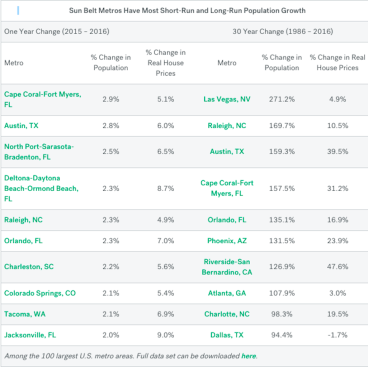
Each of the 10 metros with fastest one-year and 30-year increases in population are in just 10 states, nine of which are in the Sun Belt : Arizona, California, Colorado, Florida, Georgia, Nevada, North Carolina, South Carolina, Texas, and Washington (non-Sun Belt). Cape-Coral-Ft. Myers, Fla., leads the one-year pack, growing its population by 2.9% during that span. Las Vegas leads the 30-year pack with more than a 270% increase in population.
What’s more, apart from Sun Belt attraction, home price trends are a big factor in the growth of America’s fastest-growing markets. McLaughlin notes:
Across U.S. metros, population growth had a 69.5% (out of a possible 100%) positive correlation with house price growth, the second largest correlation over the past 30 years and second only to last year’s correlation of 76.1%.
Analysis from CoreLogic economist Archana Pradhan has data here that shows similar trends among would be home buyers, and she takes the data a step farther, looking more closely at both young adults and retiring Baby Boom generation buyers for cues and clues as to what factors most motivate them. Especially cool here, is the inflow-and-outflow migration analysis that maps where movers originate and which states attract those movers. Pradhan writes:
In contrast to millennials, data show that baby boomers preferred warmer states, along with affordability. Baby boomers from New York, Illinois, Virginia, Pennsylvania, Ohio and Maryland applied for home-purchase mortgages in Florida the most. Baby boomers seemed to be moving for warmer weather, lower taxes and affordable homes.
Within the broad swaths of ascending and descending statistical measures, one home builder’s risk shines as another’s opportunity. Many tracts of potential home sites would not make it on the radar screen of a majority of builders, because the prevailing data trends show a declining opportunity. Such parcels are exactly what the exceptional builder seek in a market like this–property others won’t bid up, but upon which they can generate value.
This is the reason for builders to acquire data, to better match their business models, community and home products, and operational processes to land positions that allow them to widen the distance between what the builder pays all in to offer the home, and what the buyer pays, all in, to own it. BUILDER, as a reminder, has a corporate sibling Metrostudy, whose specialty is in helping builders and other stakeholders widen that distance. Each year, at our Housing Leadership Summit, we find ways to integrate our Metrostudy team to a greater and greater degree into our program and networking opportunities. You can register for this years HLS, May 8-10, at the Ritz Carlton, Laguna Niguel, by clicking here.
Home-ownership rates are just a number the good builders like to mess with, home buyer by home buyer.