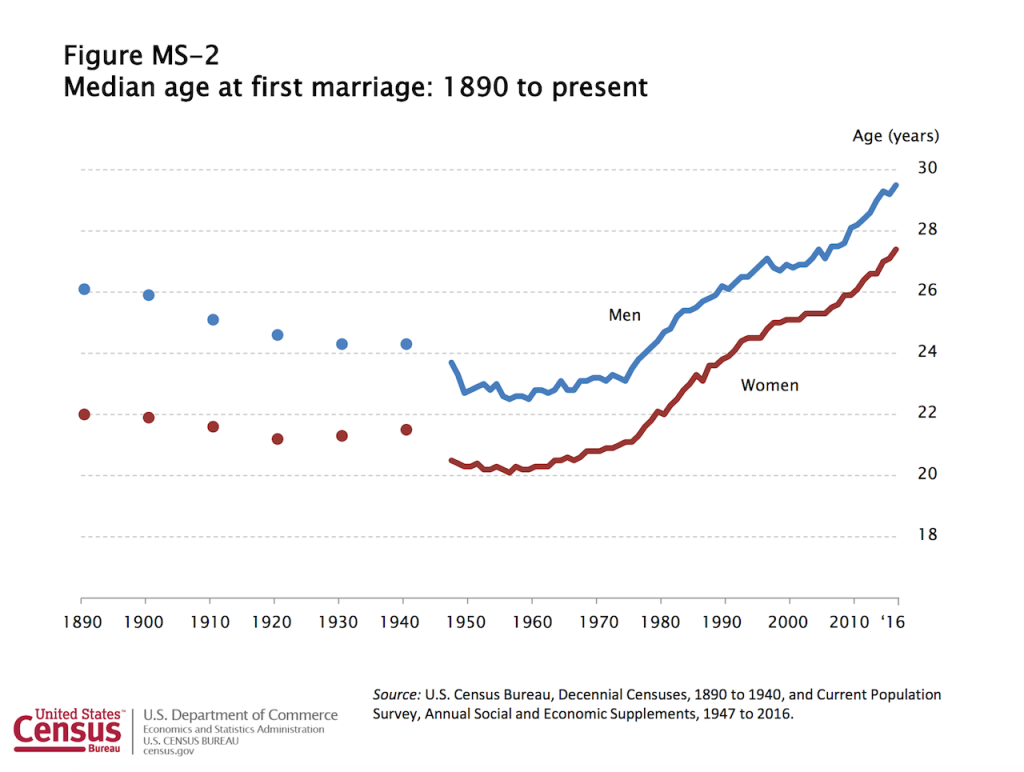
To start the conversation, the median age of a man in a first-time marriage is 29 and a half, and for a woman, it’s 27.4. Two relevant related observations are that the age of both men and women at the time of their first marriage these days is the highest on record; and, secondly, the rate of change, to older and older first marriages, is steep.
Here’s a chart from the Census at how that looks.
To continue the conversation, more and more Americans do not marry. Pew Research estimated in 2014 that one in five Americans over the age of 25 had never been married–about 42 million people in that age group–a historic high.
Underlying these trends, people are questioning fundamental assumptions about the structure of households. Pew’s Wendy Wang and Kim Parker write:
Recent survey data from the Pew Research Center finds a public that is deeply divided over the role marriage plays in society. Survey respondents were asked which of the following statements came closer to their own views: Society is better off if people make marriage and having children a priority, or society is just as well off if people have priorities other than marriage and children. Some 46% of adults chose the first statement, while 50% chose the second.
Not to mention equally seismic shifts on both the behavior and attitudes front toward work. Another Pew Research analysis notes:
Tectonic changes are reshaping U.S. workplaces as the economy moves deeper into the knowledge-focused age. These changes are affecting the very nature of jobs by rewarding social, communications and analytical skills. They are prodding many workers to think about lifetime commitments to retraining and upgrading their skills.
Even setting cyclical economic trends aside, automation and robotics, machine learning and artificial intelligence, outsourcing, offshoring, and the like, are exponentially shifting the meaning of work, career, mobility, economic security, and the American Dream.
Now, if the conversation starts with three such elemental changes in the DNA of society–family formation and the nature of work–what new conclusions does that conversation lead to for those whose livelihoods spring from answer to the question, “how do you want to live in your home today?”
The present and the future of everything housing lies in the response to that question.
Common is a co-living business model based on a goal to meet one of housing’s unmet needs, communities structured with different basic building blocks based on how differently people have begun answering that question, “how do you want to live in your home?”
Which is why we’re starting the conversation that looks at marriage age trends, family formation, household formation, the future of work, work-life balance, etc. Care to explore that with us?