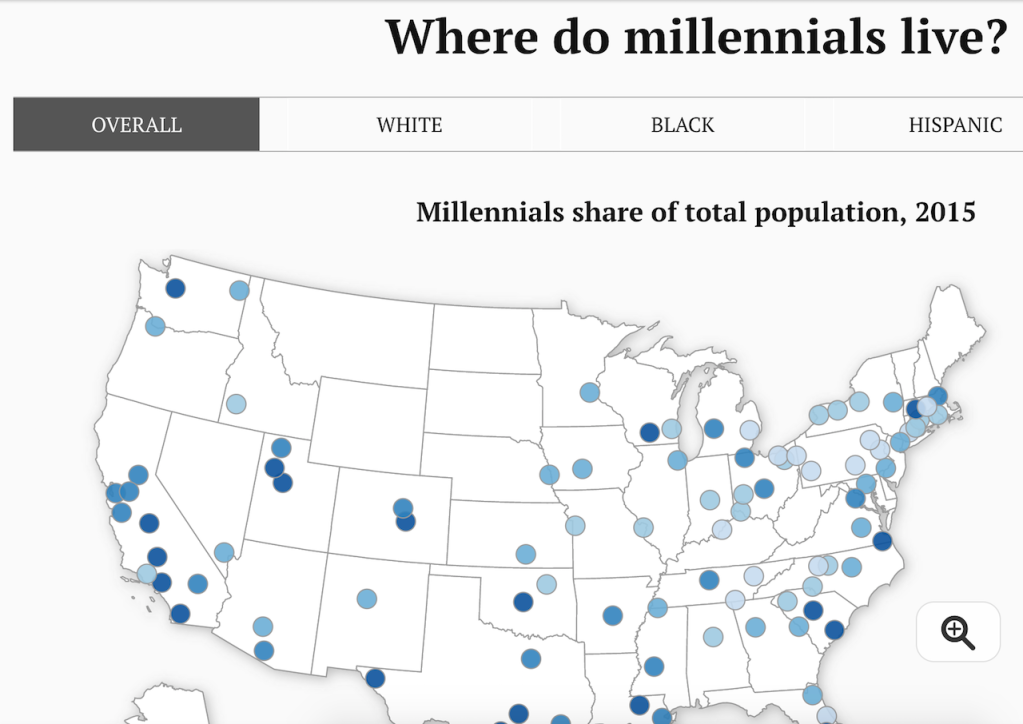
Here’s data that tells us that, just as the youngest Millennials reach his and her age of majority–in the next 12 to 18 months or so–the cohort as a whole will eclipse the Baby Boom as America’s biggest generation.
They’ll all–73 million of them, according to Pew Research analysis of population projections from the Census–be young to middling young adults, the oldest being 36 and the youngest 21. Pew Research senior researcher writes:
The Millennial generation continues to grow as young immigrants expand its ranks. Boomers – whose generation was defined by the boom in U.S. births following World War II – are aging and their numbers shrinking in size as the number of deaths among them exceeds the number of older immigrants arriving in the country.
Because generations are analytical constructs, it takes time for popular and expert consensus to develop as to the precise boundaries that demarcate one generation from another. Pew Research Center has assessed demographic, labor market, attitudinal and behavioral measures and has now established an endpoint – albeit inexact – for the Millennial generation. According to our revised definition, the youngest “Millennial” was born in 1996.
Our question–what must be a classic one through the ages–is this. Up to and including this point in the first third-ish stretch of their lives, the generation has vibrated to a largely different cultural and societal cues and motivators.
So, how will the following cohort-related characteristics translate into full-on adulthood, with its share of life-stage obligations and opportunities?
- Values
- Attitudes
- Beliefs
- Behavior
- Choices
- Preferences
- Goals
- Motivations
Each of these have different meanings, and at the same time relate to one another. Their shape, intensity, and effect typically undergo a stress test when the realities of adult life, the need to pay bills, build a livelihood, form a family, and develop a household set in for good.
Still, in ways that would have to affect those eight bulletted terms above, Millennials are different. It’s just that guessing how that difference will play out in economic behavior is exactly that, guessing.
Still, University of Michigan and Brookings Institution demographer William Frey notes pronounced characteristics that distinguish the Millennials cohort from any others.
For one, Millennials have grown up more racially diverse, and as an adult population this could “bridge the gap” of largely-white “pre-millennial” generations, and much more racially diverse “post-millennials.” How is it that Millennials became the first, much more racially diverse generation in America? Dr. Frey writes:
The large waves of immigration to the U.S. in the 1980s and 1990s, especially from Latin America and Asia, coupled with the aging of the white population[1], made millennials a more racially and ethnically diverse generation than any that preceded it.
Further, Frey observes that the Millennial cohort, now aged 21 to 35, is a more eductated generation, which suggests both better future earnings prospects and improved well-being.
More than a third of all millennials ages 25-34 achieved college educations by 2015, up from less than 30 percent for comparably aged young adults in 2000 and not quite a quarter for those in 1980.
But again, how will those two big distinctions, in racial diversity and education ultimately influence how the Millennial cohort navigates within that spectrum of eight terms, especially as regards their housing choices?
Let’s look at them again.
- Values
- Attitudes
- Beliefs
- Behavior
- Choices
- Preferences
- Goals
- Motivations
As householders, family leaders, local, regional, and national officials, voters, investors, and conscious stake-holders in the economy, the environment, society, and culture, will Millennials be more like or more different than any generation that has gone before?
Your guess is as good as mine.