Hot Spots

In kitchen design, there's always something cooking.

16 MIN READ

Everyone knows that the kitchen is the most interesting room in the house. Clients obsess over it, architects have made it a focal point of innovation, guests gravitate to it as if drawn by magnetic force. But why? Yes, everyone likes food, and that’s where we tend to keep it, but here’s another theory: In most houses the kitchen is the only room where work gets done. Work involves tools and activity, reflects our habits and preferences, and, in the case of the kitchen, stimulates all five senses. It is no wonder that we can’t stay away, or that this spot on the floor plan is the site of such ferment. A glance at the following pages is enough to gauge the time, talent, and resources that designers, builders, and clients are devoting to today’s best kitchens. Pour that much energy into such a small space, and things are bound to get hot.

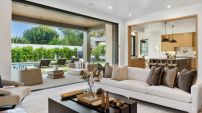
Fusion Cuisine Can a room that communicates with the rest of the house through a single 3-foot-wide door be considered an open kitchen? Consider Exhibit A, a remodel that designer Troy Adams built for his own Southern California home. With its 16 feet of glass doors nested in their pockets, this kitchen becomes less an interior room than a sheltered extension of the garden outside. And while the room itself is a simple flat-ceilinged box, Adams built visual excitement by tossing together Asian, European, and American themes in the design equivalent of fusion cuisine.

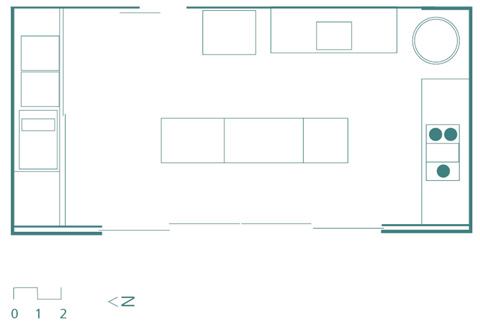
CH060401077L4.jpg Floor Plan Builder/designer: Troy Adams Design, West Hollywood, Calif.; Project size: 520 square feet; Construction cost: Withheld. The room centers on a freestanding island that looks deceptively like three separate pieces of furniture. Arrayed around the island are four “stations,” each with its own independent character: a stainless steel refrigerator, a sink base with a soapstone counter and backsplash and a glass wall cabinet above, a silo-like storage cabinet with a sliding door and turntable shelves, and a glass-faced range cabinet with a slate-tile backsplash. Across the room, a tea bar with beech cabinetry and wenge wood shelves shares wall space with a laundry closet hidden by shoji-like sliding glass doors, also fabricated from wenge. Making only the slightest gestures toward integration, these cunning vignettes make for a genuinely refreshing experience—even without the disappearing wall.

Project Credits:
Builder/designer: Troy Adams Design, West Hollywood, Calif.; Project size: 520 square feet; Construction cost: Withheld; Photographer: Doug Hill.

Resources:
Dishwasher: Fisher & Paykel; Garbage disposer; Franke; Kitchen plumbing fixtures: Dornbracht; Lighting fixtures: Bruck; Ovens: Gaggenau and Miele; Refrigerator: Sub-Zero.

Details
True to its mix-and-match theme, this kitchen’s center island collects disparate elements into a composition that is almost too clever. Its stainless steel frame supports a soapstone tabletop, a wenge cabinet with a countertop of enameled volcanic stone, and a hefty butcher block. The result is a functional multipurpose unit that looks so much like three separate pieces that one is tempted to count legs.


About the Author

Bruce D. Snider

Bruce Snider is a former senior contributing editor of  Residential Architect, a frequent contributor to Remodeling. 

Upcoming Events

  • Happier Homebuyers, Higher Profits: Specifying Fireplaces for Today’s Homes

    Webinar

    Register for Free
  • Sales is a Sport: These Tactics Are the Winning Play

    Webinar

    Register for Free
  • Dispelling Myths and Maximizing Value: Unlock the Potential of Open Web Floor Trusses

    Webinar

    Register for Free
All Events