Two rules hold sway in residential construction and development. One is that all real estate is local. Another is that timing is everything.
Firms live or die by these axioms. They apply to home design, land investment, positioning, labor force access, construction code, environmental issues, municipal permitting and zoning, etc.,
The first of those rules typically comes with a trusty corollary. It’s essentially that the wildly popular indoor-outdoor living trend is by nature a “Smile States” phenomenon. It would never work in four-seasons climates. From, say late October until at least mid-April those floor-to-ceiling sliding pocket doors would be shut tight and those outdoor living and entertaining exterior areas would lie out of livability’s bounds, forgotten or, worse, taunting.
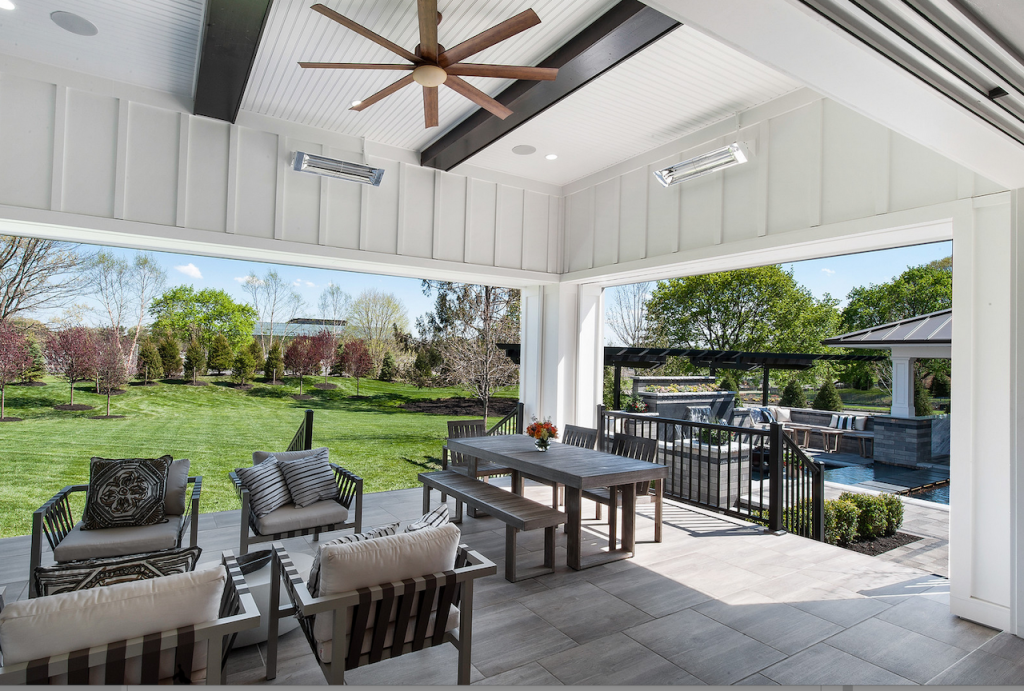
But, what if you could stretch use of those outdoor living spaces into later Fall and earlier Spring, even in the chilly northeast? Restaurants, with gas heaters and all-weather furnishings and flooring, have begun to extend their use of ambient outdoors, beyond their interior footprints? Why not homes?
That’s where the second of the two rules comes in, timing. When Toll Brothers group president Christopher Gaffney flew out to Southern California in May 2016, he had a dual mission. One reason for the trip was to receive the Hearthstone Builder Humanitarian Award during our Housing Leadership Summit proceedings, recognizing the remarkable work he’s doing with Covenant House, a national organization that serves homeless youths. The other was to get together with his Left Coast counterparts at Toll, go out to Baker Ranch and take in the indoor-outdoor living phenomenon in all its splendor.
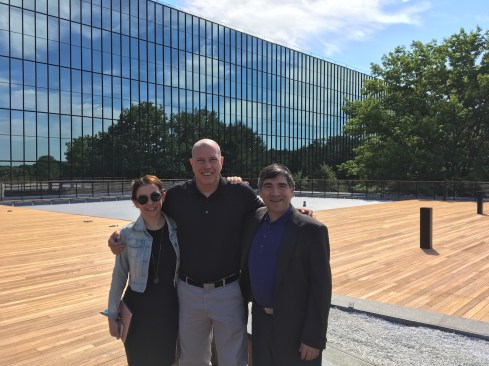
Bell Works and Reserve at Holmdel team: (from left) Paola Zamudio, principal npz studio; Christopher Gaffney, Toll Brothers group president; and Ralph Zucker, president Somerset Development.
“[Toll Brothers CEO] Doug Yearley asked me to have a careful look at what we’re doing out there at Baker Ranch with our models, expanding the living space well beyond the square footage of the home, giving a whole new meaning to livability,” says Gaffney, who took time with us during the 4th of July holiday weekend to show us what became of his reconnaissance trip to the West Coast last May. “Doug was convinced we could bring at least some of that sensibility here, but we just weren’t sure what we could do.”
One thing Gaffney knew is that for the indoor-outdoor program to work, not just any community location would do–it had to be very special, offering eye-candy natural ambience and privacy to boot. Lucky for Gaffney, Toll Brothers was just taking the wraps off its new Reserve at Holmdel [Monmouth County, N.J.] project at 472-acre iconic Eero Saarinen Bell Labs building, with formalist grounds landscaped by Hideo Sasaki, a setting of nearly mythic meaning as well as natural, down-to-earth beauty. To date, 27 of the 40 homes in the new community’s first planning area have sold, with orders on several more in the works.
“We felt that in this location, we could give those interior living spaces far more connectedness to the outdoors, and make the homes live even larger,” Gaffney told me.
A press statement on Toll Brothers’ Weatherstone model home notes:
The professionally decorated Weatherstone Manor showcases over 6,700 square feet of the best in luxury living space on the main levels plus a finished 2,100 square foot basement, a “dream bath package” highlighting Toll Brothers’ vendor partner Kohler, and interior design styling by Mary Cook and Associates. In addition, the home includes a unique indoor/outdoor living space that is brand new to the northeast region, with landscape, hardscape, plus water and fire features totaling another 4,000 square feet.
Both localism and timing played a huge role in Toll’s opportunity at Bell Works, a $100 million project that’s been nearly 10 years in the making, with master developer Somerset Development and its president Ralph Zucker pushing and prodding the landmark project toward a future of “metroburbian” possibility. Bell Works, as it is now conceived, is as a modern interior mini-village of offices, food, retail, health, and restoration, with architect Alexander Gorlin channeling Saarinen’s intentions and soul.
Here, BUILDER sibling title Architect tells the story of “The Bargain That Revived Bell Labs,” a piece by contributor Karrie Jacobs. She describes the two-million square foot site here:
Today, to visit the complex—recently renamed Bell Works by its owner, a company called Somerset Development—is to glimpse the pre-history of our current technological moment. The set of four mirrored-glass boxes linked by a gargantuan cross-shaped atrium was designed by Saarinen beginning in 1957, a follow-up to his acclaimed General Motors Technical Center outside Detroit and his IBM Thomas J. Watson Research Center north of New York City. The first section, one pair of black boxes, was completed in 1964, several years after the architect’s death, and the second pair was finished in 1966. In the 1980s, the four buildings were extended with matching additions by Kevin Roche, FAIA, and John Dinkeloo, who had worked on the original under Saarinen.
What happened is that as Zucker fought for support and zoning changes to add residential to his vision for a make-over for the property, he came into the acquaintance of a fellow with an impeccable reputation in Holmdel, one of the town’s own, one Christopher Gaffney, who’d ridden his bicycle on the grounds of the Bell Labs campus as a kid more hours than he could count.
“Even before we had a signed deal, Chris came and stood up in front of the Holmdale planning board, and they asked him, ‘are you going to build these homes?’ and his answer was, ‘yes, we’re going to build them,'” says Zucker.
Chris, and Toll Brothers, essentially got Zucker the local cred he needed to get the re-zoning he wanted for residential on the project. This, in turn, led to a series of green lights that started Holmdel back on the path of receiving local taxes on the property, and allowed Zucker to pivot in his focus to the larger matter at hand. Turning the Bell Works site into a living, breathing, New Urbanistic “heart-and-soul” of the area,” says Zucker.
Another case of all real estate being local. Another instance of timing being everything.