Even with no tee box in sight, golf carts have zoomed into everyday life for many master-planned developments. From Colorado to Texas to Florida, developers are rethinking mobility networks to fit this trending mode of transportation, especially for expansive master plans.
“Golf cart-friendly communities have grown in popularity as residents seek convenient, enjoyable ways to move around their neighborhood. What began primarily as a recreational amenity has evolved into a daily transportation mode for school drop-off, neighbor visits, and amenity access,” says Samantha Chaney, Freehold Communities marketing manager for Shearwater. “Communities like Shearwater demonstrate this shift clearly, where golf carts are now an integral part of everyday lifestyle.”
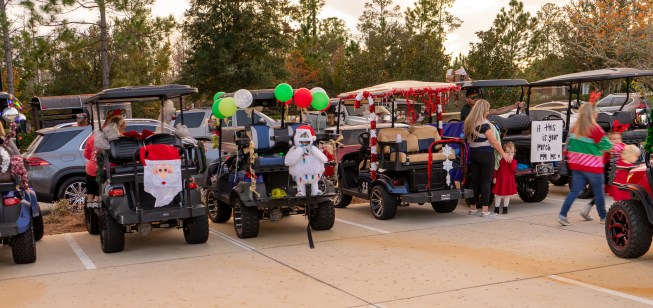
Courtesy of Shearwater by Freehold Communities
Golf carts are part of many community events including Winterfest at amenity-rich Shearwater in St. Augustine, Florida.
At The Aurora Highlands in Colorado, principal Carla Ferreria says she has seen families gravitating toward “low-speed mobility” using golf carts to get to parks, enjoy open space, and visit neighbors.
Starwood Land’s vice president of sales and marketing Tim Johnson says, “We’re finding that residents have adopted cart use within master-planned communities and are shifting from occasional neighborhood cart use to daily, trip-replacement use, and electric carts (and low-speed EVs) have become the dominant type because they’re quiet, low-maintenance, and fit the amenity-first model of a Starwood Land community.”
Beyond the Green
Ease of moving around communities is a top benefit of golf cart usage but lowering car usage, quieter streets, and creating more community interaction are additional bonuses. “Golf carts promote a more relaxed, community-oriented way of getting around. They allow residents to move through the neighborhood without relying on cars, which reduces traffic, lowers noise and encourages people to engage more with their surroundings. They’re also a great equalizer in the sense that they are accessible for older residents, easier for families with kids or gear, and supportive of anyone who needs mobility assistance. And, frankly, they’re fun! Communities thrive when people enjoy how they move around,” says Ferreria.
In Texas at Balmoral, Lago Mar, and Sierra Vista, Starwood has branded its 8-foot to 12-footwide multi-purpose trail networks as the GreenBoLT designed to connect homes with amenity villages, pools, lagoons, commercial nodes, and more. The corridors are planned with safety markers and intersection treatments serving as both a circulation spine and lifestyle amenity, Johnson notes. “We’re marketing the GreenBoLT as an ‘alternative transportation experience’ and find that messaging sparks resident interest.”
In Florida, where mild weather and golfing do thrive, GL Homes has seen a shift from just-for-golf usage to everyday use as well. “It’s become clear to residents that you no longer need to live in a golf course community for it to be acceptable to drive a golf cart around. People now see golf carts as an everyday convenience, which is why we designed Riverland in Port St. Lucie with over five miles of greenways and pathways that loop through the entire community. Given Riverland’s 4,000-acre scale, golf cart travel made perfect sense,” says Ryan Courson, GL Homes division president of St. Lucie County.
Adapting to the rise in usage, Courson adds, “We’ve also incorporated ample golf cart-specific parking and electric charging stations along the pathways and the amenity centers, making car-free travel easy and aligned with the active lifestyle residents value. In addition, our homes are designed to support golf cart usage. We have multiple home designs with golf cart garages as an added convenience.”
Flourishing Golf Cart Culture
Warm climates like Florida and Texas naturally lean into golf cart mobility thanks to year-round outdoor living, but any community with strong connectivity, a variety of amenities, and a walkable design can become golf-cart friendly. Developers are widening paths to be more universally usable, integrating parking and storage, and establishing safety guidelines as needed.
While states and municipalities have their own rules and regulations for golf carts, communities are also considering safety as a top priority. Courson says, “We have several guidelines in place to ensure golf cart usage remains safe and sustainable. Our HOA rules outline requirements such as maximum speed limits and designated travel lanes. We also require all golf carts to be electric, which supports our sustainability goals and helps reduce the community’s overall carbon footprint.”
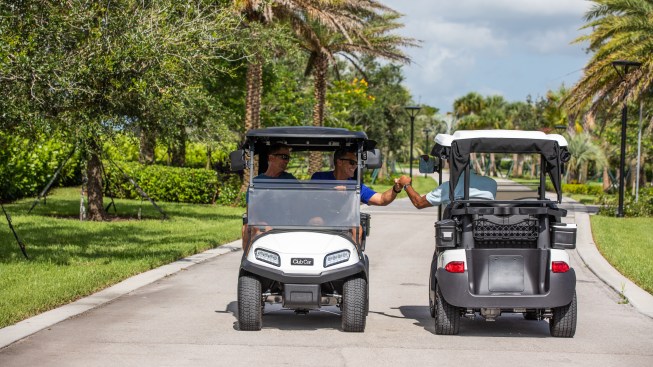
Courtesy of GL Homes
The Paseo at GL Homes' Riverland community in Port St. Lucie, Florida.
“We differentiate our golf cart paths by buffering them within heavily landscaped routes away from vehicular roadways. Within the greenway, the golf cart pathways are wider than a pedestrian pathway, and they are clearly labeled with pathway designation markings,” Courson adds.
Johnson says that Starwood’s HOA maintains rules on cart appearance, where carts can be driven, and when. He says that carts used on public streets are also governed by the varying jurisdictions’ ordinances. Clear signage for speeds and lighted paths as well as designated parking areas can improve the experience and safety of golf cart usage, Johnson adds. Designated parking can also limit the frustration of carts blocking sidewalks and driveways.
Having been designed to embrace golf cart usage, Shearwater implements events to share up-to-date info on rules and more. “All golf carts used within the community must follow Florida regulations, including ensuring carts are street legal,” says Chaney. “To help residents stay informed and use their carts safely, Shearwater hosts regular golf cart informational events that review the rules, community expectations, and any updates to state guidelines.”
Golf carts can also be an avenue for community programming. Chaney says, “Beyond everyday uses like school drop-off, pick-up, and amenity access, the lifestyle team incorporates this mode of transportation into major community events such as the Fourth of July and Winterfest by hosting golf cart parades. Residents decorate their carts for these parades, creating a fun experience the community looks forward to each year.”
Yet, golf carts aren’t the only mode gaining traction. Chaney and Johnson have both seen growth in e-bikes and e-scooters on walking and mobility paths.
Ferreira agrees, “We’re seeing a growing mix of everything from e-bikes and scooters to motorized wheelchairs and jogging strollers. Residents want multiple ways to move, and they want those ways to feel seamless. That’s why our approach is to create a mobility ecosystem instead of building for a single mode of transportation. The more options people have, the more connected and active they feel.”