According to Pat Marcoullier, BBA Fiberweb’s director of construction products, the depth of the drainage channel and how well it resists crushing and compression once siding is installed over it is critical to the successful performance of a drainage product. If the drainage channel is flattened by siding, its draining abilities can be greatly reduced.
The housewraps with drainage surfaces are designed for use with nearly any type of siding or cladding that recommends installing a weather-resistive barrier or drainage plane under it, including fiber cement, wood shingle and lap, vinyl, and stucco.
Currently, architects and custom builders are the primary users of drainage housewraps. But, says Brad Allshouse, vice president of building products sales and marketing for Ludlow Coated Products, “We see a push from all the industry experts and consultants because of all the claims around water and mold remediation and similar issues.”
Housewrap alone, however, will not solve all moisture problems. All manufacturers point out that no matter what type of housewrap or other weather barrier is used, properly flashing around windows and doors and sealing housewrap seams on the wall is critical to ensuring performance. “Honestly, you get more water through windows than you get through walls,” acknowledges Partrich. Housewrap and flashing act together as a system to prevent moisture damage. “You really can’t get full moisture protection in a wall cavity if you’re not using housewrap, flashings, and tape,” Marcoullier says.
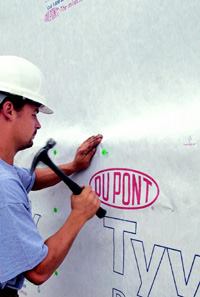
Courtesy DuPont DuPont Tyvek DrainWrap is engineered with vertical grooves on the material’s non-woven surface, providing bulk water drainage by channeling it to the outside. The housewrap resists air infiltration and water intrusion and allows moisture vapor to diffuse through the sheet. DrainWrap is recommended for use behind fiber cement and primed wood siding, and can also be used in conjunction with foam-board and other flat substrates. 800.448.9835. www.tyvek.com
Courtesy Valeron Strength Films Valeron Strength Films Engineered to facilitate moisture drainage in wall cavities, Valeron Vortec housewrap is a thin, flexible micro-perforated plastic film with a raised pattern of dimples and bumps. The housewrap’s textured surface channels water away from the building’s exterior wall surface, helping to reduce the chances for mold and mildew growth, according to the manufacturer. 800.825.3766. www.valeronvortec.com
Courtesy Benjamin Obdyke/BBA Fiberweb Benjamin Obdyke/BBA Fiberweb The Home Slicker Plus Typar rainscreen and weather-resistive barrier bonds together Typar housewrap and the Home Slicker rainscreen, protecting the wall cavity against moisture intrusion. Water is trapped in the Home Slicker’s three-dimensional matrix and drains from the wall assembly. Typar housewrap adds air and water intrusion prevention as well as breathability to the wall cavity. 800.523.5261. www.benjaminobdyke.com
Courtesy Pactiv Pactiv GreenGuard RainDrop is a woven material that incorporates vertical cords every few centimeters to create drainage channels that allow water to move to the bottom of the wall. The manufacturer says that the drainage channels cannot be crushed, even when hard-backed siding is installed over it. The breathable housewrap is colored green to reduce glare and comes in 9-foot-by-100-foot and 9-foot-by-150-foot rolls. 800.241.4402. www.green-guard.com