If you’ve been in the industry for more than 15 years, you might remember a type of cooking technology called “induction” that a few appliance manufacturers brought to the American market nearly two decades ago. A number of issues—ranging from low power and reliability to installation limitations and service availability—spelled failure for induction, and consequently it flopped. But it just might be ready for a comeback.
In the past few years, six appliance manufacturers have worked to revive interest in induction cooking, and with the current focus on energy efficiency the category may stand a fighting chance, especially since induction technology has matured and product offerings have improved. Today’s induction cooktops offer several benefits, including energy efficiency, safety, power, versatility, and a cooler kitchen, according to manufacturers.
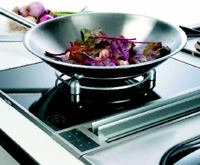
On the surface, an induction cooktop looks like a radiant electric cook-top. The elements under the ceramic-glass surface use electricity to produce a magnetic field that reacts with the ferric content in stainless steel, cast iron, and enameled steel cookware, exciting the molecules and producing heat. In induction cooking, the cookware becomes the heat source.
Induction is about 90 percent energy efficient while gas hovers at about 50 percent and electric radiant is about 60 percent efficient, according to Sue Bailey, lead product manager/major appliances for Viking. Unlike gas and electric radiant ranges, induction cooktops do not radiate heat from their surfaces, so less heat is wasted and the surrounding air temperature remains more comfortable.
Because the cookware is the heat source, food heats much faster, which cuts cooking time and saves energy. “Time to boil water on an induction top is 13 percent faster than on gas and 20 percent faster than on radiant electric,” says Lori Wood, buyer for cooking appliances for Sears, Roebuck.
Induction also offers flexible cooking capabilities, going from extremely low to extremely high settings and back again nearly instantly. “A lot of chefs in Europe use induction because it’s so precise. You can keep your food at a constant temperature … and it’s fast,” says Gudrun Berger, product manager for Gaggenau.
Safety is also a feature of induction cooking. Cookware must be present for the heat-producing reaction to occur, even if the cooktop is turned on. The cooktop’s surface remains relatively cool to the touch, although it does absorb some heat from the cookware, which dissipates in seconds once a pot is removed.
Most manufacturers are using more powerful induction coils than were used 20 years ago to deliver better performance. Those used previously were small and lower powered. Induction power is measured in watts, and most built-in induction cooktops offer between 2,800 and 3,600 total watts of cooking power, comparable to roughly 20,000 to 30,000 BTUs of gas power.
Slimmer burner boxes that take up less under-counter space than required by the original induction cooktops have also been developed. “Twenty years ago, in the mid-80s to ’90s, coil size was proportional to the amount of power you could put through it,” says Amir Girgis, managing director for Diva De Provence. The technology has evolved to the point where any amount of power can be run through any size coil, allowing manufacturers to not only reduce the size of the burner boxes, but also add more coils for more cooking elements.
The size of a burner box still can limit installation, though. Many induction cooktops cannot be installed over wall ovens because burner boxes require enough ventilation clearance to allow coils to stay cool.
Currently only three appliance manufacturers make 30- and 36-inch four- or five-element induction cooktops while another three offer single- or double-element modules. Future developments are likely to include induction cooktops integrated into slide-in and drop-in range/oven configurations, expanding installation possibilities.
The two-zone, 15-inch-wide Wolf induction module delivers a total of 3,600 watts of power. The rear element’s Hi-Power mode increases power output to 2,200 watts. Each element offers 10 power levels. If a pan is removed for longer than 30 seconds, the unit automatically shuts down. 800.332.9513. www.wolfappliance.com
Available in all-induction or induction/electric configurations, Professional series induction cooktops come in 30-and 36-inch widths. All-induction models feature four or six cooking zones, while the combination models come with either two electric radiant elements and two induction elements or four electric radiant and two induction elements. 888.845.4641. www.vikingrange.com
Three Diva Induction cooktop models each feature 12 power settings and three pre-set temperatures. The 36-inch, five-zone DDP-5 cook-top’s central burner utilizes a coil that automatically adapts itself to accommodate pans ranging in size from 4 to 14 inches. 888.852.8604. www.divainduction.com
Offering 15 temperature settings, the Kenmore Elite 30-inch induction cooktop features four cooking zones that automatically sense the presence or absence of cookware. A warm-and-serve feature allows each pan to hold a precise low temperature after food is cooked, and a power-boost mode takes the cooking zone up to 125 percent power for as long as 10 minutes. 800.349.4358. www.sears.com