A year ago, landscape architect Gregory Lombardi was called in to fix a botched attempt at screening a suburban property in Wellesley, Mass. The previous owners had remodeled the Colonial house and installed a 6-foot white fence around the entire backyard. The effect, he says, was like being in a cattle pen. It’s a classic example of the quick fix gone wrong—creating privacy while leaving the occupants feeling claustrophobic.
As lawn sizes shrink to accommodate larger houses and clients find themselves face to face with the neighbors, the need for attractive screening—whether for visual or acoustical privacy—has never been greater. The key, though, is to think of a screen as part of a controlled design plan. “It needs to be a compositional piece,” says Lombardi of Lombardi Design in Cambridge, Mass. At the Wellesley garden, he convinced the owners to give up 10 feet of lawn at strategic spots to plant mixed evergreens, deciduous trees, and shrubs alongside the fence. The lawn sloped toward the house, and by building retaining walls to create a level play lawn and a patio, he also added visual interest inside the space.
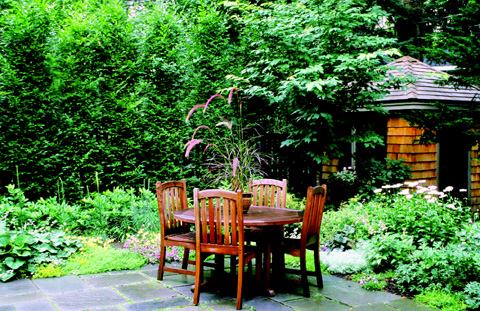
“You don’t want a uniform condition the whole way around the property,” Lombardi says. One way to mix it up is to create a focal point in the foreground. He recently added eye appeal to a compact Cambridge garden by installing an intricately paved terrace, a fountain, and a brightly colored oversize urn. Another solution is to frame a “borrowed view” outside the property; instead of being trapped, let the eye wander off somewhere. And to vary the barrier itself, he suggests using both plants and built elements. One edge can be green and orderly—a hedge, for example. Another piece can be looser—a scrim of deciduous trees. And a third element might be a jewel-like garden pavilion or a pergola with a solid back wall.
Visual and Acoustical Calm. When it comes to editing views, large properties have the luxury of square footage. Thick evergreen borders won’t encroach on precious yard space. But although the options may narrow for small spaces, the possibilities become more interesting. For an elegant look in an urban garden, Lila Fendrick of Lila Fendrick Landscape Architecture and Garden Design in Chevy Chase, Md., likes to create an aerial hedge with American or European hornbeams, beeches, and Nellie Stevens or Foster hollies. Planted in groups, these trees have dense foliage that can be limbed up to 5 feet and clipped to form a continuous eye-level barrier, and then under-planted with small shrubs. “You can use your land more effectively if screening is done at eye level and above,” she says.
On the West Coast, clumping bamboo (Bambusa) is a favorite choice of Los Angeles landscape architect Michael Schneider of Orange Street Studio. Not to be confused with the invasive running bamboo (Phyllostachys), clumping bamboo forms a soft, willowy curtain. He’s used it to edge properties or augment a screen, and its linear canes reinforce his gardens’ modernist flavor.
In many cases, though, a fence or wall is simply the most efficient solution, creating instant privacy while remaining politely in line. Like plants, this screening should go with the mood of the garden. “The screen could be cloaked in a vine, but a nice screen wall is an architectural detail that can be beautiful in and of itself,” Schneider says. “A wood- or metal-framed screen could utilize sandblasted glass or translucent resin materials.”
Such pieces are best suited to small gardens. Larger properties usually dictate a fence that recedes visually. Lombardi rarely uses white for a privacy fence; not only does it show dirt and mildew, but everything becomes silhouetted against it. He recommends neutral colors like black, dark green, or dark gray, and avoiding architectural details that attract the eye. To allow air to circulate through tall fences, thus preventing diseased plants and mossy paving, it’s a good idea to play with density. Use a slatted fence, one with offset boards, or a 4-foot solid fence with a foot or two of lattice on top.
Neutralizing background noise—from street traffic, pesky neighbors, or pool equipment—can be as essential as providing visual privacy. Common solutions are to “white out” the racket with a constantly running fountain, to install outdoor speakers, or to erect a double-sided fence with an acoustical barrier that deadens sound. “My theory is that if you can’t see it, that masks a lot of the noise psychologically,” says Schneider. “Using the earth is probably the best way to mask noise, in combination with trees and shrubs or a wall.” Fendrick agrees, adding the caveat that earth berms take up a lot of room. A 2:1 slope is too steep for planting trees. “You’re better off with a 3:1 or a 4:1 slope,” she says, “gentle enough to mow or to plant fairly good-sized root balls.”
Clients usually don’t need to be convinced of the need for screening. The hard part, Lombardi says, is convincing them to plant strategically and then let time do its job. “Most people don’t want to wait for plants to grow into each other naturally,” he says. “The secret is informing the client that creating privacy may involve more serious planning than they thought.” —Cheryl Weber is a freelance writer in Lancaster, Pa.
Landscape contractor: Bill Knight Inc., Hopkinton, Mass.; Designer: Gregory Lombardi Design, Cambridge, Mass.
Landscape contractor: Nature Care, Sherman Oaks., Calif.; Designer: Orange Street Studio, Los Angeles.