If any of your recent clients were dog owners, chances are that at least one part of the house was designed with the canine in mind. Maybe it was a concrete floor that takes scratches in stride, a low mudroom sink with a pull-out spray nozzle, or a good-looking doggie door. Pets are an integral part of household life, and these days, custom design is following the dogs-in-residence outdoors.
People love their furry, rough-and-tumble friends, but outside, that exuberance usually translates to shredded turf, broken shrubbery, and yellow spots in the lawn. Is it possible to have a luxuriant landscape and happy dog, too? Yes, says Fran Kiesling, owner of Dirty Dog Landscaping in Minnetonka, Minn. Most of her clients are pet owners who want to create a rich, playful environment that appeals to both dogs and the people of the house, not to mention the neighbors. Kiesling begins by asking clients to fill out a questionnaire that tells her how they’ve trained the dog, how much it is supervised outdoors, and what the space means to the dog. Because canines are creatures of habit, she observes them on the property, with the goal of strengthening their existing pathways and providing adventures along the way—an earth berm where they can play king-of-the-hill, perhaps, and tough, pliable ornamental grasses to romp through. Or, if space permits, a screened meadow for rousing games of Frisbee. “Maybe the meadow is 40 percent weeds that you keep mowed, but it holds the soil together and prevents dirt from being tracked into the house,” Kiesling says. “It’s not turf that the neighbors see.”
Creating a Framework. Strategic planning is the key to sharing the garden with a dog. Landscape designer and Washington Post columnist Joel Lerner, owner of Environmental Design in Chevy Chase, Md., suggests two different approaches. One is to give Rover the run of the garden, but direct his movement by creating a 2-foot mulched path around the edges that is hidden by a shrub and perennial border. Planting densely will create a sturdier barrier and minimize damage to individual plants. Although most dogs feel it is their job to patrol the perimeter, “hopefully the path is not just a square against the fence, but ties in with the design,” Lerner says. “If you have a 6- to 10-foot-deep bed, you can get a nice sweeping line.” The other solution is to subdivide the garden, which is also a classic way of making it seem larger. Install an attractive fence with a gate that allows the dog supervised visits to the larger garden.
A little ingenuity—and training—can mitigate unsightly doggie activity. For canines who love to dig, dog writer Cheryl S. Smith of Port Angeles, Wash., suggests creating a digging pit in a cool, out-of-the-way place (maybe under a big tree where nothing grows) out of loose dirt mixed with sand, and teaching them to use it by burying treats and toys there. Likewise, nature’s call should be answered in a designated spot. Smith, the author of Dog-Friendly Gardens (Dogwise Publishing), created a latrine for her border collie that is edged with shrubs and laid with cedar chips. Male dogs will appreciate a vertical surface to mark. However, she adds, enforcing this routine requires intermittent retraining with the dog on a leash, as unsupervised dogs will drift over time.
Keeping pets safe outside is top priority. Just as puppies are trained not to chew on the couch, dogs can learn not to eat the landscaping, Kiesling says. However, the safest bet is to avoid using harsh garden chemicals and toxic plants such as foxglove, yew, and rhododendron, particularly if the dog spends time alone outdoors. (Visit www.aspca.org/toxicplants for a list of common poisonous plants.)
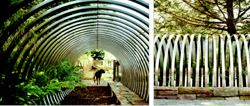
A well-made security fence is essential, too. When San Francisco landscape architect Randy Thueme designed an oceanside property for clients with an English setter, they walked the fence line with the dog to check for gaps he could slip through, adding extensions where necessary. Against the road, Thueme designed a sculptural gate and fence made of Corten steel that complements the gravel courtyard. Around back, nearly transparent, 3-foot stainless steel netting cordons off the ravine. “The dog is let out into the front courtyard, and he has a dog door in the back,” Thueme explains. “We added gates to limit the area he could run around in back there.”
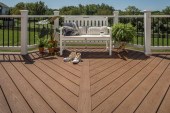
Doggie Delights. Once the essentials are in place, everything else is icing on the cake. And there’s plenty of room for creativity. Smith’s dog runs in circles, so she designed a garden in the middle of the lawn with a path cutting through. A bed of lavender planted in his path makes him smell good. Kiesling likes to include a variety of surface materials where dogs can rest, such as brick paving, 3/8-inch smooth river rock, shredded mulch, or wood decking, that give them a choice of hard and soft, warm and cool. And Sally Benson, editor of Chicago-based American Nurseryman, gave her Siberian husky a den in a corner of the property, away from sun and noise, where he could feel secure while keeping watch over his domain. “The den could be a whimsical doghouse that echoes the house or garden architecture,” she says. “It finishes the garden and ties it all together.”
“People think it’s a good idea to leave dogs out alone, but I think you should always keep an eye on them,” Smith says. “I had one dog—a springer mix—that ate my plum trees, twice, right down to the ground.” Just like a house, a canine-hardy garden considers the personalities of its occupants, idiosyncrasies and all.—Cheryl Weber is a writer in Lancaster, Pa.
Landscape architect: Randy Thueme Design, San Francisco; Landscape contractor: Craven Landscaping, Carmel, Calif.
Landscape architect: Randy Thueme Design; Landscape contractor: Craven Landscaping.