According to architect Jeffrey Berkus, designing a spa and its environs is “all about diffusing the tension of everyday life.” For some homeowners that means a secluded spot intended for two while others prefer a family-oriented location that offers easy access to public spaces. In either case, achieving the ideal balance between privacy and creating sightlines toward the best views poses an additional challenge. Berkus suggests creating a relaxing area immediately outside the spa with built-in seating and other amenities so those who aren’t soaking can interact comfortably with those who are.
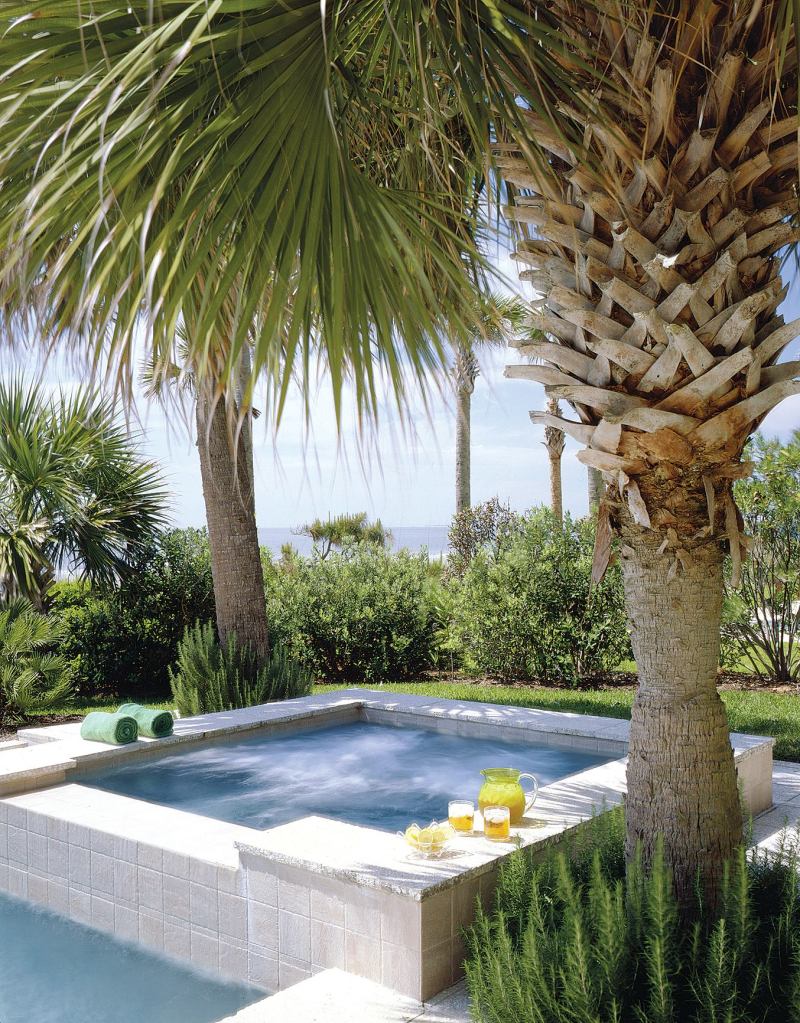
Southern Comfort “A spa can be an attractive feature even when not in use,” says architect Michael Ruegamer. “We often use them to break up the surface of a pool.” The water from this spa slides evenly over a flush edge creating a gentle waterfall. The pool and spa share a single filtration system, but the spa has a separate heating element. Coral stone edges extend to the terraced decking and up onto a 40-foot-long veranda. The porous stone is naturally slip resistant and evocative of the nearby beach.
In the temperate climate of Hilton Head, S.C., Ruegamer often encounters clients who want a spa as part of their pool experience. These homeowners wanted the spa to be accessible to everyone in the house, but also wanted to enjoy a touch of seclusion from the beach. Indigenous plantings provide seclusion but don’t block views to the ocean.
Builder: McKenna Construction, Hilton Head, S.C.; Architect: Group 3, Hilton Head; Pool contractor: Year Round Pools, Hilton Head; Photographer: Brian Vanden Brink
Water in the Round
The owners of a Martha’s Vineyard, Mass., waterfront home had specific ideas for their outdoor spaces. High on the list was an intimate, amenity-filled garden bordering their hexagonal master suite. Landscape architect Kris Horiuchi designed a paved alcove far enough from the house to benefit from full sun but close enough that the house acts as a sentinel for the spa and shower. Opposite the house, a grove of native evergreen red cedars shelters spa-goers from prevailing Southwest winds and nosy neighbors.“In order to minimize the height of the hot tub,” says Horiuchi, “we lowered it below grade into a concrete vault.” That allowed her to create a deep mahogany ledge for the custom surround only 20 inches off the ground, the “ideal height,” she says. The nearby outdoor shower is protected by a curved wall with a cut-out to keep lines of communication open between spa and shower. It also frames a glimpse of the water’s edge.
Builder: Martha’s Vineyard Construction, West Tisbury, Mass.; Architect: Mark Hutker & Associates Architects, Vineyard Haven, Mass.; Landscape architect: Horiuchi Solien Landscape Architects, Falmouth, Mass.; Photographer: Brian Vanden Brin.
Desert Passage
Hanging out in the spa takes on a new meaning in this Phoenix, Ariz., custom home. Architect Neal Jones designed the entire house in a semicircle with the radius point originating in the center of the 300-square-foot pool. In a dramatic move, the Shotcrete pool/spa combo is bisected by a matching retaining wall that allows the concrete spa to cantilever over the hillside lot.Raised above the vanishing-edge pool, the spa enjoys an unencumbered vista of downtown Phoenix and the surrounding 500-square-foot terrace that adjoins the house. A stainless steel edge plate with 250 drilled holes circumnavigates the pool so that the water overflow breaks up into hundreds of tiny rivulets that can be seen and heard by spa users. Tempered-glass panels provide the safety railing while perpetuating the illusion that the western-facing terrace simply fades into the sunset.
Jones concealed the mechanical equipment at the bottom of the hill, out of sight and sound lines.
Builder: The Construction Zone, Phoenix, Ariz.; Architect: Jones Studio, Phoenix; Structural engineer: JT Engineering, Phoenix; Photographer: Pere Planells
Modest Retreat
This spa easily holds six people, but its isolated courtyard locale exudes intimacy. The 9-by-16-foot fully enclosed courtyard is an extension of the master bath. Only a gate to the front porch hints that someone other than the homeowners might be welcome. Topped by terra-cotta latticework, pale stucco walls cradle the spa in privacy but stop just short of the mountainous horizon. “We wanted to incorporate this idea of Zen viewing where you can focus your energy to a distant natural element,” explains Jeffrey Berkus, AIA.Builder: Anderson Homes and Design, Superstition Mountain, Ariz.; Architect: BBG Architects, Santa Ana Heights, Calif.; Landscape architect: Greey/Pickett, Phoenix, Ariz.; Photographer: Visual Solutions