Halper Owens Architects
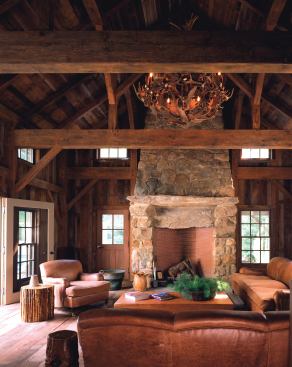
The outbuilding's rustic elements include a hand-distressed timb…
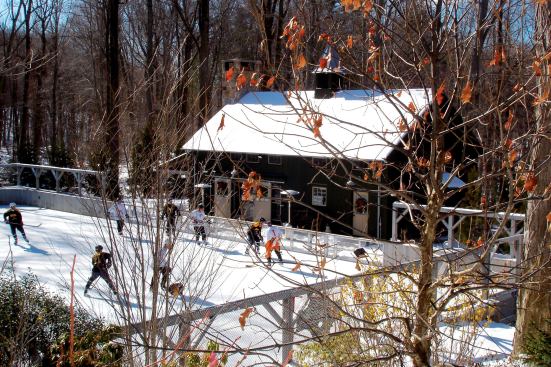
A certain degree of discomfort accompanies any outdoor sport. Two hours on the tennis court in August invite sunburn and sweat, and the same time spent ice skating in February brings on numb fingers and toes. This Connecticut playhouse, which borders a private tennis court and ice rink, provides a crowd-pleasing solution. During the summer, it offers respite from the sun after a game of tennis. Come winter, when cooling coils embedded in the court turn it into a skating surface, the playhouse transforms into a warming hut. And a sleeping loft makes it the perfect place for the owners’ children to hold slumber parties all year round.
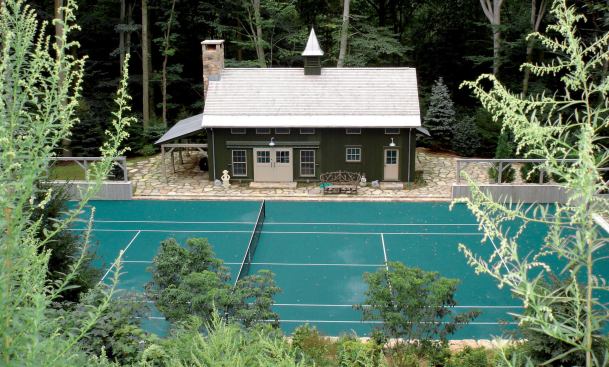
Architect Jon Halper wanted the building to appear consistent with the Shingle-style main house, which he’d designed three years earlier. So he gave it a traditional gable-roofed form and a similar palette of wood and stone. But he only pushed the resemblance so far. “With an outbuilding you have a little bit more freedom sometimes to be more playful,” he says. “You don’t want to be moving around your property and seeing the same spaces, the same décor, the same feeling.” He took the color scheme from the main house—light siding with dark green shutters and accents—and reversed it, painting the playhouse’s exterior walls dark green and saving lighter shades for its window frames and doors.
Halper, contractor Tim Ryan and his subs, and interior designer Caroline Wharton worked hard to make the project’s detailing strike just the right rural note. The stonemason handpicked each rock for the enormous fireplace surround and chimney. Sliding barn doors form the main entry, with a pair of French doors just behind them to create an airtight layer. And a strip of standing-seam metal across the eave recalls a traditional vernacular detail. “You see that a lot in New England, on anything from houses to farm buildings,” says Halper.
The main house looks down onto the playhouse, so the way it appears from above is particularly important. A metal-capped cupola adds to the visual interest from that angle, and it amplifies the project’s unaffected charm. “We thought it would be fun to make it look like a cabin in the woods that you just stumbled upon,” says Halper.
Project Credits
Builder: Mayfair Construction, Greenwich, Conn.
Architect: Halper Owens Architects, Greenwich
Landscape architect: Wesley Stout Associates, New Canaan, Conn.
Interior designer: Deborah Berke & Partners Architects, New York City
Ice rink provider: Custom Ice, Burlington, Ontario, Canada
Timber framer: Vermont Timber Frames, Cambridge, N.Y.
Living space: 1,200 square feet
Site: 10 acres
Construction cost: Withheld
Photographer: Halper Owens Architects (except where noted)
Resources: Entry door: Quantum; Hardware: Sun Valley Bronze; Plumbing fittings/fixtures: Chicago Faucets and Kohler; Refrigerator drawers: Sub Zero; Windows: Kolbe & Kolbe.